
Report received from Comrade Krishna Bhoyar, Deputy General Secretary,
All India Federation of Electricity Employees (AIFEE)
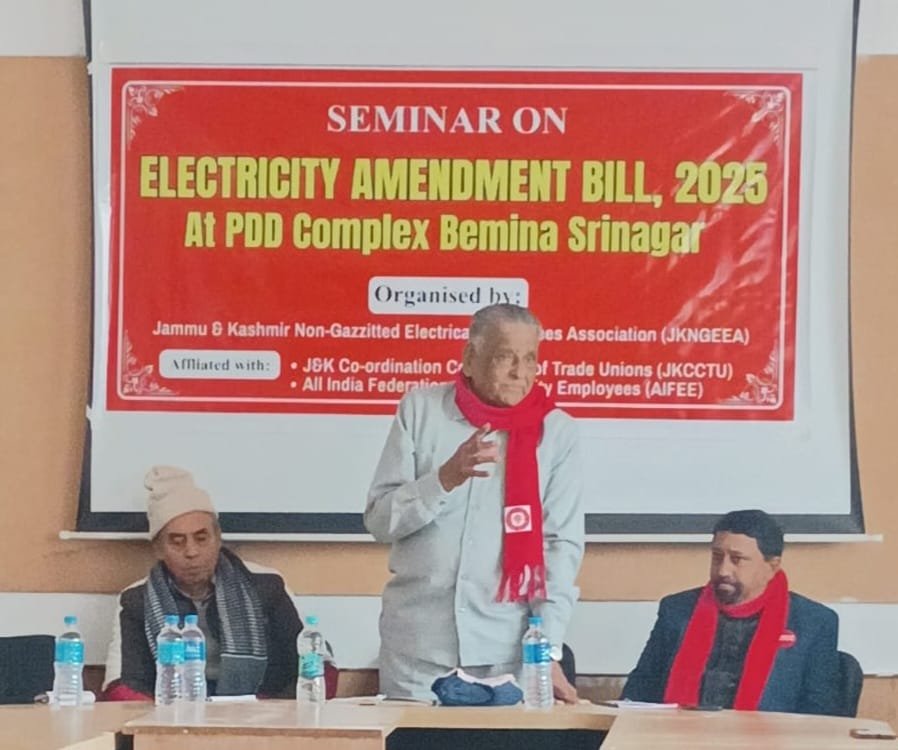
We will not allow the Central Government to pass the anti-farmer and anti-electricity consumer amended Electricity Act-2025: Comrade Mohan Sharma (General Secretary) All India Federation of Electricity Employees
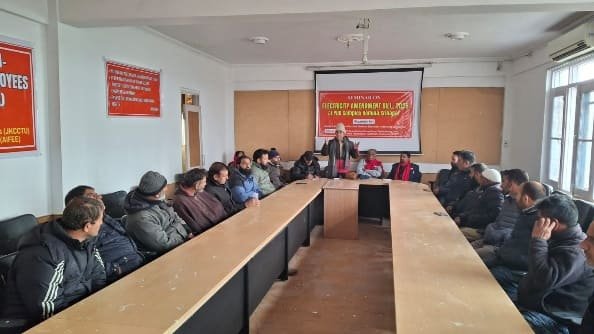
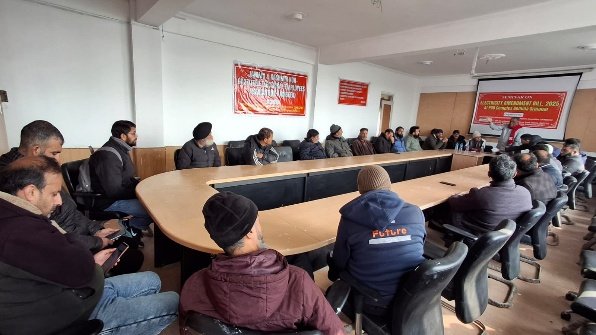
A state level conference on the proposed Electricity Act 2025 by the Central Government was jointly organized by the Jammu and Kashmir Non-Gazetted Electrical Employees Association (JKNGEEA), affiliated to the All India Federation of Electricity Employees (AIFEE) and the Jammu and Kashmir Trade Union Coordination Committee (JKCCTU), under the chairmanship of Comrade Mohammad Maqbool Gana (Convenor) Jammu and Kashmir Trade Union Joint Action Committee and President Jammu and Kashmir Non-Gazetted Electrical Employees Association President, Power Development Department, Complex Bemina, Srinagar.
The conference was inaugurated by Comrade Mohan Sharma, National General Secretary, AIFEE and National Secretary All India Trade Union Congress (AITUC). The chief guests of the conference were Comrade Krishna Bhoyar, General Secretary, Maharashtra State Electricity Workers Federation (MSEWF) and Deputy General Secretary, AIFEE and Mrs. Bharti Bhoyar, President, Mahila Aghadi, MSEWF. The conference was attended by office bearers of Diploma Engineers Union, Clerical Association, Jammu and Kashmir Non-Graduated Electrical Employees Union, JKCCTU, JKNGEEA, Teachers Forum.
Comrade Mohammad Maqbool Gana while introducing the conference said that the Jammu and Kashmir Electricity Board has been bifurcated. At present, there is Jammu and Kashmir Power Development Department (JKPDD), which is working for generation, transmission and distribution of electricity in this region. JKPDD is working in distribution through two companies Jammu Power Distribution Corporation Limited (JPDCL) and Kashmir Power Distribution Corporation Limited (KPDCL). There are currently five companies operating in the state of Jammu and Kashmir. Considering the significant potential of the state in this sector, JKPDD is responsible for the development and maintenance of power generation, especially hydropower. Jammu and Kashmir State Power Development Corporation (JKSPDC) is the parent company for power generation activities. The power generation company is working by paying 12% royalty. The company is generating 12000 MW of electricity. The maximum demand of all types of electricity consumers in the state of Jammu and Kashmir is 3000 MW.
The permanent workers in all four power companies used to be 21,600, which has now come down to 12,000. The number of contractual workers is 6,000. Considering the increased area and number of customers of power generation, transmission and distribution companies, the requirement was 35,000 employees and engineers. One employee is looking after the work of 3 to 4 substations and the lines connected to them and the villages. In the year 2021, a massive strike took place in Kashmir against the privatization of power companies in Jammu and Kashmir. In the backdrop of the strike, more than 100 workers were terminated. Currently, GSI substations are being set up using new technology. Due to this, there has been a large-scale reduction in workers.
Comrade Mohammad Maqbool Gana further addressed the gathering and said that since our organization is affiliated to the AIFEE, thousands of workers from Jammu and Kashmir will participate in the struggle against the Electricity Act 2025 proposed by the Central Government as per the directives of the National Coordination Committee of Electricity Employees and Engineers (NCCOEEE).
Comrade Mohan Sharma, while addressing the gathering, said that the AIFEE was established in 1960 in Bangalore. This is the first national level trade union in the electricity industry in the country. Trade unions of major, large and majority workers in electricity companies in 28 states are affiliated to this organization. This organization was led by Comrade A.B. Bardhan, Comrade S.C. Krishnan and Comrade Harish Tiwari, who led the working class of the country. On the initiative of Comrade A.B. Bardhan, the NCCOEEE was established by uniting all the workers and engineers’ organizations in the electricity industry in the country. Under the leadership of this organization, when the central government tried to privatize the electricity industry, there was a struggle. After the central government proposed the new Electricity Bill 2014, a big struggle was waged against it by the NCCOEEE, and the central government could not pass that Bill. After that, the central government tried to pass the Electricity Bill many times. But until 2025, the new central government could not pass the Electricity Bill. This great victory was achieved due to a joint struggle. Today, there is a need to fight like that.
The amended Electricity Bill proposed by the central government is being made only to benefit private capitalists and to give the profit sector of electricity distribution to private capitalists. If this law is passed, all types of subsidies to farmers will be stopped, similarly, the control of the state government on electricity prices will end and the power to determine electricity prices will go to the Central Electricity Regulatory Commission. Private capitalists have sought licenses for parallel electricity distribution in Maharashtra and other states in the profitable parts of 44 distribution companies in the country.
After this Bill, those companies will get the free right to issue licenses without setting up their own networks. This is a warning signal for the public electricity distribution sector. Therefore, the NCCOEEE has decided to protest against this. They asked all organizations in Jammu and Kashmir to participate in this protest. In those states where attempts were made to privatize electricity companies, the employees fought back. Privatization of electricity distribution could not be done there. The latest example of this is Uttar Pradesh. Let us salute the workers’ unions in Uttar Pradesh who have been fighting against the government’s policies for the past year.
Comrade Krishna Bhoyar, while addressing the gathering, said that the people of Jammu and Kashmir are fighting. After the abrogation of Article 370, the situation here is not conducive for agitation. The government is prohibiting agitation, a right given by the Constitution. It is a very good thing that we are holding a meeting here in such a difficult situation. The central government has sold many public sector enterprises in the country to private capitalists. The process of selling some more is underway. The public sector, which belongs to the people of the country, is being sold to private capitalists at a cheap price.
In Maharashtra too, the state government tried to privatize by issuing license of parallel electricity distribution and through other means, but due to opposition from all the organizations, the state government had to hold a joint press conference and announce that it will not privatize any power company.
More than 100 labour laws created by the struggle of workers have been repealed and 4 labour codes have been created that are anti-labour. Ten trade unions in the country are struggling against this. He called on all the organizations in Jammu and Kashmir state to participate in the movement.
Pension is being denied to employees in all industries. The old pension scheme has been closed in many states. EPF pension is not being given, unemployment is increasing on a large scale. Contract workers are being recruited on a large scale by reducing permanent posts. Even after the Supreme Court’s decision of equal work equal pay, exploitation of contract workers is happening on a large scale. If we want to stop privatization not only in the power industry but also in public industries in the country, everyone should fight against the government’s policy together. That struggle is needed today. I hope all the organizations in Jammu and Kashmir will participate in this struggle.
Mrs. Bharti Bhoyar, President Mahila Aghadi, while addressing the gathering, said that the people of Jammu and Kashmir are currently living under terror. We are aware of this. In this difficult situation, you are working for the country. There is a large amount of unemployment in Jammu and Kashmir. We are aware of this. A large number of women workers have been recruited in all the industries of the country. Women should also be given leadership in the labour movement. It is needed today. I hope that you will create opportunities for women to work in your organizations.
The office bearers of the organizations present from all sectors of Jammu and Kashmir gave detailed information about the privatization that is happening in their sectors. The conference was attended by Jammu and Kashmir Non-Gazetted Electricity Employees Union President M. Maqbool Ghani, M Iqbal Darsaroo (General Secretary), Akhtar Hussain (Treasurer), Hassan Orga Nizar, Mushtaq Ahmed Gatu, Ali Mohammad, Hilal Ahmed Pare, Mushtaq Ahmed Bhat, Kanas Raj, Fayaz Ahmed Vaid, Javid Ahmed, Ishtiaq Ahmed Baba, Manzoor Ahmed Bhat, Shaukat Ahmed Muchi, Raees Ahmed, Ramiz Ahmed, Mohammad Khan, Mohammad Shafi, Riaz Ahmed Bolsu, Bita Pampori, Manzoor Ahmed Wani, Riaz Ahmed Reshi, Ali Mohammad, Tahseen Ahmed, Suhail Ahmed Bhat, Diploma Engineers Union, Iqbal Ahmed Wadu, (GN Secretary), Clerks Union Mohammad Shafi (Secretary), Tehseen Ahmed Bhat, JKCCTU (Jammu and Kashmir Coordination Committee of Trade Union), Mohammad Munir Khan, Nazir Ahmed Wani, Sharif Uddin Waghe, Abdul Hamid Wani, Habib Ullah, Teachers Joint Action Committee, Nazir Ahmed Sheikh, Javid Hamid Mir were present. After thanking all the attendees, the meeting was concluded.