
Appeal of All India Kisan Mazdoor Sabha (AIKMS)
The All India Kisan Mazdoor Sabha (AIKMS), in its appeal dated 8 December 2025, has given a call to all the working people and farmers of the country to burn the copies of draft Electricity Amendment Bill 2025 (EAB 2025) and the draft New Seeds Bill (NSB) in every village.
The appeal explains how EAB 2025 will push ordinary people into darkness. Once the bill becomes an act, it will facilitate handing over of electricity distribution to private companies, leading to steep increase in electricity tariffs for working people and farmers.
The appeal also explains how NSB will hand over the entire seed supply to large private companies. Once NSB becomes an act, only large companies will get the license to sell seeds from the Central and State Governments, thereby capturing the entire seed market. This will make farmers dependent on the wishes of corporate-controlled crop production and marketing, as planned through the Contract Farming Act.
The appeal points out that on the one hand, farmers are agitating for profitable MSP for all crops and workers all over the country are agitating for guaranteed living wages and job security, but on the other hand, the government is in fact taking steps which will further jeopardize the livelihood of farmers and all the working people of our country.
We reproduce the appeal of AIKMS here below.
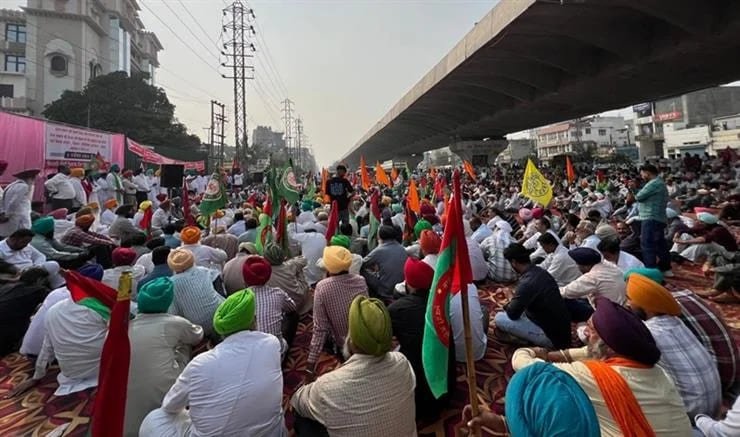
Appeal of All India Kisan Mazdoor Sabha (AIKMS) on SKM call
Burn the copies of Electricity Bill 2025 and the New Seed Bill in every village.
The Electricity Bill will push ordinary people into darkness.
The Seed Bill will hand over the entire seed supply to companies.
The Central Government has introduced the Electricity Bill 2025, which proposes to eliminate government control over electricity generation, transmission, and distribution, handing it over to private companies. The Bill states that electricity supply will now be done on the principle of guaranteeing profits for the supply companies. Through the Electricity Bill, the Central Government is clearing the way for blind plunder by corporates by handing over the entire power sector to private companies. The government that is not fixing minimum profitable crop prices for farmers, and not guaranteeing a living minimum wage for workers, is bringing a law to increase corporate profits by forcibly collecting expensive electricity charges from the poor working masses.
When the electricity department was created, consumers were divided into two types: first, ordinary consumers who used electricity for domestic purposes like fans, bulbs, refrigerators, irons, etc. Second, those who used electricity for profit-making, such as industrialists, factory owners, and other business people. To provide cheap electricity to ordinary consumers, the government offered some money as subsidy, and those who used electricity for profit were charged a higher rate, which was called cross-subsidy. But now, under the Electricity Bill, both the ordinary consumer and the large, profit-making factory owner will have to pay the same rates.
This will make electricity consumption extremely expensive for farmers, labourers, traders, domestic consumers, the middle class, and small producers. Electricity bills will be forcibly recovered from people, and by implementing Smart Meters, a system will be established where power is cut off automatically once the prepaid amount is exhausted. The Smart Meter system also includes a provision for charging rates higher than normal during Peak Hours—the period of high consumption like 5 to 8 PM and 7 to 9 AM—which is reportedly being discussed at around ₹24 per unit. This is like a prepaid mobile recharge phone, where earlier one could talk for the whole month for ₹10, but now one has to pay ₹300.
This doesn’t mean the rate is based on the cost of generating one unit of electricity, but rather on all the expenses incurred to bring the electricity to your home. Suppose the electricity supply is disrupted due to a storm, cyclone, or any other reason—poles, wires, or transformers are burned, broken, or damaged. Earlier, when the distribution sector was government-owned, the responsibility for all repairs lay with the government. Now, private companies will recover this entire cost from the common people. Power supply will be restored only if the common people pay, otherwise, the electricity will remain cut off. The greater the damage, the heavier the burden, potentially running into lakhs of rupees, will be placed on the people, forcing a large part of society to sit in darkness. Just as private schools, private colleges, private hospitals, or other private institutions give no concession—if you have money, you get the service, otherwise you don’t—similarly, electricity will only be available if you have money. Otherwise, you will remain in the dark. The Electricity Bill 2025 will also lead to widespread retrenchment of regular workers in the power department.
In 2014, the Modi government launched the Deen Dayal Upadhyaya Gram Jyoti Yojana to provide electricity to every household, giving connections, many of which existed only on paper. Despite these paper connections and the growing distress of the poor, thousands of rupees in outstanding bills are now being vigorously recovered from them.
The demands should include withdrawing Bill 2025, stopping the installation of Smart Meters, providing free electricity for agricultural tubewells, and offering 300 units of free electricity to all domestic consumers. In modern life, electricity is an essential life-giver for daily functioning and livelihood. We condemn the government’s move and call for opposition to the attempt to turn this essential resource into a tool for corporate profit.
Seed Bill
The government’s second major attack is the Seed Bill 2025. According to this, no small or medium trader or shopkeeper will be able to sell seeds without registration. Only large companies will get the license to sell seeds from the Central and State Governments, thereby capturing the entire seed market. Control over seeds means control over all crop production. Six major global companies now control over 75% of the world’s seeds, agricultural research, and pesticides. Large companies create seeds that require maximum fertiliser and maximum spray, allowing them to exploit farmers on a massive scale. In case farmers suffer losses due to these corporate seeds, the Bill makes no mention of compensation or accountability.
Naturally, the free import of seeds means the government is backing away from its responsibility to provide good quality seeds on time, which is essential for timely sowing of food crops and ensuring the nation’s food security. This will make farmers dependent on the wishes of corporate-controlled crop production and marketing, as planned through the Contract Farming Act. This will completely change the character of Indian agriculture, moving away from self-reliant and livelihood-based farming to a model that supplies commercial crops for corporations.
This Bill allows the free import of seeds and planting material, even without registration, and makes no mention of ensuring the timely availability of quality, affordable seeds in accordance with the country’s food security needs, the economic viability of sustainable farming, and the financial stability of farmers. The only provisions are for the registration of suppliers and dealers, facilities for testing and certification of seeds and plants, and provisions for prosecution for serious offences.
The Seed Bill states that foreign companies can openly import seeds without registration, and the guarantee of environmental protection and seed productivity testing will be done through self-certification. The Bill mandates the registration of all sellers and the system of a ‘Seed Inspector’, who will clearly work to control small sellers in the interest of the companies.
We must oppose this and demand its withdrawal, along with calling for fixing the accountability of the government. Multinational companies were allowed to import and sell seeds earlier as well, during the Green Revolution and later through BT seeds. India requires the development of seeds that are appropriate for Indian agro-climatic conditions and the needs of the Indian people. This Bill completely undermines that.
CEC All India Kisan Mazdoor Sabha (AIKMS)