
Speech of Com. Santosh Kumar of Mazdoor Ekta Committee at the AIFAP meeting on 7 December 2025 to demand repeal of the four labour codes
I am very grateful to the All India Forum Against Privatization (AIFAP) for giving the Mazdoor Ekta Committee the opportunity to speak.
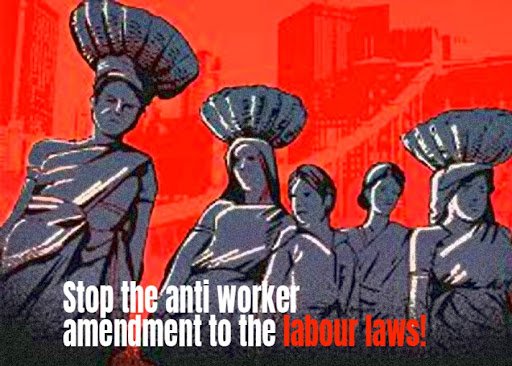
The previous speakers have explained the four Labour Codes very well. These four Labour Codes have been passed by the central government despite strong opposition from the workers and labourers. These four Labour Codes are anti-worker, anti-farmer, anti-working people, and anti-national. These Codes have been brought in to enslave 50 crore workers.
The central government has ordered the implementation of four Labour Codes from November 21, 2025. – These are:
- The Code on Wages, 2019,
- The Industrial Relations Code, 2020,
- The Code on Social Security, 2020,
- The Occupational Safety, Health and Working Conditions Code, 2020. – These codes have come into effect from November 21, 2025.
Government spokespersons and pro-capitalist intellectuals are claiming that these labour codes will promote the welfare and safety of working people. They are pretending that all workers, without exception, will receive written employment contracts and will be entitled to minimum wages, social security, annual health check-ups, and other benefits. – This is an outright lie. The truth is that currently, millions of workers are being deprived of all these rights, and after the implementation of the Labour Codes, even more workers will be deprived of their rights. The new laws further expand the scope of using contract workers. Labour contractors who employ fewer than 50 workers are exempt from many of the provisions of these Labour Codes. This limit, which was previously 20, has now been increased to 50. Now, capitalists can hire multiple contractors, each employing 50 or fewer workers, and thus violate all the rights of the workers.
The new laws further expand the scope for the use of contract workers. Labour contractors who employ fewer than 50 workers are exempt from many of the provisions of these Labour Codes. This limit, which was previously 20, has now been increased to 50. Now, capitalists can employ multiple contractors, each employing 50 or fewer workers, thereby circumventing all labour rights. Previously, there was a provision for providing ESI, PF, and gratuity to contract workers, but now the contractor is not required to provide any of these. Even for year-round work, workers can be employed in batches of 50, circumventing labour laws.
These codes promote the use of fixed-term employment. While the law claims that these workers will receive all the benefits of regular employees, it hides the harsh reality that there is no job security for these workers.
Under the Standing Orders Act of 1946, rules were made mandatory for any company employing more than 100 workers – such as informing all workers about working hours, holidays, payday, wage rates, dismissal procedures, and grievance redressal mechanisms. Now, the new Industrial Relations Code has increased this limit from 100 to 300, as a result of which a large number of workers have been excluded from the purview of these (Standing Orders) laws.
Millions of workers are deprived of the right to minimum wage because they are not considered workers, and their remuneration is not considered wages. For example, Anganwadi and ASHA workers are called volunteers and are given an honorarium instead of a salary.
Gig workers are called business partners and receive very low and uncertain wages instead of a salary. Domestic workers and many others do not have a written employment contract and therefore cannot legally claim the right to a minimum wage. The new Code on Wages does not address these loopholes that deprive workers of their rights.
The Industrial Relations Code increases the minimum threshold for the number of workers from 100 to 300, so that companies do not need government permission to close down or lay off workers. It also allows the central and state governments to further increase this minimum threshold at any time through a notification.
Both the Industrial Relations Code and the Occupational Safety Code allow the government to exempt any new company from complying with these regulations in the name of “public interest” and “employment creation.”
The Industrial Safety and Health Code (Occupational Safety and Health Code) does not include agricultural workers, workers in small construction projects, home-based workers, fishermen, and domestic workers, who together constitute a very large segment of the country’s workforce.
These Labour Codes once again demonstrate that the capitalist class does not want to grant workers’ rights as universal and inalienable rights. They consider them privileges that can be granted to some and not to others, and which they can give and take away whenever they please.
These Labour Codes increase the working day from 8 hours to 12 hours. The monopolistic capitalists of our country have been demanding changes to labour laws for years. We saw Narayana Murthy saying that Indian workers should work 70 to 72 hours a week, from 9 am to 9 pm, six days a week.
These Labour Codes are designed to replace several existing laws with new ones, including existing laws related to construction workers, beedi workers, and salt workers. The rights that these workers had won through their militant struggles are now being taken away in the name of simplification and reducing the number of labour laws.
These Labour Codes also attack the rights of states to enact their own labour laws. In recent years, workers in several states have waged militant struggles to get some of their rights recognized. Now, these rights will be replaced by the Labour Codes enacted by the central government, which are entirely in favour of the capitalists. The aim of the four Labour Codes is not only to deprive workers of their rights but also to make it extremely difficult for them to strike, thus denying them the means to fight for their rights.
According to the Industrial Relations Code, workers have to give 14 days’ notice before going on strike. As soon as the strike notice is given, conciliation proceedings begin immediately, and no strike can be held during this notice period. If the conciliation proceedings fail and the management files an application with the tribunal, the strike is further delayed. The first strike notice becomes invalid after 60 days, and workers have to give notice again to go on strike. These rules were previously applicable only to “essential services.” Now they will apply to all industries and services.
Workers have no grievance redressal mechanism if their rights are violated.
The capitalist media claims that these Labour Codes supposedly empower women because women will now be allowed to work night shifts if they wish. The reality is that the lack of safety in the workplace and public spaces makes working night shifts a punishment for women, not a sign of their empowerment.
The system that previously ensured continuous monitoring of compliance with labour laws is being significantly weakened.
The Occupational Safety, Health and Working Conditions Code has introduced a system where, instead of responding to workers’ complaints, a computer program will now determine which factory or company should be inspected. Capitalists who violate labour laws will not be arrested, but merely fined.
Many representatives of the capitalists are propagating the idea that workers should abandon the notion that their interests are opposed to those of the capitalists. They claim that these new labour codes will benefit both capitalists and workers. However, life experience clearly shows that the interests of capitalists and workers can never be aligned.
Communist parties and working-class unions have been consistently opposing these labour codes since their inception. The government has implemented the labour codes in various states, including those ruled by the Congress and BJP.
The fact remains that despite this continuous opposition, the Labour Codes have been notified for implementation. This demonstrates that the central government is committed solely to serving the capitalist class. In the current system, every government claims to be elected by the people and committed to serving them. However, life experience shows that the government’s job is to manage all affairs in a way that serves the interests of the capitalists.
These Labour Codes are part of a plan devised by the capitalists to remove all obstacles in their attempt to become a major world power by exploiting the working people.
The only way forward for the working class is to further strengthen its unity in the struggle against the capitalist class. We must fight to ensure decent working conditions for all workers without exception.
We must fight with the political objective of transforming the entire political system and establishing the rule of workers and peasants in place of the rule of the capitalist class. By seizing political power, we must take the principal means of production out of the hands of the capitalist class and bring them under social control. We must wage struggle with the aim of creating a new state of workers and peasants, which will guarantee all the rights of the working people and ensure the transition from this capitalist system to socialism.