
By Ms. Aprajita, Purogami Mahila Sangathan
If such a large majority of the population is out protesting on the streets against labour codes, why is there no mechanism that mandates the government to listen? When candidates are elected, they follow the orders of their party high command. Why is there no mechanism to force “representatives” to actually represent the voice of people? What kind of democracy is this where people have no say in deciding policies?
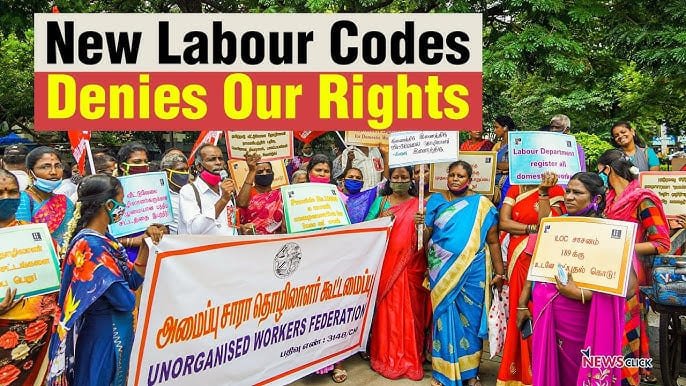
The All India Forum Against Privatisation (AIFAP) has been carrying several reports on how the four labour codes, which came into effect on 21 November 2025, are an attack on the livelihoods and hard-earned rights of workers. These codes allow employers to violate workers’ right to security of employment, safety at workplace, social security, as well as the right to form unions and strike. The codes allow capitalists to exploit workers even more to multiply their profits.
While workers across the country are strongly opposing the labour codes, we must also understand the manner in which the codes were implemented. Were the codes implemented democratically, taking workers’ views into account? If not, why not?
The first of the four codes, the Labour Code of Wages, was enacted in 2019. The remaining three codes (Industrial Disputes, Occupational Safety, and Social Security) were passed by the Lok Sabha on 22 September 2020 and by the Rajya Sabha on 23 September 2020—with hardly any debate in both houses. In the Lok Sabha, as opposition parties staged a walkout, the codes were passed with barely any opposition.
Importantly, these codes were passed at a time when the entire country was under lockdown and workers could not gather on the streets in large numbers.
Although the lockdown was a major obstacle to mobilization, more than 25 crore workers participated in the historic all-India general strike on 26 November 2020. The strike demanded complete withdrawal of the labour codes and farm bills and putting an end to privatisation measures. The united opposition of workers, farmers, and people at large could temporarily halt the enforcement of the labour codes.
However, the government continued attempts to implement the codes. In response, workers protested time and again, a few instances of which are listed below:
|
9 August 2021 |
Thousands of workers participated in protests against labour codes, farm bills, and privatisation policy |
|
27 September 2021 |
Workers and farmers observed Bharat Bandh to oppose farm laws, labour codes, and the Electricity Amendment Bill 2021 |
|
28-29 March 2022 |
The Joint Front of Central Trade Unions and Independent Federations declared a two-day strike against labour codes, privatisation, and monetisation |
|
1 May 2023 |
May Day rallies across the country opposed the anti-worker labour codes, privatisation, outsourcing, inflation, and unemployment |
|
9 August 2023 |
Tens of thousands of industrial workers, farmers, agricultural workers came out on the streets demanding scrapping of labour codes |
|
23 September 2024 |
Central trade unions observed Black Day against labour codes |
|
9 July 2025 |
Workers from steel, oil, petroleum, telecom, coal, and many other sectors participated in the all-India general strike, demanding scrapping of labour codes and Electricity Amendment Bill |
|
26 November 2025 |
Workers in sectors such as defence establishments and banks wore black badges to oppose the labour codes |
And protests and demonstrations continue today.
If such a large majority of the population is out protesting on the streets, why is there no mechanism that mandates the government to listen? When candidates are elected, they follow the orders of their party high command. Why is there no mechanism to force “representatives” to actually represent the people?
Even before 2020, workers in India have organized multiple general strikes for demands such as job security and social security for all and wages consistent with rising prices.
Not only has the state not satisfied the demands of workers, but with the implementation of the labour codes, the state has essentially enforced the opposite of what workers want.
For example, workers have been demanding a minimum wage of Rs. 26,000 for a decent life. However, the Code on Wages outlines a floor wage that risks being minimal and that can be frozen for 5 years.
Further, workers have been demanding regularization of contract workers, but provisions in the labour codes instead promote fixed-term employment. Moreover, the codes allow for increased working hours, which will in turn increase unemployment.
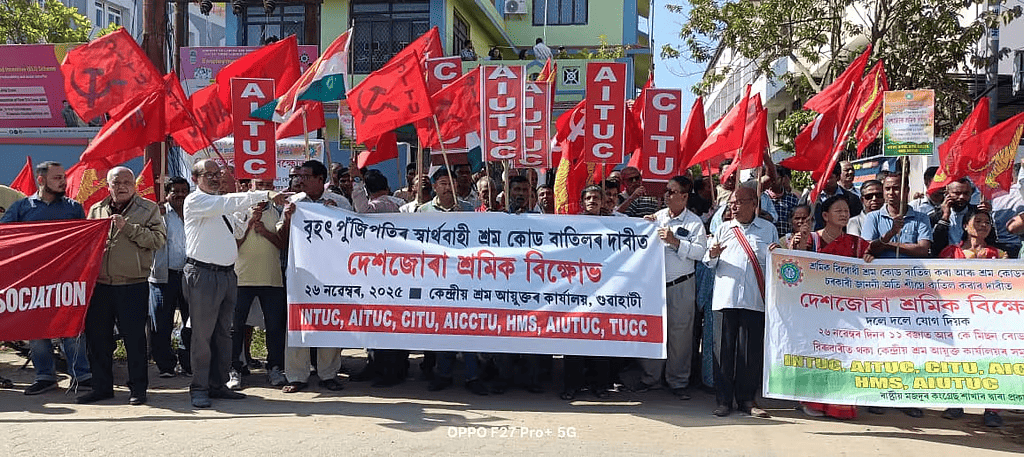
Time and again, we see that the working class has no say in the system. Workers and toilers are not consulted in the formulation of laws and policies. If a law or policy harms the interests of workers, there is no avenue where they can express their opinions, and they are ultimately forced to strike. But the labour codes dilute even the right to unionise and strike, dealing a major blow to workers’ rights.
Nevertheless, we must remember that workers in India and across the world have shown that through our unity, we can resist such attacks.
In Uttar Pradesh, electricity workers have kept their agitation going for more than a year even though the state has imposed the draconian Essential Services Maintenance Act (ESMA). They have resolved to continue agitating until the proposed privatisation of two state discoms is withdrawn. Similarly, electricity workers in Maharashtra and other states have gone on strike even when ESMA has been applied, simply because there is no other avenue for workers to put forth their demands and fight for their rights. In October 2025, thousands of workers in Greece organized demonstrations to oppose changes in their labour laws that increased working hours to 13 hours a day. Workers from both public and private sectors went on strike. In the last few years, Europe has seen massive demonstrations for increased wages consistent with inflation and against amendments to social security laws, including pension benefits.
In a capitalist system, laws and policies will always be oriented towards increasing the profits of big corporates. Profit can be increased only by intensifying the exploitation of workers. At the same time, without workers’ and peasants’ labour, what would big companies produce or sell? We must recognize the power of the working class and its unity.
Workers, farmers, and the toiling majority of our country should unitedly oppose attacks such as the labour codes. We should recognize that it is important not only to protect our rights but also to establish a system in which workers and farmers make the decisions.