
Letter by National Coordination Committee of Electricity Employees and Engineers (NCCOEEE) to the Minister of Power of Government of India
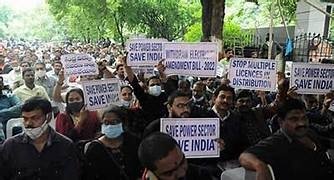
The governments at the Centre and in different States, irrespective of which political party is in-charge, are aggressively pursuing privatisation of power sector by promotion of PPP models, multi-licensing in distribution, forced smart metering and various other means. The governments are implementing the agenda of big capitalists who want to make super-profits without investing their capital through electricity distribution. Government’s policies are prioritising capitalist profits over people’ interest and welfare. The opposition of power sector workers to these anti-people and anti-social policies deserves support of the entire working class and peasants.
To
The Hon’ble Minister for Power
Government of India
Shram Shakti Bhawan, Rafi Marg
New Delhi – 110001
Dear Sir,
We, the National Coordination Committee of Electricity Employees and Engineers (NCCOEEE), representing employees’ and engineers’ federations across the electricity sector in India, hereby serve formal notice of our intent to proceed with a nationwide strike on February 12, 2026.
This decision reflects the deep concerns and grievances of lakhs of electricity employees and engineers, who are committed to protecting the public power sector as well as the interests of consumers and the industry as a whole. The electricity sector is the most crucial pillar of national infrastructure, essential for reliable and affordable energy supply that supports industrial growth, agricultural productivity, rural livelihoods, and overall socio-economic progress.
However, the Union Government’s policies, particularly the proposed draft Electricity Amendment Bill, 2025 and the National Electricity Policy, 2026, are gravely undermining this foundation. Additionally, the Governments at the Centre and in different States are pursuing strong anti–public sector policies through aggressive privatisation (Chandigarh, Uttar Pradesh being prominent examples), promotion of PPP models in the power sector, multi-licensing in distribution, forced smart metering, introduction of the TBCB model, and various other forms of neo-liberal reforms.
These measures prioritise corporate profits over public welfare, threaten to dismantle public control over a strategic sector vital to national security and self-reliance, expose the country to price volatility and unreliable supply, erode cross-subsidies, burden common consumers and farmers with unaffordable tariffs, and jeopardise long-term energy security.
In this perspective, NCCOEEE demands:
1. Immediate withdrawal of the draft Electricity Amendment Bill, 2025: The Bill seeks to introduce privatisation and multi-licensing in distribution, along with neo-liberal policies that will fragment the sector, allow private entities to cherry-pick profitable consumers while burdening public utilities with losses, raise tariffs by withdrawing cross-subsidies, weaken energy security, hamper balanced national development, and transfer public assets and essential services to private monopolies – directly endangering the people’s right to affordable electricity and the nation’s strategic interests.
2. Withdrawal of the SHANTI Act: The Sustainable Harnessing and Advancement of Nuclear Energy for Transforming India (SHANTI) Act, 2025 was passed in the last Parliament session. The Act dismantles India’s carefully built nuclear safety and accountability framework and opens the most hazardous energy sector to large-scale private and foreign participation.
3. Withdrawal of the National Electricity Policy, 2026: The Policy aggressively promotes privatisation across generation, transmission, and distribution, disregarding the proven success of the public sector in ensuring subsidised supply to vulnerable sections and stable energy infrastructure for national progress. It threatens sharp tariff hikes, subsidy cuts for farmers and the poor, and erosion of public accountability in a sector critical to India’s development.
4. Halt all forms of privatisation in the power sector: The Government is aggressively initiating privatisation of the power sector through various means. The Chandigarh power utility has been privatised forcefully, defying all opposition from employees and consumers, and the failure of this experiment is already apparent in the degrading quality of supply. Similar privatisation attacks have been unleashed on Purvanchal Vidyut Vitaran Nigam Ltd. (PVVNL) and Dakshinanchal Vidyut Vitaran Nigam Ltd. (DVVNL) in Uttar Pradesh. Rajasthan, Maharashtra, Madhya Pradesh, and other States are also under severe attack.
Privatisation through PPP models in the power sector, multi-licensing in distribution, introduction of the TBCB model, outsourcing of operation and maintenance to private players, and various other forms of neo-liberal reforms are being pursued by the Government.
Privatisation and outsourcing have already led to job losses, service disruptions, higher costs, compromised energy security, and setbacks to inclusive growth. We demand an immediate and complete moratorium on all such initiatives to preserve the public character of the sector and protect long-term national interests.
5. Withdrawal of smart metering under TOTEX/DBFOO models: Smart metering under TOTEX and DBFOO models serves as a backdoor for multi-licensing and privatisation in distribution, enabling private players to cherry-pick consumers, impose coercive time-of-day tariffs, erode cross-subsidies for farmers and households, facilitate forced disconnections and prepaid systems, hand over consumer data to corporates, and dismantle public control under the pretext of technology. We demand the complete withdrawal of all such schemes to protect affordable electricity access and safeguard public interest.
6. End contractualisation of jobs and regularise contract employees: Rampant use of contract labour exploits workers and denies them fair wages, benefits, and job security. Lakhs of contractual employees are effectively running the sector, often sacrificing even their lives, without any proper social security or protection. We demand an end to this inhuman form of employment and immediate regularisation of all contract employees in the sector.
7. Urgent recruitment of new employees: Persistent non-filling of vacancies has reduced the workforce, overburdened staff, compromised safety standards, increased risks to workers and infrastructure, and threatened reliable power supply essential for national development. Immediate large-scale recruitment is required to restore operational efficiency, safety, and energy security.
8. Withdrawal of the New Pension Scheme (NPS) and reintroduction of statutory pension: The NPS has denied employees assured retirement benefits and created financial insecurity. We demand its complete scrapping and restoration of the old pension scheme to protect the post-retirement lives of the workers who sustain this vital sector.
We demand a complete reversal of privatisation and restoration of public control in the electricity sector.
Furthermore, we wish to register that if any attempt is made to present the Electricity (Amendment) Bill in Parliament in the Budget Session, the electricity employees and engineers of the country will be compelled to launch immediate lightning action, including cessation of work and mass street mobilisation, to protest this assault on public interest, people’s livelihoods, and the nation’s future.
We urge the Ministry to immediately initiate meaningful processes to address the grievous issues stated above. Failure to engage constructively or continued reluctance will leave us with no alternative but to proceed with the strike, with the Government bearing full responsibility for any resulting disruptions in power supply or related consequences.
We remain hopeful for a positive response and reaffirm our commitment to a strong, public-oriented power sector that serves the energy security and development aspirations of the nation.
Yours sincerely,
National Coordination Committee of Electricity Employees and Engineers (NCCOEEE)
CC:
* Hon’ble Prime Minister of India
* Hon’ble Minister of Labour and Employment
* Chief Labour Commissioner (Central)
* All State Chief Ministers