
Report by Kamgar Ekta Committee (KEC) correspondent
Privatisation is the agenda of big capitalists. Public sector enterprises are turned into loss-making to justify their privatisation. As in Peru, in India, too, we can see that consecutive political parties that have come to power have pushed the policies that orients the economy towards advancing the agenda of the capitalist class. Capitalist governments can only offer exploitation, suffering, and despair to workers. Only a state run by workers and peasants can prioritize the welfare and interests of the people.
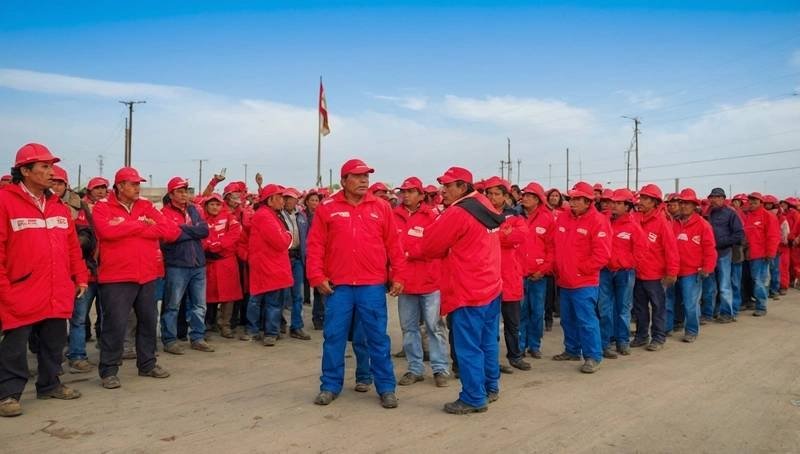
On Monday, 19th January 2026, oil refinery workers in Peru participated in a 3 day strike. The strike was organised to oppose plans for privatisation of the state-owned oil refinery in Peru, named Petroperu. The Peruvian government has approved a plan to “restructure the financially troubled company”. The plan opens doors for private investments in the most valuable assets of the state-owned company, like the Talara refinery.
A 72 hour strike call was given by workers’ unions to oppose the government’s plan of privatisation. About 2,200 workers joined the strike on Monday morning. Peru’s labour ministry has called the strike inadmissible and unlawful. However, the workers persisted and continued their strike against privatisation of the state-owned Petroperu.
Government claims that the mounting debt on the company is the reason behind this move. The Talara refinery is the country’s largest refining asset. The state-owned Petroperu dominates the domestic oil refining market, with the Talara refinery having the largest capacity to refine about 210,000 barrels per day. This accounts for a vast share of the nation’s oil refining capacity. The recent plan approved by the government in late December, seeks private investments in Petroperu. Workers’ unions informed that options to have an external private management for operating the Talara refinery are also being actively looked at.
Workers expressed that the rate at which the government is planning privatisation is shocking. Workers’ unions have strongly condemned this plan of privatisation by the government. They argue that privatisation inevitably leads to loss of jobs, threat to job security, and most importantly hands over control of the national energy infrastructure to private ownership. Energy sector is of strategic importance to the entire nation and handing it over to private investors would mean loot and plunder of it for private benefits.
Workers have announced the strike in an attempt to force the government to roll back its plan of privatisation. Workers are demanding the government to recommit to public funding of Petroperu and have announced that any move of privatisation will face strong opposition.
What do we learn from this?
We see similar reasons given by governments across the globe, including India, while justifying privatisation of any sector. We see that the most important and valuable assets, among all the assets, are the ones that are opened for privatisation, either for domestic or foreign private corporates. In this case, it was the Talara refinery – nation’s largest refinery and one of the most valuable assets. It is done in the name of shifting the burden of mounting debts onto the private investors. But in reality, the sectors that have the potential to make profits are the ones that are privatized.
Sectors of strategic national importance like energy have always been the top targets for privatisation. The capitalists are keen on gaining control over such sectors to strengthen their position among the national and international capitalists. On the contrary, the sectors that have limited or no scope of making profits continue to be owned and managed by the state.
It is important to remember that the infrastructure that is privatized is built with the sweat, blood and money of the people. Once the taxpayers’ money is invested and the infrastructure is ready to reap profits, doors are flung open for privatisation. This can be seen in almost every sector in our country like electricity, telecom, banking, railways, transport, defence, port and docks, industries like steel, aluminium and cement, and many more. Not only the developed infrastructure but also the valuable properties and assets under each of these sectors are sold to the capitalists at throw away prices.
Implementation of privatisation exposes the nature of the ruling parties that work to fulfil the interests of the capitalist class. In India we can see that consecutive parties that have come to power have pushed for policies that orients the economy towards advancing the agenda of the capitalist class.
The struggle of Peruvian workers against privatization of public property is entirely just. We must support their struggle and unitedly stand against any attempts of privatisation in our country as well as anywhere in the world. Capitalist governments can only offer exploitation, suffering, and despair to workers. Only a state run by workers and peasants can prioritize the welfare and interests of the people.
Long live the struggle of Peruvian refinery workers! Down with the idea of handing over public property to private hands!
An attack on one is an attack on all!