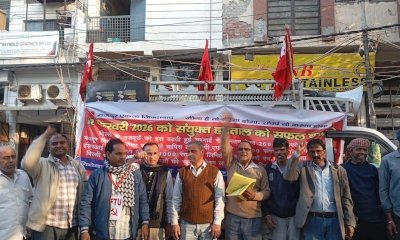
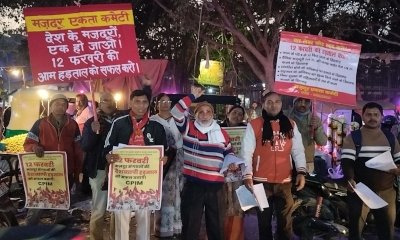
Report by a correspondent of Mazdoor Ekta Committee
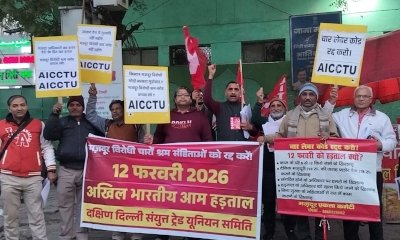
Workers’ organisations, including trade unions, called for an all-India general strike on February 12 against the four labour codes announced by the central government and against the increasing attacks by capitalists on the working class. To ensure the success of this strike, workers’ organisations including trade unions of Delhi jointly organised a continuous public campaign for the last one month. Different workers’ organizations in different areas of Delhi were tasked with uniting all workers’ organizations and conducting campaigns in their respective areas. Mazdoor Ekta Committee led the joint campaign in South Delhi.
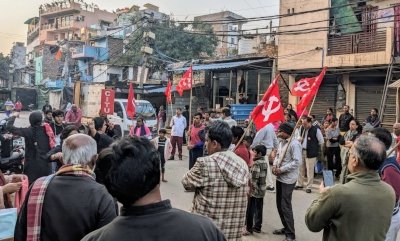
To ensure the success of the campaign, numerous meetings, processions and rallies were organized. A large banner titled “Why are we going on Strike?” was displayed, which read:
- Against increasing the working hours from 8 to 12!
- Against reducing the daily wage from ₹710 to ₹178!
- Against the attack on the right to organize!
- Against the denial of the right to strike!
- Against making women work night shifts without safety!
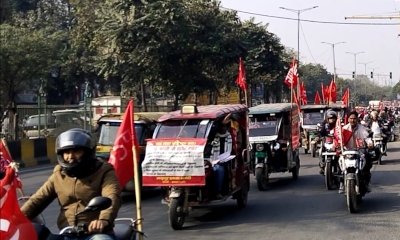
The activists involved in the campaign carried placards and banners that read – ‘Make the general strike of February 12 a success!’, ‘Withdraw the four anti-worker labour codes!’, ‘Intensify the struggle to protect our livelihood and rights!’, ‘Unite to achieve the goal of establishing the rule of workers and farmers!’, ‘Violation of workers’ rights is violation of the country’s interests!’, ‘Workers of the country, unite and make the strike of February 12 a success!’.
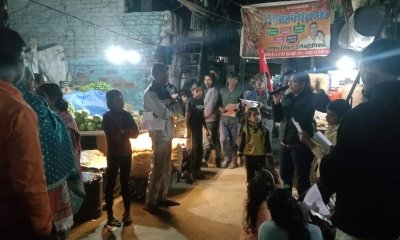
Mazdoor Ekta Committee, AITUC, CITU, AICCTU, Hind Mazdoor Sabha, TUCC, UTUC, AIUTUC, SEWA, IFTU, Inquilabi Mazdoor Kendra, IFTU Sarvahara and other workers’ organisations participated in the campaign.
Thousands of copies of the call issued by the Communist Ghadar Party of India calling for the success of the strike were distributed.
Six parties — Communist Ghadar Party of India, Communist Party of India, Communist Party of India (Marxist), Communist Party of India (Marxist-Leninist), Revolutionary Socialist Party, and All India Forward Bloc – had issued a joint leaflet calling for the success of the strike, which was also distributed during the campaign.
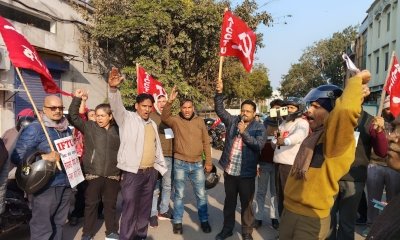
Street corner meetings and poster campaigns were conducted across industrial and residential areas and metro stations of Delhi. Lively and passionate discussions were held with workers everywhere in the city. The four labour codes were exposed, their anti-working class nature and their blatant attack on workers’ rights were explained.
During the street corner meetings and rallies, the workers enthusiastically welcomed the campaign participants, listened to them attentively, and shared their own experiences. They resolved to actively join in the preparations to make the strike on February 12 a success, and to give a strong and united response to the attacks on their rights.
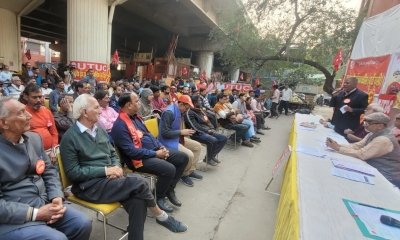
During the campaign, pamphlet distribution and street corner meetings were organised in various industrial areas of Delhi like Okhla Phase-1 and 2, Bawana, Mayapuri, Wazirpur, Patparganj, Lawrence Road, Naraina, Mongolpuri, Jhilmil, Shahdara, and many more. A massive bike rally and e-rickshaw rally were held in the Okhla Industrial Area. Vigorous campaigns were also held in various residential colonies across Delhi – Harkesh Nagar, Sanjay Colony, Bawana JJ Colony, Mithapur, Madanpur Khadar, Badarpur, Ambedkar Nagar, Sangam Vihar, Aligaon, Dakshinpuri etc.