
Call by Bhagat Singh Students & Youth Front (BSYF)
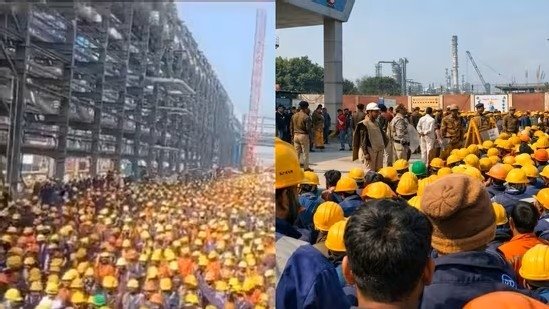
Like private companies, the public sector Panipat Refinery also employs a large number of contract laborers. These workers have launched a struggle to protest their exploitation and lack of basic amenities. It is important that this struggle not be limited to this. This struggle is against the capitalist class in power. The struggle must be taken forward with the perspective of bringing the working class to power. The call by Bhagat Singh Students & Youth Front (BSYF) reminds us that this struggle is against the capitalist system, where humans are seen only as a means to make profit.
(Translation of the Call in Hindi)
A Call for Solidarity in Support of the Just Demands of the Panipat Refinery Workers
Fellow Workers!
Thousands of workers employed at the Indian Oil Corporation Limited (IOCL) refinery in Panipat, Haryana, are on strike. On February 23rd, at 11 a.m., 30,000 to 40,000 workers began protesting at Refinery Gates 1 and 4 with some basic demands. A few hours later, the police resorted to lathi charge to forcibly end the protest, injuring some workers. There have been reports of CISF firing in the air to control the situation.
The CISF is responsible for creating a tense atmosphere by suppressing the peaceful and legitimate workers’ protests at the behest of management and contractors. What is happening at the Panipat refinery today reflects the truth reflected through the cracks in this very capitalist world. Delays in wages, arbitrary deductions, payment of eight hours for twelve hours of work, discrimination against contract labourers and the constant laxity in safety measures – these do not happen by chance. They are the result of a mindset that places “ease of doing business” above the dignity of the worker and profits above human beings.
The workers’ demands are simple and just — timely full wages, guaranteed PF and social security, permanent employment and protection from layoffs, safe workplaces, regular maintenance, adequate safety equipment, insurance and medical treatment in case of accidents, and basic amenities like food and water during work. These are not fringe benefits, but rather minimum labor conditions. But when the language of “cost cutting” and “productivity” is used, the first areas compromised are safety and well-being. Staffing is reduced, shifts are lengthened, maintenance is postponed, and training is reduced. Responsibility is blurred through contracting, leading to worker deaths, like the one at the Panipat refinery.
Prior to this, workers died in an industrial accident in Patratu, Jharkhand. Hundreds of deaths continue to occur. This isn’t mere negligence; it’s part of the profit structure. In this system, the worker is seen not as a living human being but as a “cost” or “input”.
When comrades in Panipat stopped work, the language of conversation suddenly changed. This reveals a fundamental truth: as long as production continues, our problems are sidelined; as soon as production stops, they become the central issue. The implication is clear: labor is not just a working force, but the decisive force of society. But here we must pause and understand something else. The government and the capitalist class do not permanently bow to economic demands alone. They can grant some concessions, ease tensions, and offer assurances. But if labor laws remain the same, if contract and temporary work are normalized under the guise of “flexibility,” if union power is limited, problems will return again and again.
The four labor codes enacted by the Modi government are not mere technical documents. They are part of a broader project to make labor more flexible and capital more secure. There’s talk of “equality” and “parity” on paper, but if contract workers are working in insecurity and fear on the ground, the law remains merely a formal framework. Therefore, it’s crucial to connect our economic demands with political questions. If PF protections are weak, it’s a question of policy. If safety standards aren’t enforced, it’s a question of administrative priorities. If labor laws give employers more power and workers less protection, it’s a question of the nature of power. Therefore, our fight isn’t just for wage increases; it’s about who the laws and policies favor. As long as the struggle remains confined to the factory gate, solutions will also be limited. Only when the struggle reaches the level of policy and law can the balance shift.
The rallying of forty thousand workers in Panipat is not just a demonstration; it is a testament to the fact that fear is always individual, but courage is collective, and when we stand together, fear truly vanishes.
Now is the time to shatter the illusion that the state is neutral, reforms are absolute, and that capitalists’ profits and workers’ interests are the same. History tells us that rights are never given as a gift. They are achieved through organized consciousness and collective effort. If workers recognize their power and rise above fragmentation to establish a common direction, even laws can change. If workers remain fragmented, laws will continue to be written against them. Therefore, worker unity is essential.
The wheel of history does not turn on its own. It is turned by those who produce and who are politically conscious of the interests of their class and society. Therefore, this is not just a time to react, but to set a direction. We are not just struggling for better working conditions, which the capitalist system, driven by its pursuit of profits, cannot provide. Therefore, we demand the socialization of all means of production, production not to maximize the profits of capital owners but to meet the needs of the people. We must intensify our struggle with this objective in mind.
We support the following demands of the struggling workers of Indian Oil Corporation Limited (IOCL), Panipat, and appeal to the common toilers to stand with them:
1. 8-hour duty should be strictly enforced!
2. Wages should be paid between the 1st and 7th of every month, and the full amount due should be paid upon completion of 240 days!
3. Wages should be paid according to the company’s board rate, and provident fund (PF) deposits should be made regularly and equitably!
4. In the event of any accident or mishap during work, the company should take full responsibility and provide appropriate compensation!
5. Workers taken from KKS should be immediately released!
6. Overtime (OT) should be paid at double the rate!
7. All national holidays should be extended to workers!
8. Monthly duty should be fixed at 26 working days!
9. Proper arrangements for toilets and clean drinking water should be made at the workplace!
10. The FIRs filed against the workers must be cancelled!
In revolutionary solidarity,
Bhagat Singh Students & Youth Front (BSYF)