
NCCOEEE DECLARATION
10th March 2026 Constitution Club of India, New Delhi
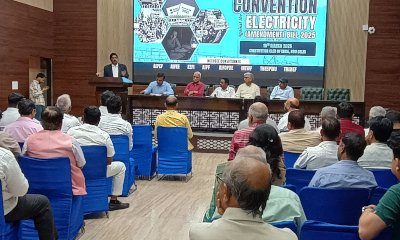
It is a great moment for the National Coordination Committee of Electricity Employees and Engineers (NCCOEEE), as today we are meeting at the Constitution Club of India with leaders and eminent personalities associated with India’s energy sector and its trade union movement. We welcome the Members of Parliament who have made time to join us at this Convention despite the busy schedule of the ongoing Parliamentary session.
Though the immediate context of this meeting is the desperation of the Government to pass the Draft Electricity (Amendment) Bill, 2025, it is necessary to place before you the multidirectional attack of privatisation on the power sector. The path of so-called reforms has already proved disastrous for our national economy and for the energy sovereignty and security of our country. Therefore, we must discuss and decide on a long-term course of united action to save the right to electricity of our people and protect India’s energy security.
After Independence, the Electricity (Supply) Act, 1948 was enacted to develop electricity as an essential service for socio-economic development. State Electricity Boards were created as integrated utilities responsible for generation, transmission, and distribution. Institutions like the Central Electricity Authority, Rural Electrification Corporation, and Power Finance Corporation were established to expand electrification across cities, towns, and villages. During this period, electricity was treated as a public service, not a profit-making commodity.
The shift began gradually. In the 1980s, SEBs were pushed to earn financial surpluses through accounting reforms. In 1991, electricity generation was opened to private participation, and by the mid-1990s states began inviting private players into distribution. Odisha, Haryana, and Andhra Pradesh enacted reform laws to facilitate this process.
The first NDA Government attempted to introduce the Electricity Bill in 2000. In response, electricity employees and engineers formed the National Coordination Committee of Electricity Employees and Engineers (NCCOEEE). Their struggle forced the Bill to be referred to a Parliamentary Standing Committee, resulting in several amendments. Nevertheless, the Electricity Act, 2003 was passed in a controversial manner late at night with very few MPs present.
During the UPA-1 government, supported by the Left parties, sustained struggles led to the Electricity (Amendment) Act, 2007, which reinstated the obligation of rural electrification on the Central Government and introduced some protective provisions.
However, the situation has drastically worsened since 2014. The present government has aggressively pursued privatisation of public power utilities. Already, more than 50% of India’s installed power generation capacity is in the hands of private players, and almost 50% of the equity of Central Public Sector Power Utilities operating in the generation and transmission sectors has been opened to the market. The Government is desperately attempting to hand over operating utilities through the National Monetisation Pipeline. It has even opened the nuclear power sector to private corporations by introducing the SHANTI Act. However, distribution is still mostly in public hands except in a few cases. Now, the Central Government is aggressively attacking the public distribution sector, as it is the last point of revenue collection in the entire power industry.
A glaring example is the forced privatisation of the profitable Chandigarh Power Utility, which earned around 250 crore annually but was put up for bidding at a base price of only 174.63 crore. Workers and citizens of Chandigarh-along with village and urban committees, women’s organisations, and farmer groups-launched a powerful resistance. Instead of addressing their concerns, the administration imposed ESMA and filed FIRs against union leaders.
Similar attempts are underway in Uttar Pradesh, where the government is trying to privatise PVVNL and DVVNL. These DISCOMs have received large investments under the Revamped Distribution Sector Scheme (RDSS) to reduce losses. They still have around ₹66,000 crore of pending recoverable bills. Yet the proposed reserve bid price is reportedly only around 6,500 crore, though their estimated value exceeds 1 lakh crore. This threatens the livelihood of 27,000 employees and engineers and about 50,000 contract workers. Due to sustained resistance by electricity workers, the state government has not yet been able to issue the tender.
Privatisation pressures are also emerging in other states. The Rajasthan government has begun bidding for generation and battery storage projects, while transmission privatisation is being pushed in states like Uttar Pradesh and Madhya Pradesh. In Maharashtra, private players such as Torrent Power. Adani Electricity, and Tata Power are aggressively seeking parallel distribution licences.
The Central Government is also pushing states towards privatisation through policy pressure. At a regional power sector meeting held in New Delhi on 20 February 2025, several states reportedly sought central support for privatisation and listing of utilities. A Group of Ministers headed by the Uttar Pradesh Energy Minister has been constituted to accelerate this agenda. Reports also indicate that a proposed ₹1 trillion bailout package for debt-ridden DISCOMs may be linked to privatisation or stock market listing.
At the same time, the government has introduced the Draft Electricity (Amendment) Bill, 2025. Ironically, the government itself admits in its explanatory note that despite two decades of reforms under the Electricity Act, 2003, the distribution sector remains financially distressed, with cumulative losses rising from about ₹26,000 crore to ₹6.9 lakh crore.
The Government is trying to place and pass Bill in Parliament despite strong objections from all employees’ organisations, repeatedly expressed through different communications, meetings, and finally in the stakeholders’ meeting called by your Ministry on 12th January 2026.
The Bill is being placed on the basis of the suggestions of the Working Group report, where one of the constituents is the All India DISCOMS Association (AIDA). AIDA has been advocating in favour of the Bill from the very beginning and thus should not be a member of any independent autonomous Working Group formed to decide on the agenda.
As per the newly proposed Draft Electricity (Amendment) Bill, 2025, private distributors will not have to make any investment in creating distribution infrastructure. State power utilities will be forced to offer their infrastructure to private competitors, while the responsibility for maintenance expenditure, losses, and network development will remain with state utilities. On the other hand, private distributors can demand compensation in case of breakdowns, and private generators will enjoy advantages along with private distributors. Private companies will target only profitable consumers such as big industries, malls, and IT parks, while public DISCOMs will be forced to serve rural and poor households with reduced revenue. This is not competition; it is a trap. The public utility pays for the grid, while the private player takes the profit.
This will cripple state power utilities, destroy the cross-subsidy system, raise tariffs for ordinary people, and push state DISCOMs towards shutdown and privatisation. As revenue to the public sector reduces, there will be no one to maintain the network, especially in areas inhabited by farmers and low-income groups.
Along with this, the Central Government is attempting to withdraw the cross-subsidy system that was established through long struggles in India. Heavy industries with large capital and high revenue-generation capacity have traditionally paid cross-subsidy to sustain agriculture, MSMEs, and low-capacity domestic consumers. This was pivotal in building India’s food sovereignty and the network of small and medium commodity production. Withdrawal of this support will lead to an abrupt increase in retail electricity prices, payment defaults, and eventual forceful disconnections and denial of electricity services.
The Bill seeks to eliminate cross-subsidy under Section 61(g). This would mean that the very rich and the very poor will pay the same tariff. Cross-subsidy is essential in a country like India, where nearly 70% of the population cannot afford electricity at market prices.
Without cross-subsidy, a farmer using a 7.5 HP pump set will have to pay more than Rs 10,000 as a monthly electricity bill. Irrigation costs will rise to unbearable levels. Farmers, already facing an acute agrarian crisis and escalating costs of cultivation, will be pushed towards complete dependence on unpredictable rainfall. A shift to Direct Benefit Transfer (DBT) for agriculture will deny support to real cultivators-landless labourers and tenant/sharecroppers-who actually pay for electricity. The deceptive nature of DBT is already evident from the experience of rising cooking gas prices, which have pushed people back towards traditional fuels.
The Bill heavily centralises powers with the Union Government. The Centre can remove members of State Electricity Regulatory Commissions on vague charges like “gross negligence.” A Central Electricity Council chaired by the Union Power Minister will control state power systems. The Centre gets unbounded rule-making powers, thus violating parliamentary accountability. This is not just an electricity bill; it is a constitutional attack on state powers.
The Bill removes the requirement of approval from the Central Government before granting licenses in military and sensitive zones. This opens the door for private control in defence areas, jeopardising national security.
This is only a small part of the dangerous privatisation agenda. The Ministry of Power has launched the disastrous private sector TOTEX model prepaid smart metering project. This scheme will segregate agricultural consumer lines from non-agricultural ones in order to antagonise one section against another and eliminate cross-subsidy. It will make every consumer dependent on market forces for electricity pricing and will permanently abolish a majority of electricity sector jobs.
Every individual consumer will have to pay Rs 8,000-12,000 per prepaid smart meter for installation, that too to private players. Its maximum lifetime is around 7-8 years. With around 26 crore consumers in India, this amounts to a direct extraction of about Rs 2,60,000 crore from the people’s pockets. The key players applying for the installation of these smart meters are Adani and Tata.
Consumers with lower approved contractual loads will face problems if their consumption suddenly exceeds the sanctioned limit. In case of any technical problem in the meter or instances of overbilling, consumers will have to lodge complaints with third-party smart metering agencies. If power supply is cut due to zero balance in prepaid smart meters-even because of technical faults of the metering agency-consumers will be forced to pay a fine, and reconnection may take hours. The smart metering process is a mandatory instrumentation for allowing parallel licensing in the public electricity network.
Meanwhile, the cost of power is on a trajectory of unbridled rise. Vide an order dated 16 February 2023, the Modi Government enhanced the ceiling price of one unit of power in the virtual market to Rs 50. This means consumers may be compelled to pay Rs 50 for a single unit of electricity. While the risks of linking the smart metering scheme with dynamic pricing were coming into public discussion, the Central Government delivered another swift and sudden blow by amending the Electricity (Rights of Consumers) Rules vide a notification dated 14 June 2023. As per this amendment, immediately after the installation of smart meters, all consumers will be brought under the Time-of-Day (ToD) tariff, under which the price of electricity will be higher during evening and night hours. It is obvious that household consumption is higher at night, and irrigation activities are also largely carried out after sunset. As electricity consumption will be higher during peak hours, consumers will be forced to pay increasingly higher dynamic tariffs for the same electricity usage.
Certainly, this constitutes the final stage of attack on India’s public electricity distribution sector. It will lead to massive de-electrification, and the food security of our country will be jeopardised. It is also a direct attack on the federal structure of India. This is the time to act-integrated and united.
What is required is to make the people aware of all these policy issues and the real face of the regime being operated by the corporate-driven government at the Centre. It is a stupendous task which will require each one of us to work tirelessly to turn our common experience into a message to the masses and to turn the tide against those in power who are pushing the nation and its people into unprecedented crises and destruction.
This National Convention of NCCOEEE calls upon electricity employees in particular and the people of our country in general to take united struggles to a higher level. We have to intensify our combat against the destructive policies of this government, both at the sectoral and national levels. We must resist the draconian Electricity (Amendment) Bill, 2025 both within and outside Parliament. Electricity is and must remain a Right of the People. Stop privatisation of the electricity sector and protect the energy security of our country.
We demand:
➤ Immediate withdrawal of the Draft Electricity (Amendment) Bill, 2025.
➤ Immediate withdrawal of the proposed amendments to the Atomic Energy Act and the Civil Liability of Nuclear Damage Act.
➤ Immediate stoppage of the installation of prepaid smart meters.
➤ Withdrawal of all existing privatisation or franchisee models in generation, transmission, and distribution, namely in Chandigarh, Delhi, and Odisha.
➤ Immediate cessation of privatisation attempts of PVVNL and DVVNL in Uttar Pradesh.
➤ Retention of cross-subsidy and universal service obligation; protection of the right to electricity for farmers and all other sections of consumers.
➤ Ensuring concrete steps to reduce electricity tariffs across the country.
NCCOEEE Constituents: AIPEF, AIFEE, EEFI, AIPF, AIFOPDE, INEWF, TNEBPWU, TNEBEF