
Report of meeting of Purogami Mahila Sangathan and Kamgar Ekta Committee
The continuing discrimination and oppression of women today lies in the nature of the state and the social system it maintains. The emancipation of women is impossible unless the capitalist system is replaced by the socialist system, and the emancipation of man is impossible without the liberation of women. The rulers try to split us on every ground like religious and political affiliations, region, nationality and even gender, but we should not fall for their plans. We should remember that we are workers and toilers who are exploited by the ruling class. We need to unite the working class, make it conscious of its strength and organise it to replace this rule by the rule of the working class and other toilers.
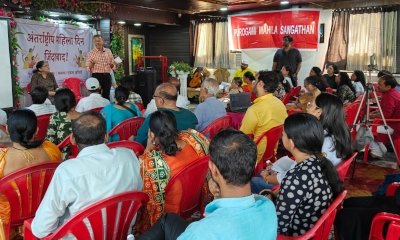
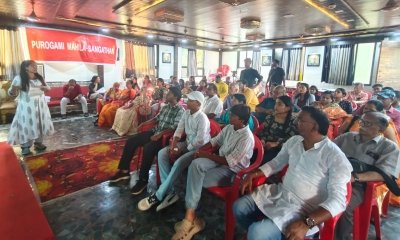
“Utha Shoor Narino” (Rise brave women) echoed through the entire room and hearts of the people participating in the International Women’s Day program organised jointly in Kalwa, Thane by Purogami Mahila Sangathan (PMS) and Kamgar Ekta Committee (KEC) on 8th March 2026. The song calls on women to emulate their brave sisters across the world today who are rising against unjust wars like the ones launched by US and Israel; it also celebrates the role of women in participating in just wars like revolutionary uprisings and freedom struggles. A wide spectrum of people including IT and health professionals, students, activists involved in various campaigns and local residents – women and men – participated enthusiastically.
Sanjeewani, one of the founding members of PMS sketched a brief history of their organisation that was established in 1980. She said that PMS had, right from the start, paid attention to understanding the source of women’s oppression and what keeps it alive to this date. She explained that the continuing discrimination and oppression of women today lies in the nature of the state and the social system it maintains, concluding that the emancipation of women is impossible unless the capitalist system is replaced by the socialist system, and the emancipation of man is impossible without the liberation of women. Girish, the Joint Secretary of KEC, explained that it is the capitalist class that is ruling our country. The rulers try to split us on every ground like religious and political affiliations, region, nationality and even gender, but we should not fall for their plans. The only identity that we should really focus on is that we are workers, and toilers who are exploited by the ruling class. We need to unite the working class, make it conscious of its strength and organise it to replace this rule by the rule of the working class and other toilers.
There followed a spirited cultural program by about 20 young women and men who are activists of the two organisations. This program embraced various forms – songs, skits, dance, rap song and a bharud (Marathi style of songs) as well as AV presentations. In a very simple and sharp way, the program brought to light these essential truths:
- Women are not the “weak” sex. They have a huge potential and strength. They have played a crucial role in every important, successful struggle and revolutionary change.
- The inferior status of women, economically and otherwise, adversely affects the entire working class and people at large.
The history of International Women’s Day was presented and a video on the same theme made by Vikalp Vani was screened. The message was loud and clear – International Women’s Day is not about gifting a woman a rose or chocolate or making them various commercial “offers”. It commemorates the glorious fight that women have been waging for more than a century – fights for the right to vote, struggles for better wages and shorter working days, safety and security at their workplaces and in society. Most importantly, it celebrates and inspires us to emulate our ancestors from across the world who fought to emancipate humanity by establishing socialism.
There was a presentation on the numerous struggles women are waging in India and all over the world against exploitation and oppression.
Various pointed questions like these were raised:
- Why do people have to fight for everything today?
- Why are people not consulted before making laws and why are laws against which crores protest not repealed?
- Why do people have no say in decision making and policies that affect them?
- Why are the guilty in cases of violence and abuse of women never punished?
- Why is there no mechanism through which people can hold the elected representatives accountable?
The presentations detailed how the capitalist class rules and how the various organs of the state, like the police, the judiciary, the bureaucracy and the entire political edifice serves it.
Is it possible to build a society where workers can rule? One presentation showed how concrete steps were taken by the socialist state to emancipate the women of the USSR – how a network of crèches, nurseries, child care centres, community kitchens, laundries, sanatoria etc. were established. How steps were taken to educate all irrespective of gender; how women were encouraged and enabled to take up highly skilled technical posts and hold important posts in the army and Air Force to defend their country against the Nazi invaders.
After this energizing presentation, a young comrade showed how people in our own country – in the kisan andolan, the warkari processions in Maharashtra, etc. have organised to ensure the safety and well-being of women.
The program was summed up well by several participants. An 85-year-old woman said, “I believe that for there to be a change, mind-sets have to change, and here in this hall today I saw that it is happening.” A young man pithily pointed out that the entire program showed very clearly how patriarchy and capitalism are linked, and how capitalism preserves patriarchy because it serves it.