
Report by a Correspondent of the Mazdoor Ekta Committee
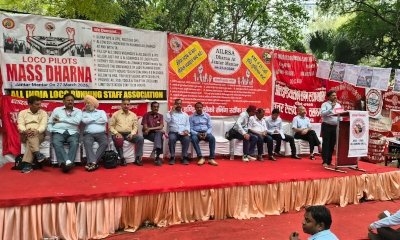
On 27 March 2026, the All India Loco Running Staff Association (AILRSA) organized a protest at Jantar Mantar in Delhi to press for their long-pending demands. The call for this protest was issued by the Central Executive Committee of the AILRSA.
More than 1,000 loco pilots and assistant loco pilots—both men and women—from 68 railway lobbies across the country participated in this protest. Leaders hailing from various regions addressed the gathering. During the demonstration, several progressive songs and poems were presented, highlighting the daily challenges faced by loco pilots in the course of their work.
Expressing their solidarity with the struggle of the loco pilots, representatives from the Mazdoor Ekta Committee, CITU, IFTU Sarvahara, and the Bigul Mazdoor Dasta also addressed the assembly.
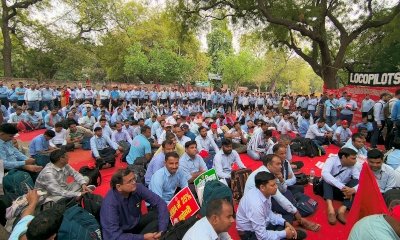
A main banner was displayed at the protest site, outlining their key demands:
- The NPS (New Pension Scheme) must be abolished, and the OPS (Old Pension Scheme) restored;
- The privatization of Indian Railways must cease;
- To ensure passenger safety, the practice of “single-man working” on EMU and DMU trains operating for more than four hours must be discontinued;
- Toolboxes must be installed in all locomotives;
- It must be ensured that the air-conditioning systems in all locomotives are fully functional;
- Risk allowance must be granted to Assistant loco pilots and loco pilots;
- In accordance with the directives of the High-Power Committee, the practice of assigning long duty hours to loco pilots must end, and a mandatory rest period of 40 hours must be implemented;
- Toilet facilities must be provided in all locomotives;
- Basic amenities and adequate rest room facilities should be provided for female loco pilots at the workplace;
- The unsafe operation of trains without guards must be discontinued; and so forth.
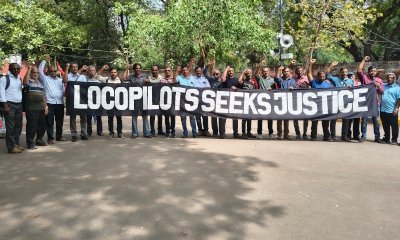
Speakers expressed concern over the fact that thousands of posts for train drivers remain vacant within Indian Railways. They raised the demand for immediate recruitment to fill these vacant positions. They raised their voices in protest against the ongoing staff reductions and spoke out against the privatization of the railways and the handing over of government institutions into private hands.
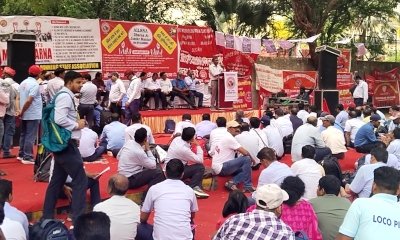
The speakers pointed out that, in accordance with the recommendations of the High-Power Committee, a loco pilot cannot be required to work for more than nine hours; however, under current circumstances, they are being made to work for twelve hours. They also highlighted that working for such extended periods leads to fatigue among train drivers, thereby posing a persistent threat to the safety of rail passengers. They emphasized that train drivers constitute the most effective safety mechanism for the railways. Even if other safety devices—such as signals—were to fail, an alert train driver could still ensure the safety of the train. However, if the driver becomes lethargic due to excessive duty hours, the risk of an accident increases significantly.
During the meeting, the loco pilots vociferously articulated their demands. They issued a warning that if their demands were not addressed, they would organise to launch a major agitation.