
Report by correspondent of Mazdoor Ekta Committee
In the face of the increasing all-sided attacks on their livelihood and rights, workers are organising to send a clear message to the rulers of this country that we who produce all the wealth of society are no longer going to put up with our increasing exploitation. We, workers must recognise that it is necessary but not enough to struggle against the attacks of the bourgeoisie (the capitalist class). We must also prepare to put an end to this condition of being an exploited class. We have to organise to replace bourgeois rule (the rule of the capitalist class) by workers’ and peasants’ rule, in which decision-making power will be in the hands of the broad masses of people.
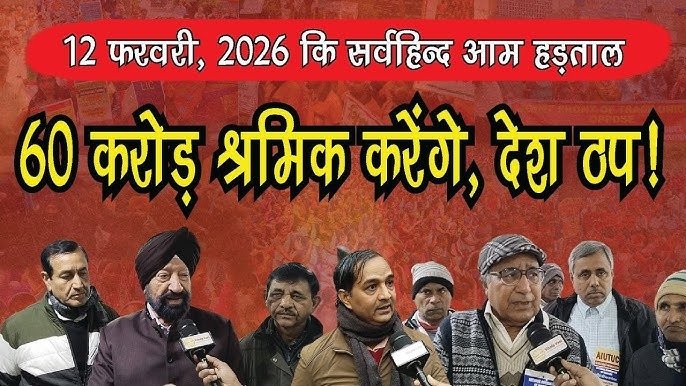
The All India Strike being organised by trade unions and workers’ organisations on 12 February is drawing enthusiastic response from workers across the country. In the face of the increasing all-sided attacks on their livelihood and rights, workers are organising to send a clear message to the rulers of this country that we who produce all the wealth of society are no longer going to put up with our increasing exploitation.
Mazdoor Ekta Committee (MEC) brought together workers from different parts of the country, from various sectors of industry and services, in a meeting on 18 January, under the banner: Make the 12 February All India Strike a big success! Unite Against the Growing Attacks on Workers and Peasants!
Representatives of IT workers, insurance sector workers, railway workers, factory workers, teachers, health workers, scheme workers, construction workers, beedi workers, fish workers, salt workers, App based transport workers and gig workers, headload workers, MNREGA workers, agricultural workers, as well as activists of various trade unions and workers’ organisations participated in the meeting and expressed their concerns. They welcomed the initiative taken by MEC in bringing together workers from diverse sections in our common struggle.
Shri Birju Nayak of MEC welcomed the participants and gave a brief introduction of the work of MEC. He then called upon the various activists to express their views.
Shri Santosh Kumar of MEC pointed out that though we workers produce the wealth of our country, the fruits of our labour are being enjoyed by the capitalists. The biggest Indian capitalists are now counted amongst the world’s richest capitalists, while we workers are facing extreme and growing insecurity of livelihood.
Denouncing the four labour codes notified by the government as an outright attack on the rights of workers, he pointed out that the Code on Wages denies a dignified living wage to the vast majority of workers. The Code on Occupational Safety, Health and Working Conditions legally allows capitalists to increase the length of the working day to 12 hours and gives them freedom to flout all safety measures at the workplace. The Code on Social Security deprives most workers of the right to health care, pension and other forms of social security. The Code on Industrial Relations makes it very difficult for us to organise ourselves into unions of our choice and practically impossible for workers to go on strike. Now only companies employing more than 300 workers will have to issue Standing Orders, or take government approval for closure and retrenchment. The scope of contract labour has been extended. Contractors employing less than 50 workers do not have to follow any labour laws. New forms of contract labour have been legalised, such as Fixed Term Contract, Apprenticeship, etc.
The aim of the four labour codes, Santosh pointed out, is to legalise the intensified exploitation of workers by the capitalist class.
He explained that in the face of the growing unemployment and our demand for the right to work, the central government had introduced the MGNREGA scheme more than 15 years ago. Now the central government has replaced this scheme with a new scheme which threatens to further reduce the availability of rural employment, by shifting a large part of the financing burden on state governments.
The capitalist system and the rule of the bourgeoisie are responsible for the massive unemployment, for the intensified exploitation of workers and the impoverishment of kisans, Santosh clarified. The Indian state is the organ through which this rule is defended and imposed on our people.
The means of production and exchange are the private property of the capitalists, headed by big monopoly houses. We workers own nothing except our labour power. In this system, the aim of production is not to provide jobs for workers, or to fulfil the growing needs of the working people. The economy and government policies are oriented towards fulfilling capitalist greed for maximum profits, he explained. He exposed the role of the Parliament and the political parties of the bourgeoisie, the bureaucracy, police, armed forces, and the judiciary, as instruments to impose the dictatorship of the bourgeoisie over workers, peasants and other working people. He also exposed the fact that through elections the bourgeoisie chooses one or another of its trusted parties to run the government. That is why, every party that takes charge of the government works to further intensify our exploitation and satisfy the capitalists’ desire for maximum profits.
Santosh called on the workers to recognise that it is necessary but not enough to struggle against the attacks of the bourgeoisie. We must also prepare to put an end to this condition of being an exploited class. We have to organise to replace bourgeois rule by workers’ and peasants’ rule, in which decision-making power will be in the hands of the broad masses of people. Workers and peasants must have the right to recall elected representatives and government officials who do not serve their interests.
Presenting a vision of the workers’ and peasants’ rule, he said that vital sectors of the economy including steel, cement, telecom, banking, insurance, electricity, rail and bus transport, wholesale and large-scale retail trade will all be brought under social control. The entire system of production will be carried out according to a plan aimed at fulfilling the needs of the people. There will be a necessity for a huge increase in the production of food, clothing, housing and all other basic needs. Lakhs of additional factory workers as well as teachers, doctors, nurses and other health workers will be required. The Right to Work will then no longer be an empty promise. It will become a reality.
With this bold and optimistic vision, Santosh concluded by calling on all the workers to escalate the struggle in defence of our livelihood and rights.
Ms Geetha, on behalf of the construction workers and other informal sector workers in Tamil Nadu, spoke of the disastrous consequences of the OSHW Code and the Code on Social Security. The state will no longer be accountable for safety of workers at the workplace, she said. Welfare Boards in various states, set up after prolonged struggle by construction workers, beedi workers and other informal sector workers will now be abolished. The vast majority of workers will be deprived of all rights, she explained, and demanded that the government immediately withdraw the Labour Codes.
Ms Moumita Chakrabarty of SEWA, West Bengal, raised the severe problems facing informal sector workers – street vendors, gig workers, domestic workers, beedi workers, construction workers, fish workers, and many others – constituting more than 90% of the working population. They are completely outside the purview of any kind of legislation and are deprived of the right to social security, redress for work-related accidents and occupational health hazards such as TB, cancer, etc. Fixed-term contract workers have no job security. Women workers face sexual harassment at the workplace. We must all unite and step up the struggle against these attacks, she emphasised.
Shri Girish of Kamgar Ekta Committee (KEC) explained that the Indian state is an instrument to defend the interests of the capitalist class. Calling for united mobilisation to make the 12 February strike a success, he recalled the lessons of history. The success of the October Revolution in the Soviet Union in 1917 and the establishment of workers’ and peasants’ rule, showed the workers all over the world that it was possible to establish a state and system in which the democratic rights of all the people are defended. Learning from that experience, he urged the workers in our country to escalate their struggle against the attacks of the capitalists, with the perspective of replacing the rule of the capitalist class by the rule of the workers and peasants.
Shri Prashant Bhagesh Sawardekar, National President of the Indian Federation of App-Based Transport Workers (IFAT), elaborated on the struggles that gig workers and platform workers – delivery workers, Ola and Uber drivers, etc. — have been waging struggles for the past 5-6 years, to be recognised as workers and for their rights as workers. The strike action by gig and platform workers all over the country on 25 December and 31 December last year forced the Labour Minister to order companies like Blinkit, Zepto and Swiggy Instamart to drop the 10-minute delivery promise from their apps, he said. Shri Sawardekar highlighted other demands of the gig workers such as assured higher income, medical assistance in case of accidents, legal protection from arbitrary harassment and dismissal, social security and legal recognition as workers, which have not yet been addressed by the government, and for which the struggle is continuing. He announced that on 7 February, gig and platform workers would be organising massive protest actions in support of their demands.
Ms Kavita Hijam, who organises FCI godown workers in Manipur, recalled the recent retrenchment of 103 workers without notice, and the immense difficulty in getting legal redressal for such unfair practices against workers. As vice-president of the local Labour Association, she spoke of her youtube channel highlighting the attacks of the capitalists on the workers and their struggles against these attacks. She described the terrible situation facing the people of Manipur, caught between the Army and state security forces on the one hand, and various individual terrorist groups on the other. Both sides participate in looting, killing, extortion and terrorisation of the people. Together, they threaten to silence the voices of the working people fighting for their rights. The ongoing violence and the prolonged period of Central Rule in Manipur has made the situation worse for our people, she said. She expressed her hope that by coming together with workers from different parts of the country on such a platform, the struggle of the workers in Manipur would gain in strength.
Ms Geeta Shant, of the All India Insurance Employees’ Association, pointed out that the ruling capitalist class has completely abandoned all semblance of caring for the democratic rights of the working class. The working class has to come forward as the defender of democratic rights, she said, calling for a united struggle against the privatisation of education, health and other public services, in defence of the right to security of livelihood, social security, universal guaranteed pension, etc. She denounced the attempts of the politicians of various parties of the ruling class to divide workers on communal lines, and called for greater unity to make the 12 February strike a success.
Shri Baskar of Workers’ Unity Movement (WUM) gave many examples to bring out the terrible exploitation and insecurity of livelihood for workers in the IT sector, textile and garment industry, health and education sectors, manufacturing industries, construction workers, gig and platform workers, contract workers, and other workers in the informal sector. The Labour Codes are meant to legalise their exploitation, he pointed out. He called upon the workers to make the 12 February strike a success, and to organise to put an end to our exploitation and slavery once and for all, by establishing a new system in which we toiling people will be the rulers and decision-makers.
Shri Hanuman Prasad Sharma, Vice President of Lok Raj Sangathan, exposed the role of the political parties such as BJP and Congress, as managers of the rule of the capitalist class. Elections, through which one or another of these parties is entrusted to manage the government, serve to legitimise this rule of exploitation and oppression for the toiling masses. He called for mobilisation of the working class to become the rulers of this country and establish a new system in which we shall reorient the economy to fulfil the needs of the toiling masses.
Shri Ram Chandra Bunkar of the Rajasthan Gram Pratihari Sangathan described the severe exploitation of the nearly 12,000 rural panchayat workers in Rajasthan, forced to work for an honorarium of mere Rs 15000 a year.
Shri Salvinder Dhillon from Indian Workers Movement (Britain) hailed the initiative of MEC and called for vigorous struggle of the workers in defence of their livelihood and rights.
Trade Union leaders such as Shri Virendra Gaur of CITU, Shri Ramesh Parasher of AIUTUC, Shri Armugam Subramaniam of the Federation of Indian Trade Unions (FITU), Ms Udita of Centre for Struggling Trade Unions (CSTU), Shri Munna Prasad of Inquilabi Mazdoor Kendra (IMK) and several others attended the meeting and expressed their resolve to mobilise widely for the success of the 12 February strike. Several other activists expressed their support for the strike.
Shri Birju Nayak called on all the participants to mobilise widely for the 12 February strike. Let us step up the struggle in defence of our rights, and organise to put an end to our exploitation and slavery by replacing the rule of the capitalist class with workers’ and peasants’ rule, he concluded.