
Report by Kamgar Ekta Committee correspondent
As we go away from Mumbai, Thane is a big station that is the terminus for some local trains. Kalwa, a suburb of Thane, is the next station, and its passengers who travel to Mumbai have to be served from local trains that come from further termini like Dombivali, Kalyan, etc. The problem for peak hour commuters is that by the time the local arrives at Kalwa, only 2-3 passengers can board from each door.
More than 5000 daily travellers have solved this problem in their own way. There is a ‘car-shed’ adjoining Kalwa station, where locals are housed in the night and for maintenance. In the morning peak hours, four trains regularly leave the car-shed and start moving towards Thane, from where they run as Thane – CSMT (Mumbai) locals. To get to the track going towards Mumbai, each train has to first cross the CSMT-Kalwa (opposite direction) track. For this reason, each train departing from the car-shed has to wait at a signal stop before crossing.
Thousands of passengers board this train while it waits at the signal stop. There is no platform there, so boarding is not that easy, but most passengers have decades or at least several years of practice. Commuters do not board trains from the car-shed as a first choice, but are forced to do so in the absence of adequate regular trains. Last year, the railway administration, in its wisdom, decided to construct a wall that will make car-shed locals inaccessible from the signal stop. It is obvious that stopping passengers from boarding the train from the car-shed without providing any solution to the existing overcrowding problem at Kalwa station is going to make the situation worse.
Realising the grave nature of this problem, the Kalwa-Mumbra Railway Pravasi Suraksha Sangharsh Samiti swung into action. It appealed to its counterpart – the Dombivali-Kopar-Thakurli Railway Pravasi Suraksha Sangharsh Samiti, which decided to concentrate its forces in Kalwa as well, because this was a much more urgent problem.
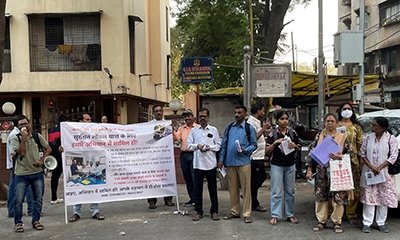
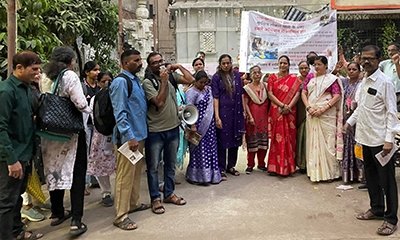
A slogan was highlighted: “Build a home platform for car-shed passengers before completing the wall!” The activists focused their campaign on car-shed passengers and received an overwhelming response. Even the security forces who are also daily car-shed train commuters, as well as those who patrol the tracks, endorsed the campaign. Railway workers responded enthusiastically too, because not only their families, but they themselves have to undergo the torture of these daily journeys!
A large number of rallies and leaflet distributions were organised over months. Different representatives at the local level were met. At the time of the TMC (Thane Municipal Corporation) elections, activists addressed the “supporters” of various big political parties. This occasion was used to publicly place the demands before the candidates of the big parties. In short, political leaders at various levels had to take note of the campaign and the overwhelming support it was getting even from their supporters.
Station-specific demands of Kalwa were also raised, and some things materialised – benches were distributed evenly to cover spaces designated for various coaches taking into account the needs of the passengers, a clinic was re-opened (though emergency facilities – including a stretcher – are absent). Steps were taken towards supplying free drinking water. The platform no. 1 was extended to accommodate a 15-car local (though this does not guarantee that these locals would indeed start, as work has not moved ahead; moreover, these platforms need to be similarly extended in other stations as well!).
The most important thing is that the authorities have not been able to build the wall yet. This is a victory, but it would be very foolish to sit back and celebrate! If the campaign weakens, the wall could be completed overnight!
This is the nature of the capitalist system!
The capitalist system prevails today in our country, and so this “democracy” is only for the capitalist class! Paisa bolta hai! (Money speaks!) Policies are made by the capitalist class. They are implemented by the “ruling party”, whose leaders are managers of this class. They are funded by the biggest of capitalists to serve them. That is why the so-called “ruling party” changes, but policies do not. The economy is geared towards maximising the profits of the ruling capitalist class, to pander to their insatiable greed and not towards satisfying the most basic of needs of the people. Just look at how hard the Committee had to fight, just to get a few benches moved!
Whatever the people have gained, not only in our country but wherever capitalism prevails, has been won through united, persistent struggles. Capitalist governments do not give anything to the people until they are forced to do so. Commuters in other countries have struggled for and won safer and better facilities.
The annual subsidy for passenger traffic across India stands at approximately Rs. 30,000 crore — a figure that pales in comparison to the Rs. 6,00,000 crore in annual tax concessions granted to a handful of industrialists. Moreover, in the past four years alone, bad loans amounting to Rs. 4,50,000 crore have been waived for big capitalists! The Committee is demanding that their money – collected by the government through direct taxes on salaries and indirect taxes on goods and services – be used to provide safe and affordable passenger travel and provide better facilities in the trains and stations, not to bail out the big capitalist defaulters.
Activists of the Committee understand that they have to deepen and broaden their campaign to ensure that the problems of Mumbai local passengers are addressed promptly by the authorities. This campaign is a positive step to strengthen organisations of working people to take up the struggle to demand their rights!