
Report by Kamgar Ekta Committee correspondent
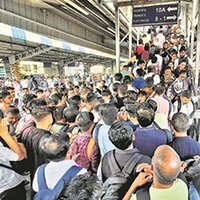
In June 2025, Kamgar Ekta Committee (KEC) intensified its on-going campaign for safe and dignified local train commute, when several passengers died in a single ‘accident’ that shocked passengers and concerned people. The campaign spearheaded by KEC has energised hundreds of local commuters to join in the effort to demand better conditions of commute.
A quick glance at the horrifying reality of the Mumbai suburban trains
About 75 lakh people living in MMR (Mumbai Metropolitan Region, which covers Mumbai as well as far-flung areas of the contiguous Thane district) have no option but to travel daily for work or for studies. Many of these towns and their suburbs have no good road connections to Mumbai and public bus services are woefully inadequate. Suburban trains offer the quickest and cheapest mode of transport.
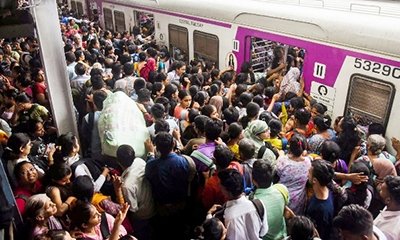
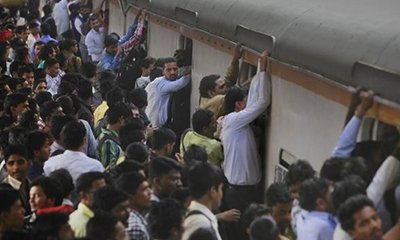
Day by day the condition of the local train service is going from bad to worse and most of the stations are in a terrible condition. The 3-4 hours of the daily travel is literally hellish – uncomfortable at best, and downright dangerous as well. The number of trains is a small fraction of the demand, so that in peak hours, each carriage carries more than 4-5 times its capacity. As a result, people are forced to hang dangerously outside the train doors, and many cross the tracks just because the few passenger bridges on platforms add a lot of time to the daily torture! The situation is so bad, that on an average, according to the Railways’ own admission, 7 passengers die daily!
KEC distributed thousands of leaflets at several stations, collected thousands of signatures on demand letters and submitted them to the Railway authorities. The following demands were raised which would go a long way in ensuring the safety and well-being of passengers:
- Increase the local trains’ frequency by at least 1.5 times. This can be done by installing a modern signalling system. This is not rocket science – this technology has been implemented all over the world and even in India for Metro trains. Such a recommendation had been done by the official agency, the MRVC (Mumbai Rail Vikas Corporation) in 2016-17 itself. As it happens with recommendations that would actually benefit the people, nothing has moved on this score.
- Increase the number of coaches in trains from the present 12 to at least 15 in order to increase carrying capacity in each train. In fact, the RDSO (Research Designs and Standards Organisation, under the Ministry of Railways) had recommended increasing the number to 18!
Further demands are being raised to bring about an improvement in the abysmal condition of local train stations:
- Free and clean drinking water and toilets on each platform
- Adequate number of benches, fans, and roofs over each platform.
- Adequate number of escalators, stairs and lifts on each platform
- Proper and clear announcements of expected trains– many times the announcements are late, wrong or misleading
- Adequate number of wide and well-maintained foot overbridges connecting different platforms and exits. (Some of them shake under the excessive load; in others stampede-like conditions often exist)
- Station Masters and other necessary staff like ticket sellers in adequate numbers at every station.
- Adequate number of ticket counters on both sides of the railway track.
- Ramps for passengers
- Stretchers, First Aid boxes, well-equipped Emergency Rooms with doctors, nurses and stretcher porters as well as ambulances at all stations. Since most stations lack these, innumerable victims die or are permanently maimed due to the delay in or lack of medical treatment.
The overwhelming response underscored the urgent need to form active committees of volunteers willing to take the campaign forward. With this objective, KEC organized Railway Pravasi Suraksha Sangharsh Samitis in Dombivali – Kopar – Thakurli in September 2025 and in Kalwa – Mumbra in the following month.
The Committees have been meeting regularly to plan and organize the railway campaign. Committee meetings are run in a democratic manner. This is possible because committee members themselves have been contributing monetarily to keep the campaign alive! In each meeting, a finance report is presented. Drafts of leaflets, banners, etc. are discussed thoroughly in committee meetings, suggestions are welcomed and those are incorporated with which the majority agrees.
With the formation of the committees, the campaign was redoubled – several rallies were organised, banners were put up in various places. Demand letters and reminder letters were given not only to the railway authorities but also to the local representatives. The campaign received publicity in several newspapers. Article 14 (https://www.youtube.com/watch?v=_CmBvKNF4Vk) and Vikalp Vani (https://www.youtube.com/watch?v=hAVzSSqBxjQ) produced a video each that got thousands of views.
Recently, railway authorities planned infrastructural changes that would have led to a desperate situation for thousands of commuters from Kalwa. That is when the Samiti decided to focus its efforts in Kalwa. Some minor victories have been achieved and so far we have been able to prevent the authorities from taking the step that would have made matters unimaginably worse for Kalwa passengers, as the accompanying article shows.