
Report by Kamgar Ekta Committee correspondent
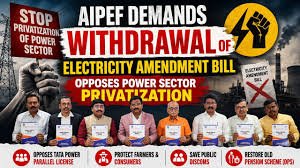
The All India Power Engineers Federation (AIPEF) held its Federal Executive meeting in Bengaluru on 12 June. The meeting adopted the following resolutions:
Resolution No. 1
Against the any unilateral attempt of Tabling of the Electricity (Amendment) Bill, 2025 in the Monsoon Session of Parliament.
Resolution No. 2
Against Grant of Parallel Distribution Licences to Tata Power in Karnataka and in Defence of Public Sector Electricity Distribution.
Resolution No. 3
Against Grant of Distribution Licence to Google AI Data Centre in Andhra Pradesh and its Adverse Impact on The Public Power System
Resolution No. 4
Against Joint Venture / Privatization of Ladakh Power Development Department
Resolution No. 5
Against the Creation of Separate Agriculture DISCOMs
Resolution No. 6
Resolution Opposing the Creation of a Separate Agriculture DISCOM (TGRPDCL) in Telangana.
Resolution No. 7
Against creation of separate Agriculture Discom in Maharashtra.
Resolution No. 8
Against the Creation of a Separate Agriculture DISCOM in Haryana.
Resolution No. 9
Regarding Grid Stability Risks from unbalanced Renewable Energy Integration and Rigid RPO Compliance.
Resolution No. 10
Against Privatization of Distribution Companies in Uttar Pradesh and Repression of Power Employees & engineers
Resolution No. 11
Restoration of Old Pension Scheme (OPS) for Power Sector Employees & Engineers Across the Country
As the resolutions deal with various attacks and attempts at privatization going on presently in the country and are of keen interest to power workers and consumers, it is proposed to reproduce the resolutions one by one.
We here below reproduce the first resolution.
Resolution
Against the any unilateral attempt of Tabling of the Electricity (Amendment) Bill, 2025 in the Monsoon Session of Parliament.
The Federal Executive of the AIPEF, after detailed deliberations on the developments relating to the proposed Electricity (Amendment) Bill, 2025, unanimously adopts the following resolution:
Whereas
1. The draft Electricity (Amendment) Bill, 2025 was circulated on 09 October 2025 with inadequate time for comments and objections from stakeholders.
2. Despite widespread opposition from power engineers, employees, trade unions, consumer organizations, farmers’ bodies, state utilities and electricity sector experts, the Central Government has continued to pursue the Bill without meaningful consultation.
3. On 12 January 2026, representatives of power sector employees and engineers from across the country unanimously demanded withdrawal of the draft Bill. However, the Ministry of Power has not even released the minutes of the meeting, demonstrating disregard for democratic consultation and stakeholder participation.
4. A Working Group constituted on 30 January 2026 included representatives of All India Discoms Association an organization openly advocating privatization of the power sector. The inclusion of such vested interests in the process of finalizing a national legislation affecting millions of consumers and employees raises serious concerns regarding transparency and impartiality.
AIPEF Notes with Serious Concern
A. Threat to Public Distribution Utilities
The Bill seeks to permit multiple distribution licensees in the same area using the same publicly funded distribution network under the guise of competition and consumer choice.
This provision will enable private companies to cherry-pick high-paying industrial and commercial consumers while leaving public DISCOMs with socially obligated consumers, including domestic, agricultural and rural consumers.
The inevitable consequence will be weakening of public utilities, erosion of their revenue base and eventual privatization of distribution.
B. Threat to Affordable Electricity
More than 90% of electricity consumers are domestic consumers with connected loads below 5 kW.
The proposed amendments are designed to benefit a tiny fraction of large consumers while ignoring the interests of ordinary households, farmers, small businesses and weaker sections.
The Bill undermines existing cross-subsidy framework that enables affordable electricity for consumers.
If high-paying consumers migrate to private suppliers, public DISCOMs will lose substantial revenue, resulting in tariff increases for common consumers.
C. Adverse Impact of Open Access Provisions
The proposed Section 43(4) empowers Regulatory Commissions to permit consumers with demand above 1 MW to shift to private suppliers.
Such consumers contribute significantly to the revenue of state DISCOMs.
While these consumers may shift away, public utilities would still be required to maintain network infrastructure and standby capacity, creating an unfair financial burden on state-owned utilities.
D. Erosion of Universal Service Obligation
The Bill permits private licensees to avoid supplying electricity where it is commercially unviable.
Public DISCOMs, however, will continue to bear the statutory obligation of supplying electricity to every consumer irrespective of profitability.
This amounts to privatization of profits and socialization of losses.
AIPEF strongly believes that universal access to electricity is a public service obligation and cannot be subjected to market considerations.
E. Failure of International Experience
International experience has shown that retail competition in electricity distribution has not delivered the promised benefits to consumers.
Studies of electricity sector reforms in several countries have demonstrated that competition in retail distribution has failed to significantly reduce tariffs and has often increased regulatory complexity and financial instability.
F. Threat to Employees and Engineers
The Bill creates conditions that will accelerate privatization of distribution utilities.
This will adversely affect job security, service conditions, career progression and other terminal benefits of power sector employees and engineers.
AIPEF believes that a strong public electricity sector is essential for maintaining technical standards, system reliability and consumer service.
G. Threat to Federal Structure
Electricity is a concurrent subject under the Constitution.
The proposed amendments undermine the powers of State Governments and State Electricity Regulatory Commissions by imposing a centralized framework favouring privatization.
This constitutes an encroachment upon the federal structure of governance.
Therefore, AIPEF Resolves
1. To unequivocally oppose Electricity (Amendment) Bill, 2025 in its entirety and demand immediate withdrawal.
2. To oppose any provision permitting multiple distribution licensees in same area using the same network.
3. To oppose all provisions that facilitate privatization, cherry-picking of consumers, weakening of public utilities and transfer of public assets to private interests.
4. To demand protection of cross-subsidy mechanisms that support social equity in electricity access.
5. To demand that no consumer category be permitted to migrate to private suppliers in a manner that undermines the financial viability of public DISCOMs.
6. To demand that any reform in the power sector must prioritize affordability, accessibility, reliability and public accountability rather than privatization and profit maximization.
Programme of Action
A. Nationwide Resistance
If the Electricity (Amendment) Bill, 2025 is tabled in either House of Parliament during the Monsoon Session, AIPEF shall immediately launch nationwide protest actions in coordination with the National Coordination Committee of Electricity Employees and Engineers (NCCOEEE) and other trade unions.
B. Lightning Strike
In the event of introduction of the Bill in Parliament, AIPEF authorizes its leadership to call a Nationwide Lightning Strike at short notice in coordination with NCCOEEE.
The strike shall commence immediately upon receipt of credible information regarding tabling of the Bill.
C. Protest Demonstrations
Power engineers and employees throughout the country shall organize demonstrations, gate meetings, protest assemblies and mass mobilization programmes at generating stations, transmission projects, distribution offices, headquarters and district centres.
D. Public Campaign
AIPEF shall undertake a nationwide campaign to educate consumers, farmers, workers, public representatives and civil society organizations regarding the adverse consequences of the proposed legislation.
Call for Unity
The Federal Executive calls upon:
– All affiliated State Associations of Engineers;
– All electricity employees’ federations and unions;
– Central Trade Unions;
– Farmers’ organizations;
– Consumer organizations;
– Public sector employees’ associations; and
– Democratic and civil society organizations
to remain fully prepared for united and coordinated action to defend India’s public electricity sector.
AIPEF Reaffirms
Its unwavering commitment to:
– Protect public ownership of generation, transmission and distribution;
– Safeguard the interests of power engineers and employees;
– Ensure affordable and universal electricity access to all consumers;
– Defend the interests of farmers and weaker sections;
– Preserve the federal character of India’s power sector; and- Resist attempts to privatize electricity distribution through legislative, administrative or regulatory measures.
The Federal Executive declares that the Electricity (Amendment) Bill, 2025 is not a reform measure but a privatization measure. AIPEF shall oppose it with full organizational strength and in complete unity with all stakeholders committed to protecting the public power sector.