
Report of meeting organised by Mazdoor Ekta Committee
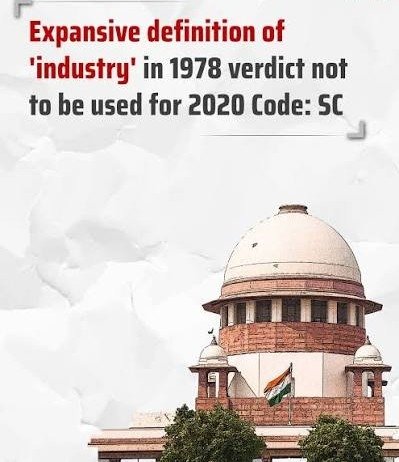
Mazdoor Ekta Committee (MEC) organised a discussion on the recent Supreme Court Judgement on Definition of Industry and its implications for the struggle for the rights of workers. The meeting was attended by representatives of trade unions and workers’ organisations from Delhi-NCR, UP, Bihar, Punjab, Rajasthan, Maharashtra, Tamil Nadu and many other parts of the country. Workers from different sectors participated in large numbers.
Com Birju Nayak conducted the meeting on behalf of MEC. He welcomed the participants and called upon Com Prakash Rao of MEC to present his views on the topic.
Introducing the aim of the discussion, Com Prakash Rao pointed out that in the prevailing system, the laws do not clearly define who is a worker and what are the rights of a worker. A lot of illusions are spread among workers about the present system, the laws related to labour, and the role of the courts, in order to ensure that workers do not fight for a new system in which their rights will be ensured. MEC, he said, is of the view that for the struggle of the working class for its rights to advance, it is very important that workers organisations committed to defending the rights of workers tell workers the truth about the existing system and what needs to be done by the working class to ensure its rights.
Com Prakash Rao explained that the Bangalore Water Supply and Sewerage Board case had to do with the scope of the Industrial Disputes Act (ID Act), 1947. In 1972, employees of the Board challenged disciplinary fines before the Labour Court. The management argued that the Board was not an “industry” and therefore was outside the ID Act. After the Labour Court and High Court ruled against the management, the matter was taken to the Supreme Court. In 1978, a seven-judge SC bench held that the Board was an industry under Section 2(j) of the ID Act and established the “Triple Test.” According to this test, an industry is one which involves (1) systematic activity, (2) cooperation between employer and employee, and (3) production or distribution of goods or services satisfying human wants, excluding purely spiritual or religious services. Profit motive is irrelevant, and public or charitable institutions may also qualify.
That judgement came at a time when powerful struggles of workers were breaking out in the decades of 60s and 70s. Many new public sector enterprises were being set up. Workers in these enterprises, as well as teachers, doctors, etc. were organising themselves in unions in universities, hospitals, schools, etc. When struggles in these places broke out, courts arrived at different decisions, sometimes declaring a university or hospital or government department as an industry under the ID Act, and in some other cases as not an industry.
The ruling bourgeoisie needed that public sector enterprises, large scale industries and services, government hospitals and universities function smoothly without disruption. It needed to ensure that the struggles in these enterprises and institutions remain within definite limits. The 1978 Supreme Court judgement, declaring that the Industrial Disputes (ID) Act 1947 would apply to most government institutions except army, police and a few other sectors, must be seen in this light.
The MEC presentation clarified that the ID Act 1947, governing the relation between workers and employers in an enterprise, has been an instrument in the hands of the capitalist state to deprive workers of definite means of fighting for their rights as workers. At the same time, the impression has been created that the ID Act is for the benefit of workers.
The ID Act puts forth all kinds of conditions on workers to prevent them from fighting for their rights. Any dispute between workers and management has to first go to a Labour court. They have to give notice to the capitalists before they go on strike. Strikes can easily be declared “illegal” and penalties imposed on workers. The management can suspend/ terminate workers in order to smash their unions and their struggle. Cases can drag on in labour courts for years. If the labour court sometimes gives an award to the worker, the management can challenge it in higher courts and refuse to implement it. Workers are caught up in endless legal struggle. The ID Act makes it very difficult for workers in large scale industry and services from using strike as a weapon.
At the same time, the ID Act has been used by the capitalist class to ensure class conciliation in large scale industry and services. Whenever there is the possibility of a major struggle of workers in a particular sector, the government can step in to organise settlement between management and unions. Many trade unions of workers, which have established a place for themselves within this system, keep the workers tied to the existing system, bargaining with the management for some crumbs, and prevent workers from fighting for a new society.
Between 1978 and 2026, subsequent disputes questioned whether welfare activities such as social forestry constituted industries. In 2020, the Central Government combined three labour laws — Trade Union Act 1926, the Standing Orders Act 1946 and the Industrial Disputes Act 1947 — into one act, the Code of Industrial Relations (IR Code), 2020. The IR Code 2020, like the previous laws, deprives workers of definite means of fighting for their rights. While its definition of industry includes the 1978 Supreme Court ruling, it excludes charitable and philanthropic institutions, sovereign functions of the government including defence research, atomic energy, and space, domestic services and any other activity that the Central Government may explicitly notify and exclude.
The 9-judge Supreme Court bench, which delivered judgment on 20 August 2026, held that pending disputes under the ID Act would continue to use the 1978 definition, while new disputes would be governed by the IR Code 2020. The Court refrained from examining the new definition under IR Code 2020 in detail. It held that sovereign functions of the state will be decided by the government, subject to judicial review.
The presentation reaffirmed that neither the ID Act 1947, nor the 1978 Supreme Court judgment, nor the IR Code 2020, nor the 2026 Supreme Court judgment defend workers’ rights. The struggle to clearly define who is a worker, and to make workers’ rights enforceable continues. This struggle has to be waged with the perspective of establishing worker-peasant rule in place of rule of the capitalist class, Com Prakash Rao said.
Com Amarjeet Kaur, General Secretary of the All India Trade Union Congress (AITUC), explained in detail about the 1978 SC judgement’s definition of industry and the implications of the 2026 judgement. She pointed out that the IR Code 2020 deprives more than 90 percent of the work force in our country of the right to form unions, the right to strike, the right to a dignified living wage, pension and other benefits. Construction workers, Anganwadi and ASHA workers, mid-day meal workers, gig workers, domestic workers and many others are fighting for recognition of their rights as workers, she pointed out, and highlighted the need to unite and intensify our struggles.
There was vigorous discussion on the problems faced by workers in the struggle for their rights.
Com Virender Gaur of the Centre of Indian Trade Unions (CITU) elaborated on the IR Code 2020 and how a very large section of the working class is denied all rights. He denounced the attempts of the government to deprive workers of the right to unionise and go on strike. The prevailing laws and courts are anti-worker, he said, and called for greater unity of all sections of the working class, in the struggle for our rights.
Shri Girish of Kamgar Ekta Committee (KEC) spoke of how the capitalist class deliberately gives different names to workers, such as ‘captains’, ‘partners’, ‘managers’, etc. to cover up their identity as workers. He clarified that the actual aim of the 1947 ID Act and the present IR Code is not to give workers justice, but to deprive workers of the means to fight for their rights and to ensure that the capitalists can continue to ‘peacefully’ exploit the workers. We cannot have any illusion that the rights of workers can be defended under the present system, he said, and called for a united struggle aimed at establishing a new system in which the workers’ rights can be ensured and defended in practice.
Lata of Self Employed Women’s Association (SEWA) described the struggle of street vendors, scheme workers, domestic workers, gig workers and other informal sector workers for recognition of their identity as workers and for their rights.
Shri Hanuman Prasad Sharma, an active fighter for the rights of teachers and workers in Rajasthan, elaborated on how justice is denied to the working people at every step. He called for stepping up the struggle for our rights, without any illusion that the courts will deliver justice to the working people.
Shri Baskar from Workers’ Unity Movement gave numerous examples of how the IR Code 2020 denies the majority of workers the right to a dignified living wage and safe working conditions, while making it very difficult for workers to organise and fight for their rights. Only when workers become the rulers, in place of the capitalists, can they ensure their rights, he said.
Participants sought clarification on several issues that arose out of the presentation. Some of the questions raised were: (1) How far can workers rely on the courts when their experience shows that they do not get justice even after a prolonged legal battle? (2) Can the courts play the role of impartial arbiters in disputes between capitalists and workers, or do they merely approve the decisions of the executive? (3) The four Labour Codes were passed in the face of great opposition of the working class. Why was the voice of the workers ignored? (4) Is there any truth to the prevalent notion that earlier court judgements were more favourable to workers, unlike at present? (5) Different names are used – partners, executives, officers, managers – to create confusion on who is a worker. What is the purpose of this?
Com Prakash Rao clarified that anyone who sells his/her physical or mental labour power in order to earn a living is a worker. However, according to the laws governing labour, a huge section of workers are excluded – such as those in the army, police and other government services. Those earning above a certain wage are not considered workers. Those working in IT industry, in APP BASED work, scheme workers and many others are not treated as workers.
Every worker must be ensured a wage that will enable her/him to lead a dignified life, guaranteed pension, health care, maternity and childcare facilities, good quality education for children, proper housing, and sanitary living conditions. However, workers who constitute a majority of the population are denied all this.
The existing system, he explained, is a system through which the capitalist class rules over the vast majority of our people. The parliament, the courts, the laws all serve to legitimize this rule. They have always done so, from 1947 till the present time. They are part of the mechanism through which the capitalist class exercises its rule and carries out the exploitation of the working class. They are not instruments to defend the interests of the workers. It is important that each one of us takes this consciousness to the broad masses of workers.
We workers must fight to replace this system with one in which the rights of workers, peasants, and all working people are guaranteed and enforceable. We must wage this struggle with the perspective of establishing worker-peasant rule in place of rule of the capitalist class, he concluded.
Com Birju brought the discussion to an end. He thanked all the participants for expressing their views on this extremely important issue. He called for stepping up the united struggle to replace the existing system of exploitation and injustice with a new system in which the rights of all workers will be guaranteed.