
Appeal by the Haryana Electricity Employees and Engineers Joint Struggle Front
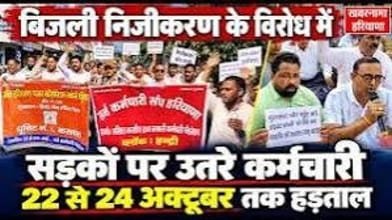
(Translation of Hindi appeal)
Impact of the parallel licensing system and smart meter scheme on the general public
Comrades,
The government is rapidly advancing the privatization process in the power sector in Haryana, which is going to directly impact employees and the general public. Despite opposition from employees, farmers, and the general public, the Haryana government has decided to hand over the parallel licensing system and the smart metering scheme into private hands. Despite massive opposition from employees and farmers, the Haryana Electricity Regulatory Commission (HERC) issued a license for parallel electricity distribution to Eleven Power Private Limited on October 19.
The infrastructure built with the tax money of the general public is being sold off to power corporations to benefit big capitalists. In 1998, showing a financial deficit of Rs. 498 crore of the Electricity Board, the board was split into four power corporations under the name of reforms. However, today that deficit has surged past Rs. 19,000 crore. Instead of reviewing this, the Haryana government is pushing ahead with privatization policies.
Impact of the parallel licensing system on the general public and farmers
Ignoring the voices of unions, public organizations, farmer and laborer organizations, and the opposition, HERC has issued a license to Eleven Power Private Company for Gurugram and Nuh. Gurugram and Nuh alone account for 42% of the revenue of the Dakshin Haryana Bijli Vitran Nigam (DHBVN). Electricity corporations sell power to high-value institutions at higher rates, and the income generated from that is used to provide cross-subsidies to the poor, farmers, and general consumers. After privatization, this will severely impact the general public. State electricity companies will be forced to provide their infrastructure to private companies, while the burden of maintenance, network expansion, and losses will remain on the state companies.
Meanwhile, private companies will only supply electricity to profitable consumers, large industries, malls, and IT parks, while the responsibility of poor consumers will remain with the public discoms. The public sector will bear the losses, private companies will make profits in this sector, the state electricity company will weaken, cross-subsidies will end, electricity rates will rise, discoms will be pushed toward privatization, the cross-subsidy system will be dismantled, and the prices of electricity will go beyond the reach of the poor man.
Adverse effects of the smart meter scheme
To promote private sector companies, prepaid smart meters are being installed under the TOTEX model by the Ministry of Power. So far, 8.73 lakh meters have been installed in Haryana. With the installation of these smart meters, the subsidies available to general consumers will come to an end. Instead of a fixed slab system, electricity rates will be determined on an hourly basis, which will directly affect the 2.6 crore consumers of the state.
The condition of the electricity corporations will become like gas subsidies and BSNL. Large private companies like Adani and Tata are eager to implement this smart meter scheme. By installing smart meters for free initially, the Haryana government is trying to mislead the general public, while the public remains unaware of the potential dangers.
The parallel electricity distribution arrangement is not limited to Gurugram and Nuh alone. The Haryana government has set a target to sell upcoming formats in other districts as well, primarily targeting high-revenue districts with low line losses. The main districts are Faridabad, Karnal, Panipat, Panchkula, and Hisar, where preparations for private distribution arrangements are underway. This will adversely affect the general public. The Haryana government is stepping back from its constitutional and fundamental responsibilities.
The number of employees will decrease, jobs will become precarious, and an employment crisis will emerge.
Come, let us together oppose these privatization policies and register opposition to the government’s issuance of parallel licenses, demanding that they be withdrawn.
We appeal to all farmers, workers, traders, general consumers, and public organizations to support electricity employees and engineers in the fight to save the power corporations and oppose the government’s decisions.
Main demands:
- Stop selling the parallel licensing system for Gurugram and Nuh.
- Stop the smart metering scheme.
- Stop the creation of a separate agricultural distribution corporation.
- Resolve issues of employees.
Long live the unity of employees and engineers!
Long live the united struggle!
Stop privatization policies!
Appellant: Haryana Electricity Employees and Engineers Joint Struggle Front