
Report by correspondent of Kamgar Ekta Committee
At one time Mumbai was known for its industries; today it is known as the financial capital of the country. It is promoted as the city of Bollywood, as the City of Dreams. Innumerable rags to riches stories are propagated that draw working people from all over the country. Once they get there, they realise that reality is far different from what is portrayed in films.

Mumbai is built on seven islands and land reclaimed from the sea. All the big businesses and offices, the best colleges and hospitals, as well as many of the homes of the richest Indians are concentrated in a tiny area – South and Central Mumbai. This area has good public infrastructure – good roads, lighting, drainage, etc. Public money gathered by way of taxes – direct and most importantly indirect- is spent here.
At one time Central Mumbai was packed with textile mills and the cramped residences of workers. With the closure of these mills, workers have lost not only their jobs, but in thousands of cases, their dwellings as well. Their lands have been handed over to big builders for a song and they have constructed glitzy offices, malls and posh housing towers. Housing prices there are so astronomical that working people cannot afford to stay there.
Masses of working people are forced to live in North Mumbai or in the contiguous towns of Thane district. As is the case everywhere under capitalism, the localities where the masses of working people stay are noticeably lacking in public amenities. Nothing is given as a matter of course. Every little bit of improvement has to be fought for.
Lakhs of people have no option but to travel daily for work or for studies. This is where the dependency on suburban trains comes from. Many of these towns and their suburbs have no good road connections to Mumbai. Public bus services are woefully inadequate. Suburban trains offer the quickest and cheapest mode of transport.
Many people have no option but to spend 3-4 hours daily in suburban trains . Added to the 8-12 hours of work, this leaves practically no time in their lives for anything else! For women it is worse – apart from contributing to the family’s income, cooking, cleaning, childcare, care of the sick and aged are assumed to be their responsibilities in most families.
Is the Mumbai suburban train system a Lifeline or Death Trap?

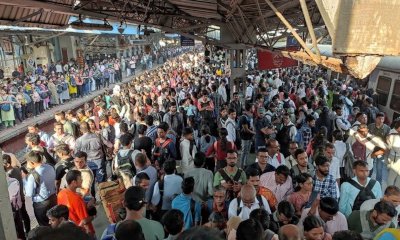
Crowded Mumbai Suburban train
About 75 lakh people travel by Mumbai suburban trains daily. The seating capacity of each coach is 86. However, during peak hours, 4-5 times this number have to squeeze inside. Many have no option but to hang out. The crowd is so dense that people have to jump out at their station before the train stops; otherwise, they are trapped inside by the incoming hordes of passengers. It is next to impossible for the aged, the frail and for pregnant women or kids to travel by locals during peak hours. Every day many passengers fall out and die!
The station infrastructure is very poor or non-existent. The passenger foot overbridges are generally narrow and in a state of disrepair. Many vibrate when they get crowded; a few have collapsed. Sometimes the crowd is so dense that it may take 15-20 minutes just to exit. That is why some people try to cross the tracks, and are run over by other trains.

The number of trains on the timetable are not adequate to meet the demand. In addition to this, almost all trains run late, particularly during peak hours. Many are cancelled. In some bigger stations, platforms are abruptly changed. Indicators are missing or incorrect. Many times, the announcements are made too late or are even wrong. This adds to the rush and confusion, where passengers are made to run from one platform to the other, fighting their way through crowds.

Near-stampede conditions are a daily reality for passengers — and this is no exaggeration. What is often referred to as the lifeline of Mumbai is increasingly becoming a death trap for its daily commuters. The number of deaths and injuries on Mumbai’s rail tracks is appalling. Over the last 20 years there have been more than 51,000 such deaths. On an average 7 people die every day! In 2024, there were 2468 deaths and, 2697 injuries. From January to May 2025 there were 922 deaths!
The situation is so bad, that even railway workers and their families as well as policemen have to travel like other ordinary passengers.
Elementary safety provisions are missing in many stations. This includes First Aid boxes, ambulances, and doctors or Emergency Rooms. Many stations do not have stretcher hamaals (porters) to lift the injured. All this means that innumerable victims die or are permanently maimed due to the delay in or lack of medical treatment. There was a tragic case where the Diva Station Master himself went to the aid of an accident victim, but was himself run over and died!
Several stations do not have Station Managers or Station Masters (SM), with the Ticketing person saddled with their duties. The SM from a nearby station is officially also responsible for such stations. How do we expect a SM to take care of any problems at a location where they are not even present? Most stations do not have an adequate number of ticket windows. There are many examples across Mumbai train stations, where multiple ticket windows are not operational due to shortage of staff. We have to demand immediate filling of vacant posts such that efficient services for passengers and reduced work load of workers is ensured.

Cattle not crammed railways, but people are!
Most stations are dirty and have no passenger amenities. Toilets, if there, are stinking, often without water. In many stations there is no provision for drinking water. Most have no ramps, elevators, and escalators. There are not enough seats on the platform, there are not enough fans. Many platforms are partially uncovered, meaning that passengers who are pushed to waiting there due to dense crowds have to suffer the tortuous heat or pouring rain.
People have not been mute sufferers
The demand for safer and more comfortable train travel has long been voiced by numerous passenger groups and other organizations across Mumbai and its suburbs. Kamgar Ekta Committee (KEC) has actively collaborated with many such organizations to address this issue.

Sometimes the anger of passengers spontaneously spills out in the form of rail rokos. In such cases, while the government may throw some crumbs to appease the angry people, many protestors are arrested and have to spend time, energy and money in never ending court cases.
Sensing the belligerent mood of the people, like for instance after the recent Mumbra accident, authorities announce a number of solutions. In this case, the solutions they are announcing are worse than the disease!
Take for example the government’s announcement that all suburban trains will have closed doors. What happens to those who cannot get in? They will keep waiting indefinitely, because crowds on the platform will keep building up! And what about those who do manage to get in? They will get crushed even more and be subject to suffocation!
There are real solutions!

The obvious one is to increase the number of local trains by installing a modern signalling system so that the distance and time interval between two successive trains can be reduced. This is not rocket science – this technology has been implemented all over the world and even in India for Metro trains. Such a recommendation had been done by the official agency, the MRVC (Mumbai Rail Vikas Corporation) in 2016-17 itself. As it happens with recommendations that would actually benefit the people, nothing has moved on this score.
The other solution is to increase the number of coaches in every local train from 12 to 15. The infrastructure for this already exists. A 15 coach train does run infrequently in the day.
Actually it is shocking that even this train gets converted to a 12 coach one sometimes. Reason? Due to the large-scale contractualisation in the maintenance department, at times enough workers are not available!
There are solutions, but they will get implemented only if a big mass movement of people is built demanding this! This is exactly what KEC along with other organisations have been doing.
The experience is that just meeting the authorities, writing letters, etc., rarely achieves anything much. However, by means of mass campaigns, KEC and other organisations have managed to get some infrastructural improvement in some stations and their surroundings.
In recent months, efforts have begun to do this in a more organised and systematic way.