
Press Statement of All India Federation of Electricity Employees (AIFEE)
All India Federation of Electricity Employees
Date: 18.10.2025
Newspaper Statement
Mumbai
As per the directives of the Union Cabinet, the Central Power Department has adopted a policy to privatize 44 public power distribution companies in the country. In the country’s power industry, along with publicly owned distribution companies, 13 are owned by private capitalists like Tata, Adani, Toronto, Goenka, Reliance, etc. in cities like Odisha, Kolkata, Delhi, Malegaon, Bhiwandi, Mumbra, Mumbai, Chandigarh, etc.
After a meeting of the Groups of Ministers of seven states, the central government has given three options to the states to privatize electricity distribution; otherwise, the draft announces that the central subsidy received by those states will be stopped. This is being done to provide more opportunities to private capitalists in power distribution.
The All India Federation of Electricity Employees has decided to oppose the draft Electricity Act 2025. A meeting of the representatives of all public and private electricity companies in the country and representatives of the All India Discom Association will be held at Sahara Hotel, Mumbai, on 4 and 5 November 2025, under the leadership of Union Power Minister Hon. Manohar Lal Khattar.
To oppose this meeting, an urgent meeting of the National Coordination Committee of Electricity Employees and Engineers is being held in Mumbai on 3 November 2025. Leaders of workers’ and engineers’ organizations from all over the country will attend this meeting.
The central government has given three options for privatizing public power distribution companies.
- The state government should sell 51% stake in the discom and run the discom on a Public-Private Partnership (PPP) model.
- Sell 26% stake in the discom and hand over their management to a private company.
- States that do not want privatization should register their discoms with SEBI and the stock market.
In the meeting of the Group of Ministers, it was decided that the states that do not accept any of the above three options will stop receiving grants from the centre, and no further financial assistance will be provided to them.
The subject of “Electricity” is included in the Concurrent List of the Eighth Schedule of the Constitution of India, meaning that the Central and State governments have equal powers in matters related to electricity. In such a situation, how can a privatization decision based on the votes of only seven select states (Uttar Pradesh, Maharashtra, Madhya Pradesh, Rajasthan, Haryana, Andhra Pradesh and Tamil Nadu) be imposed on the State governments?
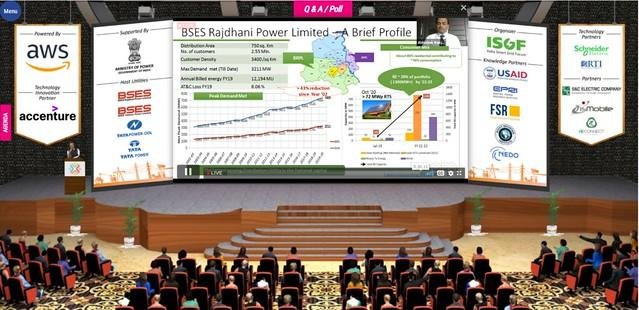
This is the sole agenda of the “Distribution Utility Meet 2025” conference to be held in Mumbai on 4 and 5 November 2025 – “PPP Models for Discoms’ Sustainability.” It is clear that the conclusion of this conference will be the same as that of the Group of Ministers’ meeting. That is, privatization of power distribution will take place on a large scale across the country.
Notably, the All India Discom Association (AIDA) has been given the status of an invitee for all meetings of the Cabinet Group. This organization is registered under the Societies Act, under which all other organizations including AIPEF/AIEEE/EEFI are also registered. However, the Ministry of Power (MoP) is giving special status to AIDA, and it is also invited to official meetings. AIDA is one of the organizing bodies of the “Distribution Utility Meet 2025,” along with private companies. This is a very serious issue. It seems that the All India Discom Association has taken on the role of a mediator for the privatization of DISCOMs.
Trade unions in Maharashtra had protested against this same policy of the government by going on strike first on 9 July and then on 9 and 10 October. Public power companies of the country should not be taken over by private capitalists. Trade unions are ready to sit together and work out whatever internal reforms are to be made in the companies. A meeting of all the trade unions in Maharashtra will be called soon against the privatization policy, according to a statement released by the National General Secretary of the All India Federation of Electricity Employees, Comrade Mohan Sharma, and National Deputy General Secretary, Comrade Krishna Bhoyar.
Yours faithfully,
Com. Mohan Sharma
National General Secretary
All India Federation of Electricity Employees