
Report by Sanjana, activist of Jan Hakk Sangharsh Samiti and Haspataal Bachao Nijikaran Hatao Sangharsh Samiti Mumbai

In the last few months, people have been coming out in large numbers in opposition to the privatization of public healthcare in many states of India. One of the main issues which they have taken up is the attempts of various state governments to hand over government hospitals to private entities.
Tens of thousands of people are regularly coming out on the streets in Vyara district of Gujarat; in Mumbai in Maharashtra; in Bijapur, Kolar, Puttur and Tumkuru in Karnataka; and in Rajpura, Moga, Moonak and Ferozepur in Punjab over the last few months.
Various organizations, including Jan Arogya Abhiyan Maharashtra, Janaarogya Chalavali Karnataka, Punjab Civil Medical Services Association (PCMSA) and the Multipurpose Health Workers’ Union Punjab, are actively mobilising for these agitations.
Wherever public hospitals and various patient services are handed over to private companies under the public–private partnership (PPP) mode, the ill effects on health services for the majority of working people have been disastrous. The details presented below show what has happened and what will happen in Karnataka if this PPP model is allowed.
Karnataka was among the earliest states to promote private hospitals through land allotments, subsidies, and PPPs. Economic reforms combined with the IT boom in Bengaluru created a consumer base that corporate hospitals were quick to exploit. The government further facilitated this entry with incentives such as tax cuts and cheap land to reduce the costs incurred by private players. Many major private hospital chains today occupy prime public land originally allotted for low-cost, public hospitals but operate as high-end, profit-maximising enterprises.
During the same period, public hospitals and healthcare suffered from chronic underinvestment. District hospitals were not allotted specialists, equipment, and budgets. Instead of strengthening the public system, successive governments outsourced diagnostics, labs, ambulances, dialysis units, and even emergency care. This outsourcing model turned key public functions into a revenue stream for private companies, while public hospitals became dependent on contractors whose main priority was profit.
Activists in Karnataka have found numerous problems in the privatisation model:
- Misuse of Government Land and Charitable Status: Several prominent hospitals received land at concessional rates in exchange of the obligation to provide free or subsidised treatment to a fixed percentage of patients. However, audits show how these norms were violated by using incomplete records, putting inflated bills which were then shown as “free treatment” and outright denial of care to eligible patients.
- Exorbitant Pricing: Because there are no strict price caps, private hospitals overcharge for consultations, diagnostics, ICU beds and surgical procedures.
- Contracting Essential Services: Outsourcing labs and dialysis to private vendors has fragmented care for the patient and made public hospitals dependent on private contractors. Contractors’ tests are not regulated in terms of cost or quality, and patients face delays or hidden charges. Complaints of faulty equipment, untrained technicians and denial of service are ignored, and the state often renews contracts to such contractors instead of terminating them.
- Insurance schemes: Schemes like Aayushman Bharat have only worsened the problem. Private hospitals use such schemes to tap into public funds, while patients, unaware of the insurance or caught in bureaucratic processes, end up paying out of pocket. Many hospitals are using this to overcharge, push unnecessary procedures, or refuse treatment to poor patients altogether.
The Karnataka state government has now declared its intention to hand over many more district hospitals to private entities in PPP mode. It is also planning to invite private entities to construct medical colleges and hospitals, for which the government will be giving many concessions.
Karnataka’s health sector is being systematically privatised to favour private capital over public good. This shift is not accidental. It is the result of deliberate policies, incentives, and institutional arrangements that have enabled a small set of private hospital chains to convert the healthcare system into a profit-making machine at the cost of people’s rights and publicly-funded hospitals.
This shift exemplifies the usual tactic of the state to deliberately defund publicly created and funded essential services, weaken them, use this as an excuse to hand over services to private players at losses, and boost private profits through bogus insurance schemes. Corporate hospital chains profit from public subsidies, land, and insurance funds, while ordinary people bear the costs through denial of care, debt and even death. The story of Karnataka’s hospital privatisation is playing out across the country.
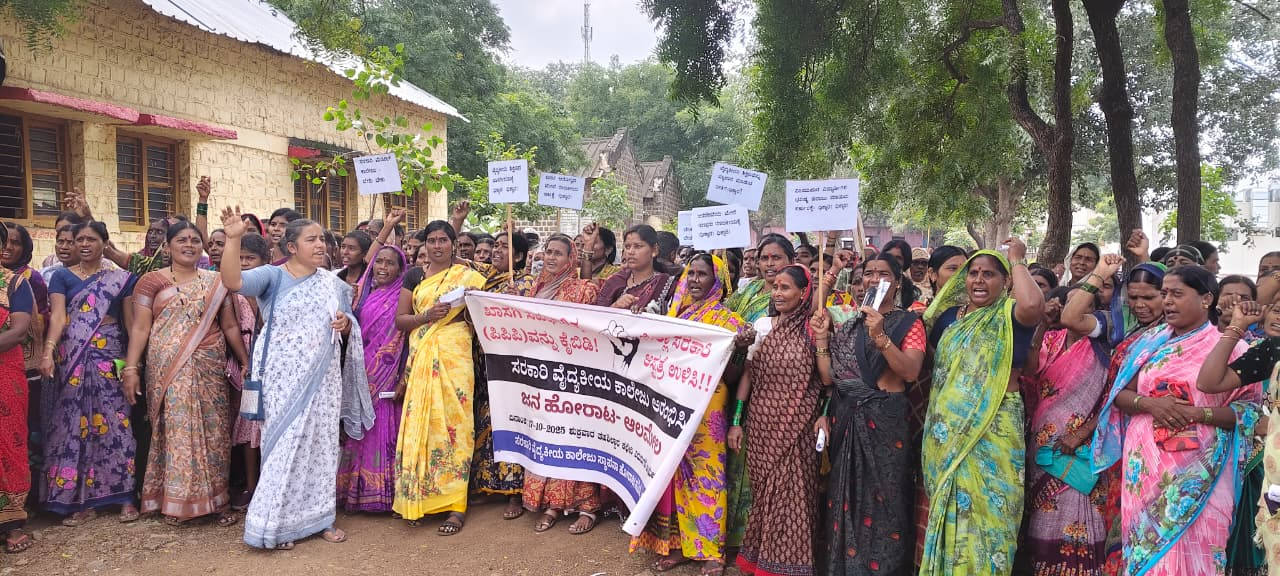
People are Fighting Back
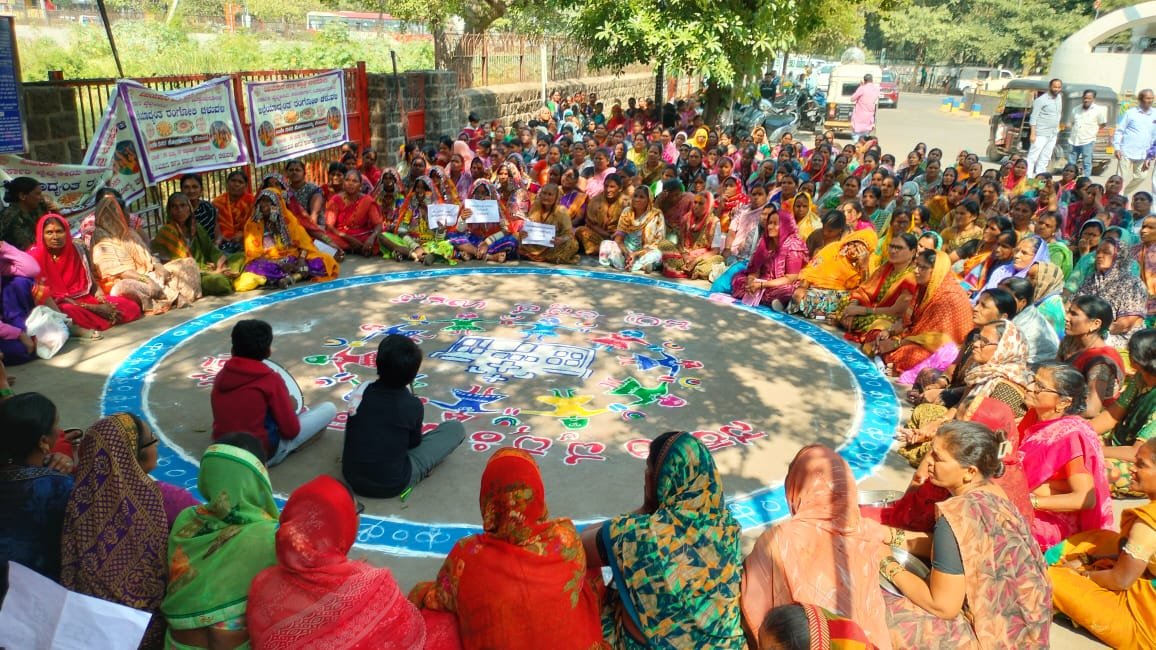
Despite the overwhelming power of state-backed private healthcare actors, resistance is increasing across Karnataka. Communities, unions, doctors and public health advocates are challenging privatisation through multiple methods and protesting. Women are participating in the protests actively and in large numbers. Across districts, health workers’ unions have opposed outsourcing of diagnostics and labs, arguing that contract systems exploit workers while degrading care quality. Activists have also organised around issues like land misuse, denial of emergency care, refusal to treat poor patients, and inflated billing.
These organizations are calling for a shift away from private and insurance-based models toward a rights-based, publicly funded healthcare system. Movements have also demanded recruitment of permanent staff, more public investment, and reversal of PPPs. The argument is simple—healthcare cannot be left to market forces because market logic is incompatible with the principles of equality and justice. These protests signal growing awareness among people of how corporate hospitals benefit from public resources without fulfilling obligations.
Healthcare is a very important aspect of life of all working people of our country, irrespective of whether they work in public sector enterprises or in private enterprises, whether they are permanent workers or contract workers or gig workers. Hence, it is imperative that all working people demand
- strengthening public hospitals,
- reinvesting in health workers well-being, and
- removing corporate players from healthcare.
All workers must continue to assert that healthcare is a right and not a commodity for private profit.