Statement of Kamgar Ekta Committee
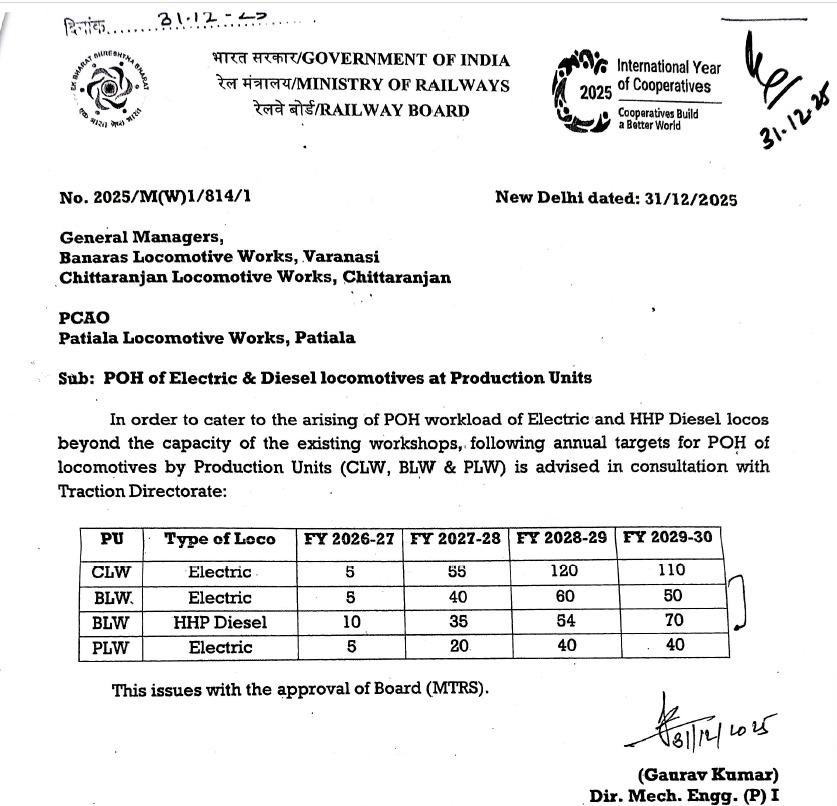
On 31 Dec 2025, the Railway Board issued Circular No. 2025/M(W)1/814/1 (attached) setting annual targets for periodic overhaul (POH) of electric and diesel locomotives for the three production units, Chittaranjan Locomotive Works (CLW), Benares Locomotive Works (BLW) and Patiala Locomotive Works (PLW), for the period 2026-2027 to 2029-2030. Later, on 28 Jan 2026, the BLW Planning Office issued Circular No. M/Gen/03(also attached), based on the above letter of the Railway Board and the Railway Board’s revised locomotive production program for BLW for 2026-2027 only. This circular of BLW Planning Office also gave annual targets for the POH for BLW for the period 2026-2027 to 2029-2030.
CLW was established in 1950 and BLW in 1961 for the specific purpose of indigenously producing locomotives, initially steam engines, then diesel and now electric locomotives. These two production units used to supply the Indian Railways’ entire needs for 5,000 HP, 6,000HP and 9,000 HP and 12,000 HP electric locomotives for both goods and passenger hauling.
Most surprisingly the BLW Planning Office set a target for the production of 600 locomotives for 2026-2027 and NIL production of Locomotives for 2027-2028, 2028-2029 and 2029-2030 at this plant. At the same time, it increased the target for POH of locomotives year by year, for the period 2027-2030.
Similar targets for POH have been set for CLW and PLW. Though there is no official circular regarding curtailing production of locomotives at these plants,, increasing targets for POH must mean a corresponding decrease in the production of locomotives also at both these production units.
It is evident that the purpose of closing production of electric locomotives at the CLW, BLW and PLW is to hand over their production to private players. This must be condemned!
Production units such as BLW, CLW and PLW must continue to manufacture advanced high horsepower locomotives which have been indigenously developed and have served the needs of the Indian Railways all these years.
The Railway Board has justified converting locomotive production units into POH units in its Circular No. 2025/M(W)1/814/1 dated 31.12.2025 by stating that it is “beyond the capacity of existing workshops” to cater to the POH workload of Electric and HPP Diesel Locomotives. On the other hand, it is handing over the POH workshop at Dahod (Western Railway) to private players for loco production. That workshop used to carry out POH of locomotives, but it has been handed over to Siemens, a foreign multinational, for manufacture of 9000 HP electric locomotives, which were already being manufactured by the CLW. It is learnt that the closure of the POH workshop at Parel, Mumbai is under consideration. So, the justification given by the Railway Board is not true. The real reason for cutting production of locomotives at the three production units is to privatise the entire production of locomotives.
Moreover, the POH requires specialised maintenance and repair expertise, which is entirely different from manufacturing processes. Existing workshops dedicated to POH are technically better equipped for it, possessing specialised facilities and people.
The Railway Minister announced in June 2019 that all the production units would be corporatized. The workers understood that corporatization was one step towards privatization and the announcement was met with a massive united protest across all the production units. The workers united under Joint Action Committees and came on the roads with their families in their tens of thousands. Seeing this massive opposition, the Railway Minister had to drop the plans for corporatization.
Similarly in 2023, the privatisation of production of Vanda Bharat trains at integral Coach Factory in Chennai was foiled by the united action of workers. (See the Box for details)
To oppose this latest attack, the workers of CLW, BLW and PLW need to again unite and form Joint Action Committees.
The Railway Board’s attempt to close production at CLW, BLW and PLW is a part of the overall strategy of privatisation which is being pursued all across the Indian Railways. There has been increased outsourcing, employment of contract labour, as well as the surrender of existing posts in the Indian Railways. The railway administration has refused to fill the nearly 2 lakh vacant posts in the safety category alone and the equally large number of vacant posts in the other categories.
The privatisation of the Indian Railways is totally against the interests of the workers of the railways and the crores of working people who use the railways as a lifeline for travel.
Along with privatisation of the Railways, all other public sectors such as electricity, banks, insurance, defence, coal, oil and gas, heath, education etc. are being handed over to Indian and foreign big corporates. Privatisation has the single aim of increasing the wealth of the big corporates who rule this country and who dictate their economic agenda to the ruling governments.
Only the unity of rail workers can halt the privatisation. Indian Railway workers deserve the support of all the working people of the country in the spirit of “An Attack on One is an Attack on All”!
Successful struggle by ICF workers to stop privatisation of production of Vande Bharat trains
In June 2023, the Railway Board entered into a MOU with Titagarh Rail Systems, to manufacture 80 Vande Bharat trains at Integral Coach Factory (ICF) in Chennai in the next 3-5 years and another agreement with the Russian engineering company TMH to manufacture 120 Vande Bharat at Marathwada Rail Coach Factory (MRCF) in Latur.
The agreement with Titagarh was to make 80 Vande Bharat at Rs. 140 crore per train, and the agreement with Russian TMH was to make 120 Vande Bharat for Rs. 120 crores, whereas ICF was making it for Rs.104 crore. These two private companies were given all the design and drawings of VB trains designed by the ICF. They were to be given space in ICF and in MRCF, as well as infrastructure including water, electricity, etc. ICF workers who have the knowhow and skills for manufacturing these trains were to be employed by these companies.
Immediately after the MOU was signed, all the workers of ICF united under a Joint Action Committee which included all the unions of workers and supervisors in ICF. They held demonstrations and gate meetings under the banner of the JAC. The AIFAP organized a national online meeting on December 17th 2023 which was addressed by the General Secretaries of AIRF, NFIR, the Member of Parliament from DMK and the leaders of the Unions at ICF and Kamgar Ekta Committee. The National Coordination Committee for Railwaymen’s Struggle (NCCRS) issued a statement against the handing over of Vande Bharat production to Titagarh dated January 19th 2024. All these united actions and opposition forced the Railway Board to withdraw its proposal.