
Report by correspondent of Workers Unity Movement
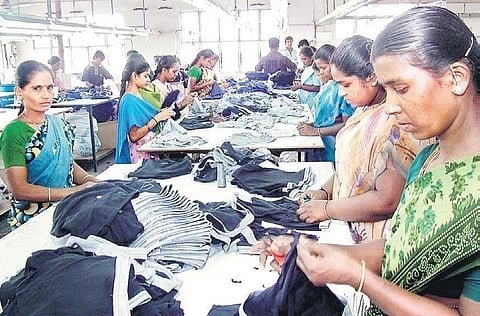
More than hundred workers of Celebrity Fashions Ltd. (CFL) protested outside the Madras Export Processing Zone (MEPZ) in Tambaram on 22 May. They demanded restoration of their jobs and withdrawal of the attacks by the management on their working conditions.
The struggle is being led by the Garment and Fashion Workers Union (GAFWU). Workers Unity Movement (WUM) and other organisations are actively participating in the struggle.
The management of CFL suddenly informed the workers, majority of whom are women, that the transport facility the company had been providing till now, will be stopped. Instead, the workers will be given a monthly travel allowance and will have to make their own arrangements for transport. This announcement has left them devastated.
The women workers daily travel 88 km each way from Chunnampet (near Madurantakam) to the MEPZ Special Economic Zone (SEZ). Highlighting their terrible plight, the protesting workers stated that “Over 100 of us rely on these company-provided buses—a system that has been reliably maintained for more than a decade. Withdrawing this transport is equivalent to retrenchment. It is physically and financially impossible to manage this commute without dedicated transport. Many of us live in remote interior villages and already have to walk a couple of kilometers to reach the company pickup point. For women especially, losing this bus service leaves us incredibly vulnerable, unsafe, and entirely without a support system.” Restoration of the daily transport facility is one of the main demands of the protesting workers.
The workers have also complained that the management has failed to deposit their Provident Fund (PF) and Employee State Insurance (ESI) contributions, despite routinely deducting these amounts from their monthly salaries. They are demanding payment of Provident Fund, Gratuity, Retrenchment Allowances and Leave Encashment, in case some of them are forced to leave their jobs due to the lack of transport.
The workers routinely suffer exploitation and abuse at the workplace. They face threats and intimidation of the management for affiliating themselves with the trade union. CFL and several other garment companies have been systematically downsizing, laying off workers, or transferring them between factories without consulting the workers or their union representatives.
The protest at CFL highlights the condition of workers in the entire garment manufacturing sector in Tamilnadu. According to the General Secretary of the GAFWU, the union has fought for workers’ rights for more than 15 years and has hundreds of CFL employees as its members. Yet, both the company management and government officials refuse to recognize or engage with GAFWU. “They deliberately prolong the conciliation process, leaving workers—who do not even earn a basic minimum wage— to fend for themselves”. GAFWU has declared that it is committed to fight for their dignity and rights.
The Secretary of Penn Thozhilalar Sangam, a women’s trade union, described the extreme vulnerability of the women workers: “The labour laws are insensitive to women workers. They work on the shopfloor for 9-12 hours, travel for 3 to 4 hours a day, besides they have domestic responsibilities. Some of them see their children only on weekends. Children of women workers suffer due to lack of care, and often drop-out or get into small crimes. The women workers from the marginalized communities need more support than cash transfers”.
The GAFWU has demanded that employer-provided transport should be treated as a core, non-negotiable term of employment for long-distance rural commuters, particularly women, under occupational safety frameworks. It has demanded an immediate state labour department investigation into CFL’s payroll records to trace the un-deposited PF and ESI collections. It has called for recognition of GAFWU by the authorities and for enforcement of mandatory conciliation timelines. It has asked for mandatory payment of PF, gratuity and settlements to the workers in case of layoffs or retrenchments. Workers should be covered by insurance paid by the management. The Department of Labour of the government should use the Labour Welfare Fund as a support to the vulnerable women workers, they have demanded.
The union has pointed out that companies violating workers’ social security payments should be penalised strictly and not given subsidies and financial incentives.
The struggle of the CFL workers is an important step in the struggle of garment workers and other workers on temporary contracts, for their rights as workers.