
Report of Kamgar Ekta Committee correspondent

Newly recruited loco running staff (assistant loco pilots) in the Indian Railways have been sent to various stations for road learning, a crucial phase of their training. However, even before the training begins, these employees are facing conditions that not only violate their dignity but also raise serious questions about the railway’s safety system.
According to reports, the railway administration failed to provide adequate accommodation and rest facilities for the large number of new running staff arriving at the JNPT station area for road training. As a result, many employees were forced to sleep on the floor in parks and open fields at night. Photos circulating on social media showed dozens of employees resting under the open sky.
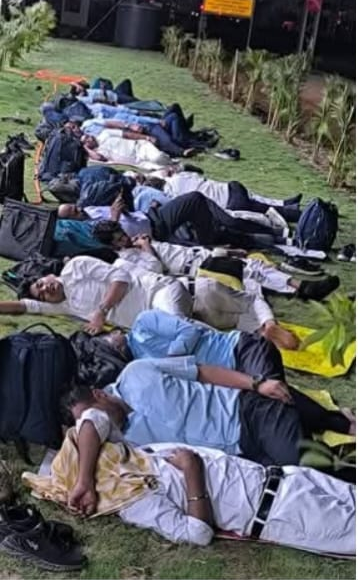
The number of workers was already known, but no preparations were made
This situation did not arise suddenly. The number of employees selected and sent for training was already known to the railway administration. Despite this, no additional running rooms were arranged, nor were temporary housing, dormitories, or other alternative arrangements made.
Experts believe that before any major training program, the relevant divisional administration should develop a detailed plan, prioritizing basic needs such as housing, food, transportation, and rest. However, in this case, the new employees directly suffered the consequences of administrative negligence.
What will a tired employee learn about safe operations?
Loco running staff are considered the most important pillar of railway safety. The safety of millions of passengers and goods worth crores of rupees rests in their hands. Therefore, if trained staff are not provided with adequate rest, proper accommodation, and a respectful environment, how can they be expected to maintain a high-level training and safety culture?
Railway safety experts say that fatigue, mental stress, and chaotic living conditions pose serious risks to any safety-sensitive job. When employees struggle to access basic amenities even during training, their morale and efficiency are bound to be adversely affected.
Question on Railway’s housing policy
This incident also highlights the shortcomings of the Railway’s housing and training management system. While the Railways tout modern technology, high-speed corridors, and safety upgrades, its new employees are deprived of basic amenities like housing and rest.
The question also arises that if the Railways does not have adequate accommodation for its training staff, then why has a long-term and systematic solution not been developed for the staff sent to out stations?
Anger among employees
It has been reported that this incident has caused widespread resentment among running staff organizations and employees. They argue that the railway administration should view employees not merely as human resources but as the backbone of the security system. It is the administration’s responsibility to provide a respectful environment, adequate rest, and necessary amenities to the employees undergoing training.
Urgent reform needed
The railway administration should learn from this incident and take concrete steps to prevent such situations from recurring. Advance planning, provision of additional accommodation, expansion of running room capacity, and provision of alternative resting places should be ensured for the number of employees being sent for training.
Safe train operations depend not only on modern engines and technology, but also on trained, healthy, and respectful working conditions for its employees. If the Railways cannot provide even basic amenities to its future loco pilots, it is not only an administrative failure but also a serious concern regarding its approach to safety.