
By Gig and Platform Service Workers Union (GIPSWU)
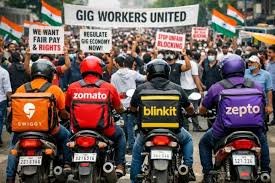
Background note by the Kamgar Ekta Committee Team:The 114th international Labour Conference, held by International Labour Organization (ILO) concluded on 12 June with the adoption of the first international labour standards aimed at improving working conditions for millions of people who earn their living through digital labour platforms. The new Convention on Decent Work in the Platform Economy calls on Member States to ensure that digital platform workers enjoy fundamental rights at work, including freedom of association and collective bargaining, protection from discrimination, child labour and forced labour, and the right to a safe and healthy working environment.
Platform workers are being told to welcome a historic breakthrough. But from the workers’ side, this moment feels far more like a warning than a victory. After years of organizing, strikes, testimonies, and demands from platform workers across the world, what has emerged is not the transformation workers fought for, but a compromised text that still leaves too much power with platforms, too much discretion with governments, and too little that will immediately change the lives of ordinary workers.
The Convention acknowledges that the platform economy has serious decent work deficits. It recognizes unsafe work, algorithmic control, inadequate protections, problems of classification, weak social security access, unfair pay practices, arbitrary deactivation, and the cross-border nature of digital labour platforms. But recognition is not justice. Naming exploitation is not the same as ending it.
Platform companies are already organized globally. Their business models, capital, investors, data systems, and algorithmic controls operate across borders, while workers are forced to struggle country by country, law by law, and case by case. In this reality, a convention that does not establish strong, enforceable rights in unmistakable terms will not bring substantial change in the lives of workers. Without binding global standards, companies will continue to shift responsibility, exploit legal gaps, and play one jurisdiction against another while workers remain trapped in low pay, insecurity, surveillance, and silence.
This is why many workers see the outcome as deeply inadequate. The Convention allows exclusions for certain categories of platforms or workers, leaves key protections to national law and practice, and depends heavily on future ratification, implementation, and enforcement by states. Workers know what that means in practice: delay, dilution, and loopholes.
The text speaks of fair payment, but it does not guarantee a universal living wage floor for all platform workers. It addresses social security, but only according to workers’ classification, which is exactly where platforms have historically escaped responsibility by misclassifying workers. It speaks of algorithmic transparency and review, yet it still leaves workers vulnerable to opaque systems that decide who gets work, who gets punished, and who gets removed from the app.
Workers did not fight simply for better language. They fought for power, bargaining rights, protection from retaliation, full recognition as workers, employer accountability, and real remedies when rights are violated. A framework that still permits exclusions, postpones justice to national processes, and softens employer obligations cannot be presented as a complete achievement for the working class.
We reject any attempt by governments, international institutions, or platform companies to package this as a finished victory. For workers on the ground, there is no victory where wages remain unstable, costs are pushed onto labour, social protection is uncertain, and deactivation can still destroy a livelihood overnight. There is no victory where workers are recognized in principle but denied justice in practice.
GIPSWU therefore insists that this Convention must be treated as a floor for continued struggle, not as the end of it. Governments must ratify it quickly, close every exclusion, enact stronger national laws, and ensure full enforcement through labour inspection, collective bargaining rights, social security, wage protection, data rights, and safeguards against arbitrary suspension and termination. Platform workers need more than symbolic recognition. They need enforceable rights, global accountability, and a system that puts human dignity above digital exploitation.
Nirmal Gorana
National Coordinator
Gig & Platform Service Workers Union (GIPSWU)