
By Alavandar Venu Madhav, General Secretary, Singareni Retired Employees Welfare Association, Hyderabad
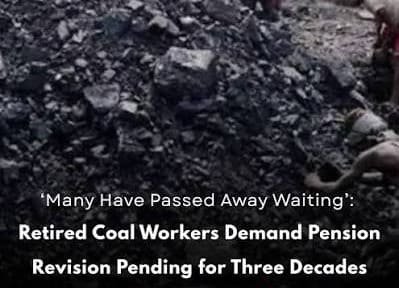
The coal industry is one of the sectors that has served as the backbone of India’s industrial development. A major share of the country’s electricity generation still depends on coal. It is the hard work, sacrifice, and dedication of mine workers who extract coal from deep underground that keeps the nation’s economy moving forward. To provide a dignified life after retirement for workers who have served for decades in this difficult and dangerous profession, the Coal Mines Pension Scheme (CMPS) was introduced.
However, a key provision in this scheme is increasingly being seen as causing serious injustice to thousands of workers. Because only a maximum of 30 years of pensionable service is taken into account in pension calculation, employees who have served for 35, 38, or 40 years receive no benefit for their additional years of service. As a result, an employee who worked for 30 years and one who worked for 40 years receive almost the same pension.
This is not merely a matter of numbers. It is an issue related to the value given to labour, experience, and dedication. For a worker to serve an additional ten years, he must endure greater physical strain, more health risks, and more mental stress. Every year of work in the mines is valuable. The lack of recognition for such additional service in pension benefits goes against the principles of natural justice.
Thousands of employees in coal mines, including Singareni and subsidiaries of Coal India, have served for 35 to 40 years. These employees provided organizations with experience, productivity, and stability. They trained new employees. Even in dangerous conditions, they kept the organization running. Yet, it is painful that their additional service receives no financial recognition at the time of retirement.
Let us imagine this once. Two employees are working for the same salary. One retires after 30 years of service. Another retires after serving 40 years in the same organization. Normally, the second employee should receive a higher pension. But under the current rules, both receive almost the same pension. That means the additional 10 years of service are valued at zero.
This situation also sends the wrong message to younger employees. The feeling that “no matter how much more you work, there will be no additional benefit” can undermine commitment among workers. An employee works with greater dedication only when there is confidence that hard work will be rewarded appropriately.
Another important point is that coal mine work is not like an ordinary office job. Workers have to work underground amid high temperatures, dust, air pollution, and dangers. Health problems such as lung diseases, back pain, joint problems, and hearing loss are more common among mine workers. In such harsh conditions, every additional year of work deserves special recognition.
Internationally too, many countries have policies that provide additional pension benefits or special benefits to employees who have served for long periods. In our country as well, many pension schemes increase benefits in proportion to the length of service. However, the continuation of the 30-year limit in the Coal Mines Pension Scheme needs to be reviewed in line with changing times.
In this context, the Central Government, the Ministry of Coal, the Coal Mines Provident Fund Organisation (CMPFO), managements, and recognized trade unions must work together to find a permanent solution to this problem. Alternatives such as removing the 30-year limit or providing an additional pension percentage for every extra year of service after 30 years should be considered. Steps should also be taken to ensure justice for retired workers who have already completed long years of service.
Worker welfare does not mean only paying wages while they are employed. It is equally important to give due respect for the service rendered throughout their lives. Giving the same pension to a worker who produced coal for the nation for four decades and kept the wheels of industry turning as to an employee who served for only three decades goes against the spirit of social justice.
The principle of “more service – more recognition” should be the lifeblood of every welfare scheme. Only when the Coal Mines Pension Scheme also changes in that direction will thousands of mine workers truly feel secure in their lives. Solving this problem today is not just about increasing pensions; it is about honouring the labour of a worker who dedicated his life to nation-building.