
Report by Mazdoor Ekta Committee correspondent

Latur bank workers’ agitation on 27 January 2026 (file photo)
On 23 August, around 800,000 bank employees across the country, under the leadership of the United Forum of Bank Unions (UFBU), announced a major agitation over their long-pending and legitimate demands.
The nationwide agitation will begin on 24 August and culminate in an indefinite strike from 26 October. The protests will take place in the following stages:
- Employees will take steps such as leaving official WhatsApp groups and working only during designated working hours.
- A one-day nationwide strike on 11 September 2026.
- A three-day nationwide strike from 28 to 30 September 2026.
- An indefinite strike beginning 26 October 2026.
The unions said that the government has been ignoring their demands for a long time.
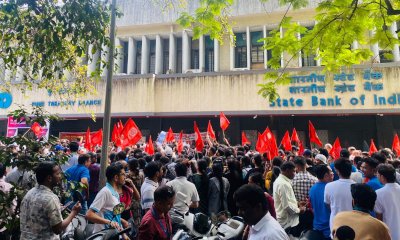
Pune bank workers’ agitation on 27 January 2026 (file photo)
The UFBU comprises seven bank employees’ unions: the All India Bank Employees’ Association, All India Bank Officers’ Confederation, National Confederation of Bank Employees, All India Bank Officers’ Association, Bank Employees Federation of India, Indian National Bank Employees Federation, and Indian National Bank Officers Congress.
The main demands of bank employees are:
1. Implementation of a Five-Day Work Week
Bank unions have been demanding a five-day work week in the banking sector for the past 15 years. An agreement has already been reached on this issue between bank employees’ unions and the Indian Banks’ Association, the organization representing bank management. However, it has not been implemented because government approval is still pending.
2. Withdrawal of the Performance-Linked Incentive (PLI) Scheme
Employees are demanding the withdrawal of the PLI scheme.
The unions argue that banking is a collective activity involving teamwork, whereas the new system places emphasis on individual performance, thereby encouraging favoritism and discrimination. They also fear that the pressure to meet individual targets indiscriminately could lead to inappropriate lending practices and increase risks to the banking system.