
Letter by Shri E A S Sarma, Former Secretary to Government of India to the Union Finance Minister
To:
Smt Nirmala Sitharaman
Union Finance Minister
Dear Smt Sitharaman,
I refer to my earlier letter of October 15, 2026, addressed to you, raising legal, financial and ethical concerns about the proposed sale of the Centre’s stake of up to 30.48% and LIC’s stake of up to 30.24% in IDBI Bank to Fairfax, a Canadian company, for Rs 52,878 crore. The transaction would leave the Centre with a residual shareholding of 15% and LIC with 19%.
Read my earlier letter on the proposed IDBI disinvestment.
Subsequently, in a letter dated October 18, 2026, I appealed to the President, reiterating my concerns, particularly about the highly opaque process of inviting financial bids for IDBI’s equity. The process gave the impression that it was designed to hasten the sale at the cost of financial prudence and transparency.
Read my appeal to the President.
In that letter, I appealed to the President to order an independent enquiry into the legality and prudence of disinvesting IDBI and to place its findings before Parliament for discussion, covering not only IDBI’s disinvestment but also the desirability of disinvesting other Central Public Sector Enterprises (CPSEs). Pending such an enquiry, I demanded that the government keep in abeyance its decision to transfer IDBI’s ownership and management control to Fairfax.
In principle, it is fallacious for the government to justify the disinvestment of public assets in the name of improving their management or raising additional fiscal resources. It is all the more objectionable to hand over public assets to a foreign entity, as is proposed in the case of IDBI.
It is laughable that the government should have no trust in itself or in LIC to manage IDBI, but should instead trust a foreign firm like Fairfax, which repatriates profits earned from public deposits and public investment in India to Canada.
Questions over the valuation and bidding process
Please recall the highly convoluted press release issued by DIPAM on October 14, 2026, to justify the selection of Fairfax as the successful bidder for the government’s and LIC’s equity. In my letter to the President, I raised the following concerns:
DIPAM’s experts would have arrived at the benchmark reserve price of Rs 94.42 per share, on the basis of which DIPAM called for financial bids in January 2026, as the best indicator of the bank’s true net worth. Offers from the two foreign agencies, to which the bidding process became restricted, fell short of that reserve price.
At that stage, considering that there was insufficient competition and the bid offers did not match IDBI’s net worth, the government ought to have opened the bidding process to a wider set of bidders, including other public sector banks. Instead, the government resorted to other valuation methods in a highly contrived manner to justify a reserve price 19.5% lower than the earlier one.
The Canadian bidder subsequently offered Rs 81 per share, on the basis of which the government hastily finalised the sale of an aggregate 60.72% of IDBI’s equity to that bidder.
It is not clear whether the government properly assessed IDBI’s net worth or factored in the potential value of its land assets.
For example, IDBI owns a property of more than 50 acres in a highly developed area of Hyderabad. A recent auction conducted by the Telangana state government indicated a market value of Rs 269 crore per acre. On that basis, IDBI’s Hyderabad landholding alone should be valued at Rs 13,450 crore. If its other urban properties were valued similarly, the total value of its land assets could be phenomenally high, far exceeding the approved bid value of Rs 52,878 crore.
More recently, an investigative report by Business World revealed internal DIPAM notings about the decisions taken following the aborted bids of January 2026. That report has fully corroborated my contention.
Read the Business World investigation into the IDBI–Fairfax deal.
It is ironic that, instead of exercising prudence and reviewing the Cabinet Committee on Economic Affairs (CCEA) decision on disinvestment, the government issued another press release on October 29, 2026, attempting to justify the decision already taken. The justification is as convoluted as the earlier one.
Read the government’s October 29 press release.
For example, the press release states:
“The press note dated 14.10.2026 clearly explains that there is no a priori benchmark for bidding. The bidders do their own valuation and submit their bids in a confidential manner. Independent agencies are hired to do a fair valuation of the enterprise contemporaneously, which is then used as a comparator to assess the reasonableness of the bids submitted. The bid discovered price and the comparative valuation can, therefore, be above or below each other.
“To handle this situation, provision is ex ante built into Para 5.3.6(iii) of the RFP: ‘In the event the Financial Bid of the Highest Bidder is lower than the reserve price, the GoI will decide the further course of action and the QIPs shall not subsequently question any decision taken by the GoI in this regard’.”
The intention underlying Para 5.3.6 of the Request for Proposal (RFP) does not give DIPAM a licence to adopt a procedure that runs counter to the public interest. Had DIPAM and the government properly assessed IDBI’s true value and sought to ensure that the sale of the government’s and LIC’s equity yielded optimal proceeds, they ought to have revoked the auction proceedings when the bids fell short of the reserve price of Rs 94.42 per share.
They should have widened the field of competition and invited fresh bids, not only from the shortlisted bidders but also from public sector financial institutions such as SBI, to ensure more accurate price discovery.
In this connection, I may mention that the Supreme Court, in a similar matter, recently observed that public bodies may scrap auctions to obtain a better price for public assets, and that such a decision is “neither arbitrary nor unreasonable when guided by public interest and transparency”.
Read the report on the Supreme Court’s observation.
IDBI’s land assets and financial performance
The Request for Qualification (RFQ) issued by DIPAM for IDBI in September 2023 was comprehensive in its valuation methodology, as set out in Para 3.1. In particular, it stipulated that IDBI’s land assets should be valued at prevailing market prices.
It should be remembered that IDBI has 120 properties across seven cities: 68 properties in Mumbai, 20 in Pune, nine in Chennai, seven in Ahmedabad, six in Kolkata, and five each in Delhi and Hyderabad. As noted above, the 50-acre landholding in Hyderabad alone has a market value of more than Rs 13,450 crore. This gives an indication of the potential value of IDBI’s other properties. The cumulative value of all these properties could far exceed the Rs 52,878 crore offered by Fairfax.
The RFQ was issued in September 2023 and comprehensively set out the valuation methodology. More than two years have passed since then. When DIPAM fixed the reserve price at Rs 94.42 per share in January 2026, it was reasonable to infer that DIPAM had followed its own guidelines and arrived at that benchmark as the best indicator of IDBI’s value.
To disregard that reserve price as soon as Fairfax offered a lower bid raises serious concerns about the propriety of the transaction.
For the government and DIPAM to assume that the reserve price of Rs 94.42 per share did not reflect IDBI’s true value is far too simplistic. IDBI’s overall performance has improved significantly over the years, and its profits have increased.
IDBI’s profits rose from Rs 2,439 crore in 2021–22 to Rs 9,513 crore in 2025–26. Its profits over the last five years totalled Rs 28,746 crore, equivalent to 54% of the proceeds from the proposed Fairfax transaction.
Similarly, IDBI’s earnings per share increased from Rs 2.36 in 2021–22 to Rs 8.57 in 2025–26, a 3.63-fold increase.
I have also compared IDBI’s average share prices over different periods in the following chart.
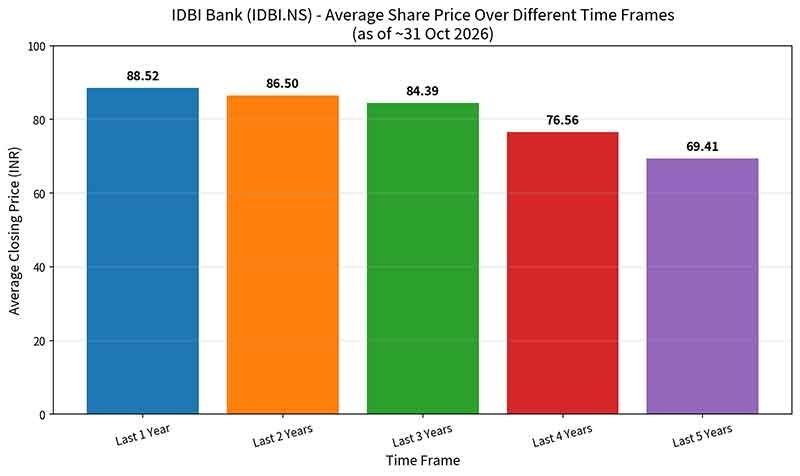
IDBI’s shares have been trading at progressively higher average prices year after year. The average share price in 2025–26 was Rs 88.52, and it is likely to improve further over time. If volume-weighted average share prices are considered, the increases would be even greater. Even compared with the 2025–26 average share price, the transaction price of Rs 81 per share is significantly lower.
These comparisons show that the government’s and DIPAM’s approach to selling IDBI’s equity is conceptually faulty. The social cost of transferring control of IDBI to a foreign firm is far greater than the perceived social benefit.
As a development financing institution, IDBI can play a more effective role in promoting societal welfare than as a company controlled by a foreign entity. There are also serious legal objections to the proposed sale of a majority stake to Fairfax, which I have addressed in my earlier letters to you and, more recently, in my appeal to the President.
The risks of transferring public assets to private control
How misguided and imprudent the government’s and DIPAM’s decision on IDBI disinvestment is can be illustrated by the experience of ArcelorMittal in South Africa. The private steel company’s handling of a large steel mill there has threatened large-scale job losses and economic distress. South Africa’s state-backed Industrial Development Corporation has agreed to bail out the struggling mill with a $607 million financial assistance package.
Read more about South Africa’s state-backed rescue effort.
This illustrates two points: private managers of public assets can let a government down, while a state-backed development finance institution, if adequately empowered and encouraged, can help a government manage public assets in a manner that delivers greater social benefits.
The revelations in the Business World investigation suggest that DIPAM came under intense pressure to hasten the sale of the government’s and LIC’s equity in IDBI to provide fiscal relief to the government. If that was the case, the manner in which the government concluded the disinvestment becomes all the more imprudent, as the proceeds from Fairfax are negligible compared with the government’s annual revenue receipts.
Considering that the average effective tax rate paid by companies earning annual profits of more than Rs 500 crore is only 18.85%, compared with 23.68% for companies earning profits of less than Rs 1 crore, the Finance Ministry could readily raise additional fiscal resources by increasing the average effective tax rate applicable to large private corporations. This would be in line with thinking at the global level.
Read the UNRISD working paper on corporate taxation and the G20.
The additional fiscal resources raised in this manner could far exceed the marginal resources obtained through the disinvestment of CPSEs.
Possible conflict of interest raises further concerns
I have just come across another revelation in an investigative report by Business World. It indicates that an LIC director sat on the board of a Fairfax subsidiary while LIC was selling IDBI to Fairfax. This raises concerns about a possible conflict of interest that undermines the credibility of the disinvestment process.
The report shows how clumsily DIPAM has handled the entire process of selling IDBI’s equity. It is possible that further revelations remain to emerge.
Read the Business World report on the LIC director and Fairfax subsidiary.
Demand for an independent enquiry
In view of the issues set out above, I demand that an independent enquiry be instituted into the IDBI disinvestment process and that its findings be placed before Parliament and the public. This would enable a meaningful discussion of the government’s approach to the disinvestment of IDBI in particular and CPSEs in general.
Pending such an enquiry, I demand that the ongoing disinvestment of IDBI be kept in abeyance.
Yours sincerely,
E.A.S. Sarma
Former Secretary to the Government of India
Visakhapatnam