
An article by a loco pilot of India Railways and its abstract by Kamgar Ekta Committee correspondent
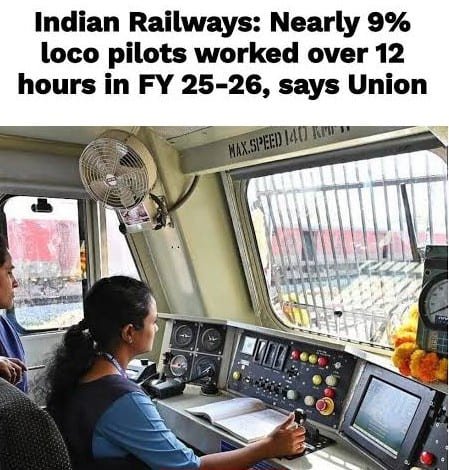
Every day crores of working people use Indian Railways for travel. Similarly huge portion of in-land goods transport is done by Indian Railways. That is why Indian railways is called life line of our country.
Hence, safe travel conditions must be one of the topmost priorities for all of us. Unfortunately, that is clearly not the priority of the Central Government. That is why, Central government is least bothered about huge vacancies which exist in all the operating department workforce of Indian Railways like Loco-pilots, Track Maintainers, Train Managers (Guards), Station Managers (Station Masters), S&T staff, Train Controllers, Pointsmen, etc. Vacancies in many divisions of Indian Railways are as high as 25%!
Such huge vacancies result in excessive work load on the existing workforce. Excessive work load adversely impacts concentration of workers while carrying out their duty. Loco pilots of Indian Railways have repeatedly drawn attention towards it. We are giving below, an article written by a loco-pilot, an active member of All India Loco Running Staff Association (AILRSA), which give detailed account of their problems but he wishes to be anonymous due to fear of victimization by Indian Railways.
The well researched article vividly brings out as to how duty hours of loco-pilots have been viewed by various Central Government appointed committees right from 1947!
We urge you to go through the article since it highlights following important aspects which adversely impact concentration of loco-pilots and hence travel safety :
- One High Power Committee (HPC) report quotes various studies conducted by RDSO, NASA etc. and mentions that time period from 2 a.m. to 6 a.m. is a Window of Circadian Low (WOCL), a time window during which human body very naturally gets ready for sleep and hence reduced overall concentration
- During October-November 2020, a team of Railway doctors conducted a study of 100 loco-pilots and 100 other railway workers doing stationary duty, to compare degree of stress and its causes. As compared to 4% doing stationary duty 57% loco-pilots were found to be under medium stress level.
- Most of the causes creating stress for loco-pilots noted which were revealed during the study are directly linked to issues like very long duty hours, absence of proper sitting arrangement, noisy cabins, lack of toilet facility in locomotives, very long stay away from family. All these issues loco-pilots have been raising since last many decades!
- HPC study recommended that for goods train loco-pilots, 5.5 running hours night duty should be considered as 8 running hours day duty
- An analysis of 100 accidents or near accidents revealed that lack of alertness was most important contributor
- HPC also pointed out that SNCF of France have mentioned that loco-pilots should not be assigned more than maximum 2 continuous night shifts. It also mentions that Federal Railroad Administration of USA states that any loco-pilot who is assigned duty starting any time from 8 p.m. to 4 a.m. should be given 24 hours rest at HQ before next duty.
- HPC analyzed 3 major accidents and found that continuous night duty was assigned to loco-pilots for many nights.
- HPC recommended to restrict continuous night duties to a maximum of 2 nights.
(English translation of Hindi article)
Continuous night shift work: fatigue, watchfulness, and the issue of railway safety
A night duty, a question
Recently, at Prayagraj Junction between 1:30 and 2:00 in the night, I had to take charge of a mail or express train. The shunting loco pilot working there looked very tired and sick. When I asked about his health, he told me that this was his fourth consecutive night duty.
Fatigue was clearly visible on his face. I asked if he was feeling sleepy or experiencing micro-sleep. He said that while fatigue was visible on his face, he was not feeling sleepy. He also mentioned that the crew lobby in-charge at Prayagraj seemed only focused on catching micro-sleep cases, which made the staff too scared to sleep. He stated that despite trying hard to stay awake, micro-sleep can still happen. Citing staff shortages and constant monitoring by the Railway Board, he said that he was bound to work four-night shifts.
I gave him my compiled rules related to night duty, telling him to read them and raise his demands strongly.
This incident raised an important question: Is feeling sleepy or experiencing micro-sleep at night just the personal fault of the employee, or is it also related to the body’s biological clock, continuous wakefulness, and duty-rest arrangements?
Biological impact of staying awake at night
The risk of night duty is not limited to physical tiredness from hard work. Staying awake at night also goes against the body’s natural sleep-wake cycle. This can affect physical and mental energy, alertness, and work capacity.
The high-power committee (HPC) report mentions research by RDSO, NASA, and other institutions on sleep, the body’s daily biological clock, and night alertness. The report refers to the time between 2:00 AM and 6:00 AM as the Window of Circadian Low (WOCL), which is the time when the body naturally prepares for sleep and performance may drop.
Therefore, when observing sleep or micro-sleep during night duty, it is necessary to understand not just the employee’s face or behavior, but also the duty timings, consecutive working nights, received rest, and the impact of the biological clock.
Medical study of loco pilots recorded in the HPC report
Pages 62 to 64 of the HPC report contain details of a study conducted on the stress of railway loco pilots and its causes. A team of railway doctors conducted this study in October and November 2010. Dr. Sumit Prakash, Senior Divisional Medical Officer and Psychiatrist at the Central Hospital in Bilaspur, led the team. The study took place under the guidance of the Chief Medical Director of South East Central Railway in Bilaspur and the Director General of Railway Health Services in New Delhi. Dr. S. K. Agarwal, Chief Medical Director of North Eastern Railway in Gorakhpur, sent its report to the HPC chairman via a letter dated January 27, 2012.
The study included 200 employees, consisting of 100 loco pilots and 100 stationary duty staff such as station managers, station superintendents, and station masters. The participants were between 26 and 50 years old, with the 31 to 40 age group being the most common. Among the loco pilots, 91% were married.
According to the study, psychological stress among loco pilots was mainly related to work demands. Moderate stress levels were found in 57% of loco pilots and mild stress in 42%. In comparison, among stationary duty staff, 4% had moderate stress and 96% had mild stress.
Major causes of increased stress and their percentages:
- Uncomfortable seating posture and limited workspace – 96%
- Noisy workplace – 95%
- Long duty hours, inadequate rest, and dissatisfaction with space and services at mid-journey rest places – 88%
- Fear of accidents due to fatigue, exhaustion, and sleepiness caused by work stress – 83%
- Absence of toilets despite working for long hours while being responsible for thousands of lives – 75%
- Serious consequences of making a mistake on duty – 71%
- Staying away from home and city for a long time and failing to balance work and home life – 71%
- Inadequate protection from extreme temperatures and rain – 70%
Medical effects recorded in the study:
- Impairment in sexual functions – 67%
- Muscle pain – 65%
- Sleep problems – 60%
- Headaches – 44%
- Stomach issues – 39%
- Irritability and anger – 30%
- Frustration and anxiety – 18%
The report concluded that stress builds up among Indian Railways loco pilots due to conditions at the workplace, duty hours, and mid-journey rest places. Part of this stress can be reduced by improving these conditions. This study focused on loco pilots, whereas the employee in the Prayagraj incident was a shunting loco pilot. Instead of treating both as part of the same study, they should be viewed as separate contexts related to night duty and fatigue.
HPC discussion on night duty and RDSO studies
The HPC noted that railway operations depend largely on the work of employees. Therefore, the alertness and watchfulness of employees on duty are crucial for the safety of train operations. The round-the-clock working nature of railways makes night duty inevitable.
According to the report, Justice Rajadhyaksha in his 1947 decision fixed a limit of six consecutive night duties for Indian Railways running staff. Justice Miyabhoy’s railway labor tribunal decision from 1969 to 1972 also did not change the limit for consecutive night duties.
The Railway Accident Inquiry Committee of 1978 recommended in item number 60 of its report that RDSO study the effects of day and night duties, especially fatigue levels. RDSO published three reports on this topic:
- Psycho Technology on Indian Railways, Report Number 76-80-8, September 1980
- Laying down limits of duty hours of Running and Station staff for night working, Experimental Study, Report Number 83-83.1, March 1983
- A study on duty hours of Running and Station staff for night working, Report Number 89-84.3, September 1984
The high-power committee report outlined the findings of these studies as follows:
- A study on stress or fatigue caused by speed and duty hours among mail and express drivers was ongoing. The initial two phases found that drivers experience the highest stress and lowest mental alertness from midnight to early morning hours. Working a second consecutive night further decreases alertness and increases the risk of operational errors.
- During night duty, drivers experience specific losses in activity and physical fatigue. The report linked this to the less-arousing effect of night shifts. The study did not show as much decrease in motivation levels as it did in the other two dimensions.
- Factors such as motivation, a sense of personal safety, and experience can somewhat reduce the impact of the body’s daily rhythm. The report also suggested that night allowances help maintain motivation.
- During the night shift time block from 00:00 to 06:00, the brain activity of freight train drivers showed a clear slowdown after 5 and a half hours of running duty.
- Decreases in psycho-motor tasks, increases in fatigue experiences, and heightened symptoms were observed in drivers during night duty. Freight train drivers showed reductions in cognitive tasks along with psycho-motor coordination. Station masters did not show such a decline in psycho-motor coordination, although they reported higher symptoms of fatigue.
- The 1984 study did not state a need to reduce night duty hours for mail and express drivers and assistant station masters, but highlighted the need for adequate restorative rest and sufficient sleep after night shifts. The report also mentioned that taking sleep at scheduled times may not be possible with shift duties and abnormal working hours.
- The study gave a temporary estimate equating 5 and a half hours of night running duty or a total of 72 hours of duty—with a maximum of two hours of waiting duty—for freight drivers to be equal to 8 hours of day running duty or a total of 10 hours of duty. It stated that experiments need to be repeated on selected sections with heavier traffic and faster operations for broader conclusions.
The HPC commented that while RDSO recorded problems and findings related to night work in the 1980s, including the aspect of night allowances and motivation somewhat downplayed this serious issue. The committee also noted that despite the recommendation for further study in the 1984 report, such a study was reportedly never conducted. There are no specific recommendations visible for restorative rest to reduce fatigue caused by irregular night duty. According to the HPC, no serious effort has been made to reduce the stress of continuous night work on running staff since Justice Rajadhyaksha’s decision.
Sleep and the biological clock in NASA and other research
The HPC also reviewed the report of the committee chaired by Dr. Nasim Zaidi on civil aviation duty hours, NASA reports, and other research material. From these, the report recorded the following points:
- Sleep is a fundamental biological requirement for the body. It is necessary for alertness, work capacity, mood, and overall health. The report stated that an average of 8 hours of sleep in 24 hours is suitable for performance and physical alertness. A sleep loss of even two hours can create acute sleep debt, which affects subsequent alertness and work capacity. Sleep debt accumulates over several days and can only be recovered through sleep.
- The human brain has a biological clock that controls the 24-hour cycle of body functions. It influences many physical, mental, and behavioral functions along with the sleep-wake cycle.
- Body temperature, hormone secretion, digestion, physical and mental performance, and mood change regularly at different times of the day.
- The body’s daily rhythm is normally designed for waking during the day and sleeping at night.
- The time from 02:00 to 06:00 is described as a period when the body prepares for sleep and performance drops. The report calls this the Window of Circadian Low.
- Changes in timing within the daily biological rhythm do not adjust quickly; therefore, planning times and shifts is crucial in round-the-clock work.
- A study by Finland’s Brain Work Laboratories described the work of train drivers and rail traffic controllers as requiring high mental focus. Technology increases the need for attention and information processing while the work can sometimes be monotonous. Drivers must pay attention to speed, acceleration, changing forces, terrain ahead, signals, and communication.
- Railway transportation shifts are often irregular. They may include early morning shifts and short rest periods between shifts. If a driver does not sleep at home, sleep conditions between consecutive shifts can deteriorate.
- Better sleep for safety-critical employees and more humane shift planning are stated to be essential.
- While completely avoiding night and early morning shifts may not be possible, fatigue can be reduced by altering shift lengths, rest time between shifts, and shift combinations.
- An analysis of over 100 accidents and near-misses identified a lack of alertness as the single most important contributor.
- According to the Finnish report, about a quarter of Swedish train drivers reported persistent fatigue at least once a week. Excessive fatigue was found to be highest during night and early morning shifts.
- The report stated that sleeping during the day does not fully compensate for night sleep requirements. Continuous night work can accumulate sleep debt. This can affect decision-making, judgment, memory, concentration, learning ability, physical coordination, and reaction time. The report also listed effects such as increased risks of anxiety, depression, other emotional problems, obesity, diabetes, high blood pressure, and heart disease.
- According to the Finnish study, the risk of severe sleepiness during night shifts was found to be 6 to 14 times higher than during day shifts, while during morning shifts this risk was double that of day shifts. Each extra hour of core sleep reduced the risk of severe sleepiness by 15 percent.
- The Swedish TRAIN project report stated that even though drivers may be satisfied with their jobs, working hours and physical working conditions—such as noise, vibration, inadequate maintenance, and poor cab environments—remain problems. Working hours interfere with social life and cause sleep and fatigue problems. Sleeping during the day after a night shift can lead to poor recovery and higher sleep debt. The report emphasized keeping schedules as regular as possible, limiting them to a maximum of 9 hours, and providing at least 24 hours of extra rest after a night shift.
From these studies, the HPC drew three main conclusions: daytime sleep does not fully make up for lost night sleep; continuous night duty can accumulate partial sleep loss; and this accumulated loss can cause stress, slow reactions, reduced alertness, and sleepiness during duty. The report considered this an issue linked to safety, employee health, family life, and social life.
The HPC noted that some foreign railway systems limit continuous night duty to two to four nights, followed by mandatory long rest at home. The report cited examples of Germany’s database system allowing a maximum of four consecutive nights, or five with mutual agreement, and France’s system allowing a maximum of two consecutive nights. Regarding the Federal Railroad Administration in the United States, the report mentioned 24 hours of rest at headquarters after duties starting between 8 PM and 4 AM. In Indian civil aviation, a maximum of two consecutive nights is mentioned for passenger flights and freight flights, with provisions for further reduction for duties falling within the WOCL.
High-power committee analysis of signal passing at danger cases
The HPC studied 147 Signal Passing at Danger (SPAD) cases available on the railway safety website between 1 April 2011 and 1 September 2012. According to the report:
- The time of the accident was not available on the website for 15 cases.
- 27 cases involved motormen who generally get full night rest daily, or the cases were related to shunting work according to fixed rosters.
- Of the remaining 95 cases, 47 happened during daytime—meaning between 06:00 and 22:00—and 48 happened during nighttime—meaning between 22:00 and 06:00.
- Some daytime incidents may have involved drivers signing on or off between 22:00 and 06:00 or working part of their duty at night. The HPC did not include such cases in the nighttime incident count.
- Out of the 48 nighttime cases, 25 occurred during the WOCL time of 02:00 to 06:00.
The HPC observed in this analysis that more than half of the SPAD cases happened at night, and more than half of those night cases happened between 02:00 and 06:00.
Analysis of three accident cases
The HPC analyzed the sequence of duty and rest in three cases:
|
Case |
Accident and injuries |
Details of duty before the accident as described by the HPC
|
|
Hampi Express, Train 16591 |
On May 22, 2012, at 03:10 AM at Penukonda station, the loco pilot passed the down home signal and collided with a standing freight train. 25 people died, 14 were seriously injured, and 17 sustained minor injuries. |
28 trips occurred in the month before the accident, including 22nd night duties and 17 during the WOCL. Within this period, there was one instance of 7 consecutive nights—with 5 during the WOCL—one instance of 5 consecutive nights—with 4 during the WOCL—and one instance of 3 consecutive nights—all during the WOCL. Immediately before the trip in question, the worker had worked for 7 consecutive nights, with 5 during the WOCL. Full periodic rest was given before this trip; the report notes that 3 periodic rests were given instead of 4 during that period.
|
|
E-BOX Freight Train |
On May 2, 2012, at 05:04 AM at Bilokpura station, the loco pilot passed a signal with no deaths or injuries. |
29 trips are mentioned in the 30 days before the accident, with details for 8 working days unavailable. 16 trips involved night duty and 13 involved work during the WOCL. There was one instance of 4 consecutive nights worked, with 2 during the WOCL. The report further states that after 16 hours and 45 minutes of headquarters rest, the loco pilot signed on at Agra at 13:45, reached Tughlakabad at 17:10, and signed on again at 20:10. Afterward, he got only 3 hours of outstation rest, which the report termed inadequate. Treating outstation rest also as duty, the report stated total duty was 15 hours and 19 minutes, with 3 hours falling during the WOCL.
|
|
Rajdhani Express, Train 12424 |
On March 11, 2012, at 05:05 AM at Begusarai station, the loco pilot ignored the starter signal and entered a sand hump with no deaths or injuries. |
26 trips occurred in the 28 days before the accident, including 15 night duties. In this period, 3 consecutive nights were worked on two occasions, with 2 during the WOCL. In the 7 days before the accident, the loco pilot worked at night 6 times, with 4 during the WOCL. According to the report, full night rest in a bed was obtained only once during these 7 days. |
Clarity regarding date: The date of the E-BOX case is inconsistent across different parts of the report. The earlier HPC description indicates that the incident occurred on 2 April 2012, while the detailed accident excerpt mentions 2 May 2012. A letter provided by the Railway Board also mentions the accident date as 2 April 2012. Therefore, this discrepancy is kept clear here, and neither date is removed by choosing the other.
From the analysis of these three cases, the HPC stated that the concerned loco pilots had performed continuous and irregular night duty with prolonged wakefulness; sleep debt had accumulated and was not fully compensated by adequate sleep. The report linked this to poor judgment, weakened decision-making capacity, reduced alertness, and poor psycho-motor coordination at the time of the accident.
The HPC also noted that various inquiry committees, including Commissioner of Railway Safety level inquiries, had investigated these cases, but none discussed the issue of night duty in connection with the causes of the accidents.
High-power committee discussion and recommendations on rest
The HPC stated that according to research, at least two consecutive nights of sleep are generally the minimum requirement to stabilize sleep patterns and return to normal performance and alertness. Daytime sleep quality was not found sufficient to recover accumulated sleep debt.
The report explained running staff rest in three parts:
- The time needed to calm down and fall asleep before sleeping
- The opportunity to sleep for at least eight hours, which the report notes can vary slightly from person to person
- Extra time for personal needs such as hygiene, meals, bathing, and commuting to the workplace
The report also stated the need for additional rest from time to time for social needs and civic responsibilities. The HPC stated that rest planning should account for accumulated sleep debt and include arrangements to clear that debt before a new duty starts.
The HPC also suggested that the impact of continuous night duty on stationary duty staff working on fixed rosters might be less compared to running staff working irregular hours. The reason given was that the body’s biological clock can stabilize to some extent with a fixed roster, whereas it is difficult to stabilize with changing duty timings for running staff.
The HPC recommendations were as follows:
- Reduce consecutive night duties for running staff from the existing six nights to two nights. After this, provide at least one full night of rest in bed before the next shift.
- If a third night duty is unavoidable due to operational reasons, provide at least 10 hours of rest before signing on, and ensure the third night duty is directed toward headquarters.
- Provide full rest at headquarters after such a trip, including an opportunity to sleep for a full night in a bed.
- Keep the definition of night as 22:00 to 06:00.
- Count work done between 00:00 and 06:00 as night duty for calculating consecutive night duties. The report stated this is similar to the system used in civil aviation.
Railway Board decision on HPC report and duty hours
In response to HPC recommendation 9.17, the Railway Board document states that it was “partially accepted”—to the extent that four consecutive night duties can be performed provided the fourth night duty is directed toward headquarters, along with applicable conditions.
Thus, while the HPC recommendation was for two consecutive nights, the Board’s decision accepted an arrangement of four consecutive nights. The HPC had talked about allowing a third night only under operational necessity and with conditions.
In recommendation 9.18, the HPC talked about treating night as 22:00 to 06:00 and counting work done between 00:00 and 06:00 in calculating consecutive night duties. The Board document accepts this recommendation in accordance with the decision on recommendation 9.17.
Whose accountability is it and how can the truth come out?
The HPC had recommended limiting consecutive night duty to two nights. The Railway Board partially accepted this and approved an arrangement of four consecutive nights. The author considers this significant gap affecting employee safety to be a betrayal by the Railway Board toward employees, as duty limits were set beyond research and committee recommendations.
When an accident happens, the focus of investigation and action is often on the loco running staff operating the train at that time. But does the inquiry also ask who scheduled continuous night duty, why adequate rest was not provided, and what action was taken on warning reports? If accountability of policy makers and implementers is not fixed, blaming only the employee for every accident is unjust. The author’s view is that instead of searching for the root of the accident solely in alleged employee negligence, wrong policy formulation and the responsibility for maintaining those policies should also be investigated.
Even if an employee survives an accident, the story does not end. According to the author, hemorrhoids and other neurological problems have been quite common among employees over the past year. Some employees had to undergo surgery for nerve or brain-related issues, while some underwent heart surgeries. These are experiences shared by the author, not conclusions of a systematic medical study. Still, instead of ignoring these health problems, independent and systematic studies on running staff health, duty-rest sequences, and working conditions should be conducted. The author suggests that such a study should be conducted by a judicial committee or an institution like AIIMS.
Treating sleep or micro-sleep as intentional misconduct and creating fear among employees is not a solution to safety. Research recorded in RDSO, NASA, and HPC reports should be considered seriously; crew reviews should also include the biological clock, continuous night duty, and lack of rest. Public life and railway property security will only become robust when investigations of mistakes are accompanied by investigations of the systems and policies that sent the employee to work in that condition.
Bringing this truth to light cannot be accomplished by the sole effort of a single employee. Running staff must raise their voices collectively for their rights, safe duty, and adequate rest. Open discussions should take place among unions, employees, and responsible citizens on this subject so that facts related to railway safety and employee health reach the public and policy decisions can be questioned. The goal of the movement should not just be fixing blame after an accident, but demanding a system where the likelihood of accidents decreases and employee concerns are heard.
Putting the worker in the dock after an accident is easy; the difficult but necessary task is to demand answers from the policy and decision-makers who made risk a rule of duty. This question must be raised among employees and in front of the public so that the truth is not suppressed and responsibility for safety is clear to everyone.