
Report by Kamgar Ekta Committee correspondent
Railway workers in Spain have been waging strike struggles for several months. Since June this year, railway workers in Spain have repeatedly launched strike actions. The main issues have been railway safety, infrastructure maintenance, staffing levels, working conditions and the implementation of agreements between railway unions and the government. Indian railway workers will certainly resonate with the demands they are fighting for.
Spanish railway workers on strike after the January 18th rail accident killing people and train driver.
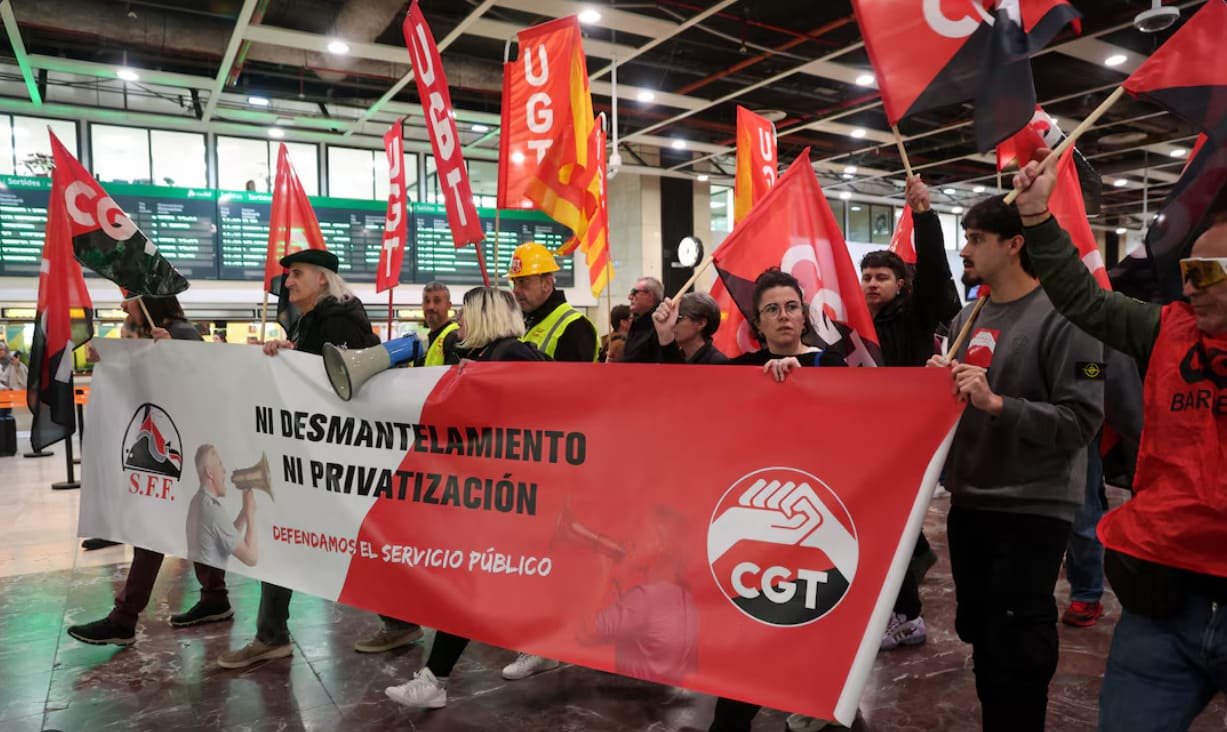
On 17th November, train services across Spain were crippled due to the strike call given by railway workers’ unions. The strike involved unions represented on the general works councils of Renfe and infrastructure manager Adif, along with the train drivers’ union SEMAF and other railway labour organisations such as CCOO and UGT.
Railway workers in Spain have taken to the streets several times over the past few months. Their main demands include better working conditions, addressing staff shortages, adequate investment in infrastructure and proper safety maintenance.
The nationwide struggles are a result of growing concerns among railway employees about safety, infrastructure maintenance and adequate staffing following serious rail accidents in the recent past. On 18th January, a train accident at Adamuz in Córdoba province resulted in the deaths of 46 people. Another recent accident, on 28th October at Urda in Toledo province, claimed 69 lives. The unions are seeking increased investment in maintenance, additional employees at Adif and stronger railway safety procedures. Some representatives have also demanded audits of high-speed and conventional railway infrastructure, rolling stock and working conditions.
The Sindicato Ferroviario organised strikes this year on 29th June and 15th July. Its principal concerns included:
- Possible private-sector involvement in Renfe Mercancías.
- Outsourcing of locomotive maintenance.
- The potential closure of the Miranda de Ebro maintenance workshop.
- Alleged failure to honour employment and social-condition guarantees agreed upon in November 2023.
Indian railway workers reading this article would immediately resonate with these demands, since they are facing similar challenges from the Indian government.
In Spain, the Spanish government-owned companies, namely ADIF and ADIF Alta Velocidad, are responsible for managing and operating the entire railway infrastructure (tracks, stations and signalling). Train operations, on the other hand, are handled by the Spanish government-owned railway operator Renfe, which has more than 81% of the passenger market share, in competition with two private operators: Ouigo (operated by France’s state-owned SNCF group) and Iryo (majority-owned by Italy’s state-controlled Trenitalia).
Through continuous struggles, railway workers in Spain have managed to force the Spanish government to accede to the following demands:
|
Government commitment |
Intended effect |
|
Strengthening the State Railway Safety Agency (AESF) |
Greater inspection and safety oversight |
|
Empowering train drivers to stop trains |
Drivers can stop operations when they consider conditions unsafe |
|
Introducing a just safety culture |
Improving the reporting and investigation of safety incidents without automatically blaming individual workers |
|
Clarifying driving-time calculations |
Better protection of train drivers’ working and rest arrangements |
|
Increasing maintenance funding |
Improving railway infrastructure and maintenance |
The government also committed to a railway infrastructure financing programme worth approximately €19 billion through 2030.
The 17th November strike was in response to the slow pace at which the Spanish government was fulfilling the demands it had already agreed to. The demands of Spanish railway workers are just and must be supported by all workers.