
Kamgar Ekta Committee (KEC) correspondent report
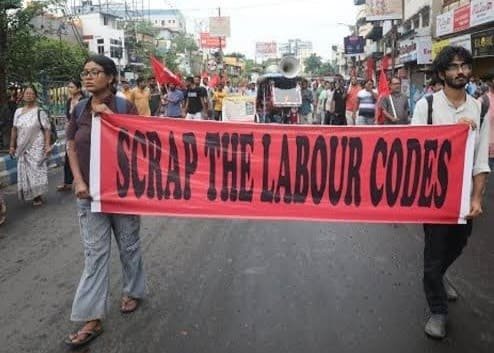
Earlier in May, the Maharashtra government published draft rules for the four labour codes announced by the central government, with a 45-day period for challenging the rules.
The four labour codes—Labour Codes on Wages, Industrial Disputes, Occupational Safety, and Social Security—attack the livelihoods and hard-earned rights of workers.
While contract workers in different sectors, including strategic sectors such as electricity, have been fighting for permanent appointment, the labour codes promote fixed-term employment. This means that even more workers will have no job security.
Earlier, any enterprise with more than 100 workers had to follow rules regarding working hours, holidays, wage rates, as well as regarding closing down the establishment and undertaking layoffs. Now, this limit has been raised to 300 workers. That is, thousands of small establishments will no longer be required to meet basic standards, and tens of thousands of workers will soon be deprived of their fundamental rights.
The codes will allow 12-hour shifts instead of 8-hour shifts, making work much more tiring and stressful.
The labour codes also dilute rules related to safety in the workplace and allow higher number of working hours. Moreover, women will be allowed—or rather, expected—to work night shifts, further endangering their safety. Women refusing to work in night will lose their job, making their employment even more precarious.
With the new codes, workers will be required to give 14 day’s-notice for strike, after which conciliation proceedings with the management will start. Striking during the conciliation period will be considered illegal! If conciliation proceedings fail and the management applies to a tribunal, the strike has to be further postponed. The first strike notice would become invalid after 60 days, and a fresh notice will have to be given.
These codes snatch workers’ rights and suppress their organizations and fighting power. The codes are clearly meant to allow capitalists to exploit workers even more to multiply their profits.
Since 2020, the working and toiling people in India have organized massive protests and strikes to oppose the labour codes. This includes the historic strike on 12 February 2026, which saw the participation of crores of workers. Yet the central and state governments have completely disregarded people’s opposition and are moving ahead with notifying state-wise rules for the labour codes.
It is necessary that workers and citizens across the country unite to mount even stronger opposition to anti-worker labour codes. The rights won by workers through struggles of years and sacrifice of lives have to be defended with steely unity, cutting across all divisions.