
Charter of demands of All India Railway Track Maintainer Union (AIRTU) to the Railway Board
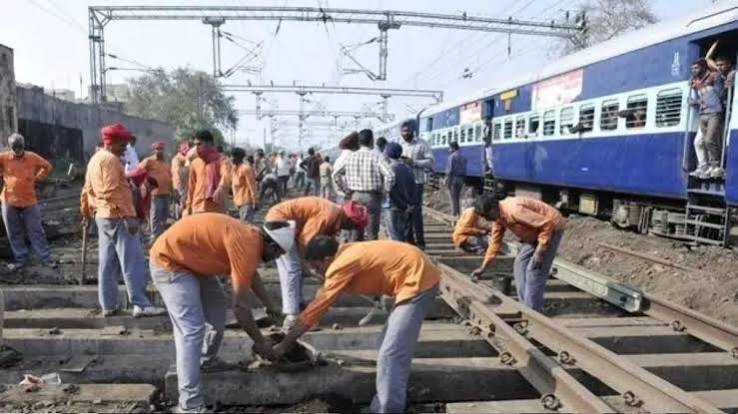
Among railway workers, track maintainers are perhaps the most neglected section. Rail passengers also rarely pay attention to these workers. However, the railway administration adopts an extremely poor attitude toward these brothers and sisters who shoulder the critical responsibility of repairing and maintaining railway tracks.
They are assigned 18-kilometer night patrolling duties, which is entirely impractical and amounts to physical harassment. To immediately reduce this distance to 10–12 kilometers, the All India Railway Track Maintainer Union (AIRTU) has submitted a charter of demands to the Railway Board (attached).
The charter explains why an 18 km night patrol is impractical in a straightforward way that even a school-going child could understand.
Understand the math: carrying safety gear weighing over 20 kg in biting cold and dense fog requires net walking time of 8 hours and 20 minutes. Stepping aside and finding safety to evade the approximately 20 trains passing at night consumes 1 hour and 40 minutes. Getting safety logbooks signed by gatekeepers, station masters, and patrolling partners from the opposite direction takes another 1 hour. In total, 11 hours of work is being imposed within an 8-hour shift, which is an outright violation of IRPWM and HOER rules.
The charter outlines the following demands:
✅ Reduce night patrolling distance to a maximum of 10–12 km.
✅ Make double patrolling (two personnel) mandatory in foggy and auto-signaling sections.
✅ Do not assign night duty for more than 3 consecutive days, and ensure adequate rest.
✅ Promptly pay overtime (OT) whenever work exceeds 8 hours in emergency situations.
(Translation of Hindi charter of demands)
All India Railway Track Maintainer Union
Letter No.: AIRTU/GS/RB/Patrolling/2026/14
Date: 05/08/2026
To,
The Chairman & Chief Executive Officer (Chairman & CEO),
Railway Board, Rail Bhawan, New Delhi – 110001.
Subject: Representation regarding the prevention of violations of IRPWM rules, reducing the excessive distance of winter night patrolling (18 KM) in Indian Railways to a maximum limit of 10 to 12 kilometers, and protecting the lives and health of Trac kmaintainers.
Respected Sir,
Through this charter of demands, the All India Railway Track Maintainer Union (AIRTU) wishes to draw your attention to the safety, health, and inhumane treatment meted out to “Track maintainer” employees—often referred to as the backbone of Indian Railways. Currently, in various railway divisions across the country, an excessively long and life-threatening distance of 16 to 18 kilometers is being assigned to a single track maintainer for winter and regular night patrolling (Night Patrolling), which is completely impractical and against established norms. On this matter, the union submits the following irrefutable technical, practical, health-related, and statutory provisions of IRPWM for your consideration:
1. Violation of IRPWM (Indian Railways Way and Works Manual) Rules:
- Sir, according to Paras 803 and 805 of IRPWM rules, the Patrolling Chart must be prepared in full conformity with the stipulated 8-hour working period under the Hours of Employment Regulations (HOER). The currently assigned 18 km patrol (over four rounds) cannot be completed under any circumstances within 8 hours, which is a direct violation of the manual’s core principles.
- Sir, according to Para 807 (Equipment for Patrolling), it is mandatory for patrolling personnel to carry heavy safety equipment (such as fog signals/detonators, tricolor hand signal lamps, spanners, staff, etc.). Walking continuously for 18 kilometers carrying a dynamic load of over 20 kilograms in severe cold and dense fog causes total physical breakdown for an employee. This condition is also a severe violation of the humane labor standards of ICMR and ILO (Recommendation 128). Para 811 (Duties of Patrolmen): According to the manual, the primary duty of a patrolman is to detect any track defects (such as rail fractures or buckling) and ensure the immediate protection of trains. Due to chronic fatigue, the employee’s reflexes slow down, posing a direct “run-over” risk to their own life as well as creating a critical hazard to train operations.
2. Sir, based on the railway’s own infrastructure and engineering standards, completing an 18-kilometer patrol within the designated 8-hour shift (HOER) is physically impossible:
- Number of Poles: Over a distance of 18 kilometers (18,000 meters), at an average spacing of 72 meters between Railway OHE (Overhead Equipment) poles, there are a total of 250 poles.
- There are at least 120 sleepers between two poles. The spacing of each sleeper is equal to one human stride. If an employee walks continuously without stopping carrying the heavy burden of safety gear at a steady pace of 1 step per second, it takes 2 minutes to cross 1 pole. Thus, just to walk continuously past 250 poles (18 KM) takes a net time of 500 minutes, or 8 hours and 20 minutes.
- At least 20 trains pass through dense fog during the night. Under safety protocols, sighting a train, stepping aside onto the cess, waiting for the train to clear, and resuming the patrol takes 5 minutes per train, which inevitably consumes a total of 100 minutes (1 hour and 40 minutes).
- Getting safety books signed by gatekeepers, station masters, and patrolling partners from the opposite direction during the patrol consumes at least 1 hour.
- Adding all these together (8 hours 20 minutes + 1 hour 40 minutes + 1 hour) results in a minimum total time of 11 hours, which is a direct violation of the sanctioned 8-hour duty roster.
3. Sir, the situation has become extremely alarming in sections where Indian Railways is rapidly expanding Automatic Signaling.
Here, trains remain queued back-to-back. Walking alone in severe cold and dense fog makes it impossible for a track maintainer to anticipate which train might suddenly start moving. This is the reason why tragic “run-over” deaths (being hit by trains) of track maintainers are occurring continuously across the country.
4. To protect the lives and health of lakhs of track maintainers across the nation, the All India Railway Track Maintainer Union urges the Railway Board to take an immediate policy decision and issue the following directives:
- Limit distance under IRPWM: Across Indian Railways, the impractical 18 KM distance for winter and regular night patrolling should be strictly capped/frozen at a maximum of 10 to 12 kilometers in accordance with IRPWM and HOER rules, so that it can be safely completed within 8 hours.
- Mandatory Double Patrolling under Section 8: Completely prohibit solitary patrolling in foggy, heavy-traffic, and auto-signaling areas, and uniformly implement a policy across Indian Railways to deploy two employees together (Double Patrolling) as a mandatory life-safety measure.
- Rotation Policy: No track maintainer employee should be rostered for night patrolling duty for more than 3 consecutive days, and mandatory adequate rest should be provided after each night patrolling block for complete physical recovery.
- Overtime Payment: If an employee is made to work beyond 8 hours under any emergency situation, prompt payment of Overtime (OT) must be ensured as per rules.
Sir, the track maintainer is that vigilant guardian of Indian Railways who stays awake to safeguard the journeys of crores of passengers. It is hoped that the Railway Board will adopt a humanitarian, statutory (IRPWM), and scientific approach, give sympathetic consideration to this charter of demands, and issue policy orders at the earliest.