
By Ms. Sucharita
Gross underfunding of the public health system and rapid growth of private hospitals and private health insurance are leading to the exploitation of people’s ill health for maximum private profit.
Spokespersons of the central government claim that its numerous health insurance schemes, including Ayushman Bharat Pradhan Mantri Jan Arogya Yojana (PMJAY), National Health Protection Scheme (NHPS), Pradhan Mantri Suraksha Bima Yojana (PMSBY) and Rashtriya Swasthya Bima Yojana (RSBY) have significantly reduced the amount of money that poor working people have to spend on health care services. However, the most recent large-scale survey of household spending on health, conducted in 2025, shows that the poorest 60 per cent of households spend an average of Rs. 25,000 to 35,000 every time a family member is hospitalised. Given that many such families earn monthly incomes of less than Rs. 20,000, this is by no means a small financial burden.
In 1978, the Government of India endorsed the international declaration of Alma Ata, that providing comprehensive health care for all sections of the population is a state responsibility. The first National Health Policy adopted in 1983 set the goal of providing “Health for All by 2000”. However, what exists today, in 2026, is a health system which is driven by the motive of maximising private profits of hospitals, clinics and insurance companies, and not by the aim of ensuring good quality health care for all at affordable rates.
Neglect of the public health care system
In the early decades after Indian independence, primary health centres (PHCs) were set up all over the country, which were meant to serve as the first and closest place where any family could consult a qualified doctor. For every four PHCs, there was to be a Community Health Centre (CHC), the closest hospital like facility with at least 30 beds. People were supposed to first visit these facilities, after which the more serious cases would be referred to the nearest large hospital. However, the primary health care system has suffered from gross neglect and underfunding.
Today, there are more than 26,000 PHCs in the country, but a quarter of them have no doctor in place. More than 65 per cent of specialist posts at CHCs are vacant[1]. As a result of the underfunding and neglect of primary health care, people in most parts of the country do not rely on these facilities. Most people in rural areas travel to the nearest town to consult a doctor in a district or city hospital. This has led to overcrowding at public hospitals.
A recent study by an international team has observed that “illnesses in lower income households go undiagnosed for long periods and are detected only when complications set in, leading to higher healthcare costs and poor outcomes.”[2]
Neglect of the public health system is also evident in the way its workers are treated. Most of them are overworked and underpaid. About 35 per cent of the 2 lakh auxiliary nurse midwives (ANMs), who have numerous responsibilities including the conducting of deliveries. are hired on temporary contracts and paid less than the legal minimum wage. As many as 13.5 lakh (1.35 million) anganwadi workers, 10.2 lakh anganwadi helpers and 10.3 lakh Accredited Social Health Activist (ASHA) workers, who serve as the first point of contact in the villages, are not even recognised as workers. They are called “volunteers” and paid a miserably low amount as monthly “honorarium”, well below the legal minimum wage.
Among urban industrial workers, only those with regular jobs who earn less than Rs. 21,000 per month are covered by the Employees State Insurance (ESI) scheme. Money collected from the employers and workers are not fully spent on improving the services. For instance, in 2023-24, the audited accounts of the ESI Corporation shows that total income was Rs. 37,000 crores, while expenditure was only Rs. 22,000 crores, less than 60 per cent of the income. The overcrowding at ESI facilities lead to long waiting time, driving many workers to go to private doctors and clinics.
Unregulated growth of private health care
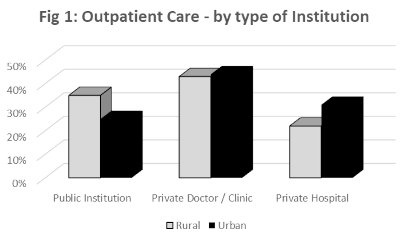
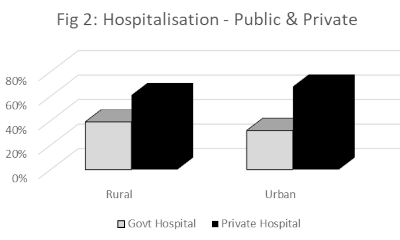
Neglect and underfunding of public health have led to the growth of private hospitals and clinics all over the country. According to the latest official survey, the proportion of people who go to a private doctor, clinic or private hospital for consultation is as high as 65 per cent in rural areas and 71 per cent in urban areas (Fig 1)[3]. Among those admitted as inpatients, private hospitals account for 58 per cent in rural and 65 per cent in urban areas (Fig 2).[4]
The majority of qualified health workers, including 65 per cent of MBBS doctors and 51 per cent of nurses, are currently employed by private institutions.[5]
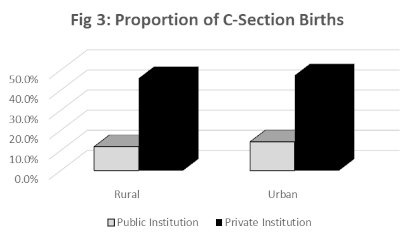
When health care is provided by private institutions, the profit motive distorts the quality of service provided. Instead of prescribing what the patient needs, doctors are under pressure to recommend tests, procedures and medicines which will fetch maximum profits for the institution. For instance, it has been found that the proportion of child births using caesarean operations (C-sections) is extremely high in private hospitals and clinics, far higher than in government run facilities (Fig 3)[6]
There is no official body that regulates the practices of private hospitals or the prices they charge. Doctors employed in private hospitals are under pressure to meet targets for the number of tests they prescribe, the number of patients they admit and the expensive procedures they recommend. A CT scan of a head injury, for instance, takes about a minute and costs around Rs. 1000, whereas an MRI takes about 30 minutes and can cost as high as Rs. 30,000. While a CT-scan is the first test suitable for most persons with head injuries, doctors in private hospitals are known to recommend an MRI instead.
The recent growth of health insurance in the country has further accelerated the growth in health care costs. Private hospitals push more expensive treatment on patients who have insurance policies.
Health Insurance
Between 2018 and 2025, the proportion of people covered by at least one government sponsored health insurance scheme has increased from 13 per cent to 45 per cent in rural areas and from 9 per cent to 32 per cent in urban areas[7]. In the same period, the proportion of people covered by private health insurance policies has risen from 1 per cent to 2 per cent in rural areas and from 10 per cent to 14 per cent in urban areas. While insurance coverage has grown, this has not ensured affordable health care for all sections of the population.
Ayushman Bharat Pradhan Mantri Jan Arogya Yojana (PM-JAY), the largest health insurance scheme with more than 36 crore (360 million) registered beneficiaries, provides coverage of hospitalization cost up to Rs. 5 lakh per family per year. However, it does not cover the consultation fees charged by doctors in Outpatient Departments (OPD), nor does it cover the cost of medicines.
According to NITI Aayog estimates, there are about 40 crore people who are considered “too rich” to be eligible for this scheme, but too poor to be able to afford a comprehensive private health insurance policy. As a result, they end up spending huge amounts of money on health care, which they can ill afford.
Private insurance companies charge high annual premiums, which most families in the country cannot afford. Those who invest in such policies face numerous problems when it comes to claiming their benefits under the policy. Capitalist companies find various ways to reject claims and reduce the amount they have to pay.
After tax profits reaped by private companies from health insurance grew by 100 per cent in 2023-24, reaching Rs. 917 crore compared to Rs. 457 crore in the previous year. Among the major hospital chains, net profits earned in 2024-25 was Rs. 1426 crore for Apollo Hospitals, Rs. 790 crore for Narayana Hrudayalaya and Rs. 757 crore for Max Healthcare.
Conclusion
The right to health is a fundamental human right. The state is duty bound to ensure that all members of society have access to good quality health care. The Indian state is abrogating this duty by encouraging the growing privatisation of health care and health insurance.
We, the people, must demand and fight for an immediate halt to the privatisation of health care services. We must demand and fight for the principle that the state must ensure the provision of good quality health care and health insurance out of public funds, free of charge or at affordable rates.
[1] T. K. Rajalakshmi, “Pay to Heal”, Frontline, 30 April, 2026.
[2] Report of the Lancet Commission on a Citizen-Centered Health System for India, January 2026.
[3] NSS 80th Round, conducted between January and December 2025
[4] NSS 80th Round, conducted between January and December 2025.
[5] Report of the Lancet Commission on a Citizen-Centered Health System for India, January 2026.
[6] National Family Health Survey, 2019-21 (NFHS-5), India Fact Sheet.
[7] NSS 80th Round.