
Resolution adopted by the Federal Executive Meeting of the All India Poer Engineers Federation (AIPEF) held at Bengaluru on 12 June 2026
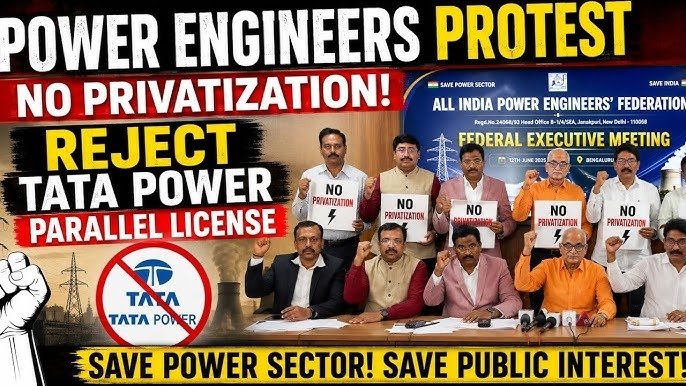
AIPEF Federal Executive Meeting adopted eleven resolutions. As the resolutions deal with various attacks and attempts at privatization going on presently in the country and are of keen interest to power workers and consumers, we are reproducing the resolutions one by one.
We here below reproduce the second resolution.
(Please visit https://aifap.org.in/17805/ for full list of resolutions and the full text of the first resolution, “Against the any unilateral attempt of Tabling of the Electricity (Amendment) Bill, 2025 in the Monsoon Session of Parliament.”)
Resolution
Against Grant of Parallel Distribution Licences to Tata Power in Karnataka and in Defence of Public Sector Electricity Distribution.
The All India Power Engineers Federation (AIPEF), representing power engineers across the country, expresses its serious concern and strong opposition to the grant of Parallel Distribution Licences sought by Tata Power Company Limited in nineteen districts covering all five Electricity Supply Companies (ESCOMs) of Karnataka.
AIPEF notes that Tata Power has filed Petition Nos. MP 02/2026 to MP 06/2026 before the Karnataka Electricity Regulatory Commission (KERC) seeking parallel distribution licences in areas presently served by BESCOM, HESCOM, MESCOM, GESCOM and CESC. This proposal poses a grave threat to the public electricity distribution system, consumer welfare, rural electrification and the financial sustainability of Karnataka’s state-owned distribution utilities.
AIPEF Resolves That:
1. Parallel Licensing is a Backdoor Route to Privatization
The proposed grant of parallel distribution licences is nothing but a backdoor mechanism for privatization of electricity distribution. It allows private entities to enter profitable urban and industrial markets while leaving state utilities burdened with social obligations, agricultural consumers, rural areas and economically weaker sections.
2. Statutory Requirement of Independent Network Must Be Strictly Enforced
The Sixth Proviso to Section 14 of the Electricity Act, 2003 permits grant of a parallel distribution licence only when the applicant establishes and operates its own independent distribution network. AIPEF notes that no credible, adequately funded and technically feasible plan has been demonstrated for creating an independent network across the proposed nineteen districts. Grant of licences without fulfilment of this mandatory statutory condition would be contrary to the spirit and intent of the Electricity Act.
3. Cross-Subsidy Mechanism Will Be Seriously Damaged
The existing tariff structure in Karnataka depends upon cross-subsidization, wherein industrial and commercial consumers contribute significantly towards subsidized supply to domestic consumers, farmers and vulnerable sections of society. If private licensees are permitted to selectively target high-revenue consumers, the entire cross-subsidy framework will be undermined, ultimately resulting in increased tariff burden on common consumers and farmers.
4. Financial Viability of State DISCOMs Will Be Jeopardized
Loss of premium-paying consumers will severely weaken the revenue base of Karnataka’s ESCOMs. Reduced revenues will adversely affect maintenance of distribution infrastructure, system strengthening, network expansion and quality of supply. This will create long-term financial stress on public utilities and increase dependence on government support.
5. Universal Service Obligations Cannot Be Compromised
State-owned distribution companies have a statutory responsibility to provide electricity to all categories of consumers, including remote villages, agricultural pump sets, low-income households and difficult geographical areas. Private operators cannot be allowed to cherry-pick profitable consumers while avoiding universal service obligations.
6. Public Electricity Infrastructure Built with Public Funds Must Be Protected
The distribution network in Karnataka has been developed over decades through public investment and consumer contributions. Any policy decision that weakens public utilities and facilitates transfer of profitable consumer segments to private entities is against public interest and detrimental to the long-term sustainability of the power sector.
Therefore, AIPEF Demands:
1. Immediate rejection of Tata Power’s applications for parallel distribution licences in Karnataka.
2. A comprehensive independent assessment of the financial, technical, legal and consumer impact of the proposed licences before any regulatory decision is taken.
3. Invocation of Section 108 of the Electricity Act, 2003 by the Government of Karnataka to issue appropriate policy directions safeguarding public interest, consumer welfare and the viability of state-owned DISCOMs.
4. Full participation of BESCOM, HESCOM, MESCOM, GESCOM and CESC in all proceedings before KERC, with detailed examination of the implications of the proposed licences.
5. Protection of the existing cross-subsidy framework and universal service obligations to ensure affordable electricity for domestic consumers, farmers and weaker sections of society.
Conclusion
AIPEF reiterates that electricity distribution is an essential public service and not merely a commercial activity. Any attempt to weaken public sector distribution utilities through selective privatization or parallel licensing will adversely affect consumers, employees, farmers and the overall power sector. AIPEF therefore calls upon the Government of Karnataka, KERC, power sector employees, engineers, consumer organizations and all stakeholders to collectively oppose the proposed parallel distribution licences and safeguard the public character of electricity distribution in Karnataka.