
Letter by E A S Sarma, Former Secretary to the Government of India to the Finance Minister
To
Smt Nirmala Sitharaman
Union Finance Minister
Dear Smt. Sitharaman,
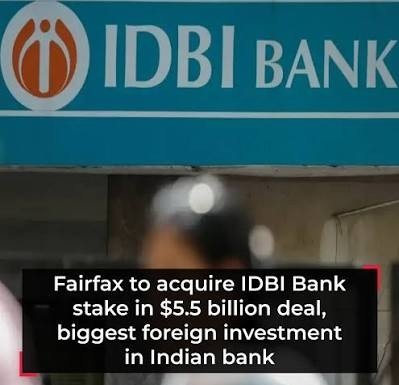
I understand that both the Finance Ministry and the RBI are about to finalise disinvestment of IDBI in favour of Fairfax of Canada.
In that connection, I refer to my letter of 25-2-2026 raising concerns about the proposal.
The proposal, in my view, is prima facie invalid and has far reaching social costs.
I reiterate those concerns below.
Legal issues:
On the face of it, there are two serious legal concerns about the disinvestment of IDBI, as follows:
- IDBI has in its possession several highly valuable land assets across the country. Several of them were acquired in the past under the earlier land acquisition Act of 1894 on the premise that such acquisition was for a “public purpose”, which was defined in Section 3(f)(iv) as for a company wholly owned/ controlled by the government. In other words, if IDBI were to slip into the hands of a private company, all such lands should revert to the government, as otherwise it would imply an outright violation of that statutory provision. The bid documents make no mention of this!
- Section 5(1) of the Industrial Development Bank (Transfer of Undertaking and Repeal) Act, 2003 implicitly provides an assurance that under no circumstances, the service conditions of IDBI’s employees be altered. The terms of disinvestment of IDBI, as spelt out by DIPAM, violate that provision.
IDBI’s welfare mandate:
As of now, the Centre and the LIC hold more than 90% of the equity of IDBI. As such, it is a public sector entity subject to SC/ST/OBC reservations mandated by the Constitution and, also the welfare mandate envisaged in the Directive Principles. As and when 60.72% of its equity is privatised, as is the intention underlying disinvestment, the government will be permanently putting an end to such reservations and shutting doors on the welfare benefits of IDBI, depriving SCs/STs/OBCs of their entitlement to employment opportunities through IDBI, in addition to introducing uncertainty in the future of the existing 9,500 such employees from the disadvantaged sections. Reservations for the disadvantaged primarily result in empowering those communities and it is unfortunate that the government should ignore it and go ahead with privatisation.
It is in that context that the SC/ST/OBC employees of IDBI have rightly demanded that the government should protect their rights (https://www.thehindubusinessline.com/money-and-banking/idbi-bank-sc-st-and-obc-employees-forum-seeks-protection-of-rights-careers/article70521406.ece). The government cannot afford to brush aside their fears.
In addition, one should also remember that IDBI has stood by government’s policy to empower women and provide reservations for differently abled persons. IDBI’s workforce comprises 6,911 women employees and 884 differently abled employees. Privatisation would put an end to this, apart from creating uncertainty in the lives of those existing employees.
IDBI’s role till date is that of a development finance institution with a network of 2,122 branches across the country, providing access to people in many remote areas. IDBI hosts more than 18.72 lakh accounts under the Pradhan Mantri Jan Dhan Yojana (PMJDY); more than 10.86 lakh Bank account holders under Pradhan Mantri Suraksha Bima Yojana (PMSBY); more than 3.81 lakh Bank account holders under Pradhan Mantri Jeevan Bima Yojana (PMJJBY); more than 5.48 lakh Bank account holders under Atal Pension Yojana (APY); maintains 191 Aadhaar Enrolment Centres; one Rural Self Employment Training Institute (IDBI-RSETI) at Satara District which trained 7,165 candidates out of whom 5,241 have got employed. Would not privatisation put an end to all this?
Due to re-classification of IDBI Bank as a “private sector bank” by RBI, Metro and Urban Branches of IDBI Bank have unfortunately stopped providing interest subvention for KCC loans to farmers since March, 2019. If the Bank goes into the hands of private/foreign players, even the semi-urban and rural branches are likely to be stopped from lending to farmers. IDBI may also stop giving small loans viz., MUDRA/PMSVANIDHI/Stand Up India, education loans to students which are normally offered as unsecured loans.
Breach of an assurance given to the Parliament:
In the 13th Lok Sabha, the Parliamentary Standing Committee on Finance dealt in detail with the IDBI (Transfer of Undertaking and Repeal) Bill 2002 and in its 46th Report of June, 2003 at Para 33 had observed as follows:
“The Committee are given to understand that there is huge investment of Rs. 10,000 crores by general public in IDBI which is not secured. They are of the opinion that this dispensation holds good so long as IDBI is a Government–owned banking company, but the day the Government holding in converted IDBI comes below 51% there will be chaos – like situation in the country making investors panicky. Hence, they recommend that the Government should make provisions which will ensure that Government’s shareholding in IDBI do not come below 51%”
The then Finance Minister to Lok Sabha on 08.12.2003 and Rajya Sabha on 15.12.2003 gave an assurance that Government shall at all times maintain not less than 51% equity holding in IDBI as a Banking Company. The above assurance was taken on the records of the Government Committee on Assurances.
In other words, the decision taken by the present government to disinvest IDBI constitutes a breach of that Parliamentary assurance.
As on 31-3-2025, public deposits in IDBI stood at Rs.3,10,294/- crores, as against IDBI’s total business of Rs.5,28,714/- crores. Many small investors have invested their hard earned savings in IDBI, assuming that it has the government’s backing. Privatising IDBI would imply letting them down.
According to IDBI’s disclosure of July 14, 2026 to NSE, neither the bank nor its shareholders are aware of DIPAM’s proposal. Should not the small shareholders of IDBI have been taken into confidence?
No competition for IDBI privatisation:
On the face of it, the IDBI disinvestment exercise has all along been a non-starter. Initially, as per reports, there were three bidders, Fairfax, Kotak and NDB.
Kotak has announced its exit from the bidding process (https://www.newindianexpress.com/business/2026/Feb/09/idbi-bank-sale-just-two-foreign-bidders-in-the-fray-as-kotak-quits-the-race).
Fairfax faces a conflict of interest as it has acquired a majority share in the Catholic Syrian Bank (https://www.fairfaxindia.ca/press-releases/fairfax-india-to-acquire-51-of-the-catholic-syrian-bank-ltd-2018-02-20/).
In other words, the only contender for IDBI is Fairfax which already controls one bank in India. It has been the well established policy of RBI, the banking regulator not to permit the same promoter to control two banks at time. If DIPAM considers disinvesting IDBI in favour of Fairfax, the deal will stand ab initio invalid as it involves a clear conflict of interest.
It may also be noted that DIPAM has excluded CPSEs in India from bidding for IDBI but not excluded entities controlled by foreign governments. Such exclusion is not only discriminatory but also, it has resulted in a questionable outcome as above.
Against the above background, I feel that the balance of advantage lies in favour of dropping the proposal to privatise IDBI.
Instead, the government should focus its attention on strengthening IDBI by enabling it to fulfil its role as a development finance institution.
Regards,
Yours sincerely,
E A S Sarma
Former Secretary to the Government of India
Visakhapatnam