
Report of Kamgar Ekta Committee (KEC) correspondent
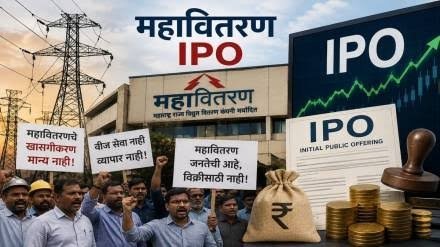
In an online meeting on 5 July 2026 organised by the Kamgar Ekta Committee (KEC), leaders of Maharashtra electricity workers and other workers’ organizations stated that the proposed IPO of the state electricity distribution company (Mahavitaran) and closure of generation company (Mahagenco) units are no doubt steps towards privatisation. Leaders declared that such anti-worker, anti-people steps are being taken only and only for the profit of big capitalists and should be strongly opposed!
Recently, the Maharashtra government approved plans for launching the initial public offering (IPO) of Mahavitaran. Furthermore, existing power purchase agreements (PPAs) with Mahagenco were cancelled in favor of buying power from private generation companies, and the closure of several Mahagenco units of total 1600 MW capacity was announced. Against this background, Kamgar Ekta Committee organized an online meeting on “Oppose the IPO of Mahavitaran! Oppose the shutdown of electricity generation units of Mahagenco!”
Com. Mohan Sharma (President, Maharashtra State Electricity Workers’ Federation), Com. Dr. Karad (Chief Coordinator, Trade Union Joint Action Committee), Shri Girish (Joint Secretary, Kamgar Ekta Committee), Shri Devidas Tuljapurkar (senior banking expert), and Shri Santosh Khumkar (General Secretary, Subordinate Engineers’ Association) addressed the meeting, with more than 200 participants attending. Shri Tuljapurkar shared the experience of IPOs of public sector banks, which is extremely educative for all workers fighting against privatisation (see box below).
Speakers in the meeting noted that it is because of workers’ and consumers’ persistent struggles that central and state governments are forced to undertake privatisation by deceitful means such as parallel licensing, IPO, proposed division of Mahavitaran into a company for agricultural consumers and one for non-agricultural consumers, closure of generation units, smart meters, etc. Furthermore, there are plans to launch IPO of Maharashtra’s power transmission company.
Speakers stated that the IPO of Mahavitaran is a clear step towards privatisation. By launching the IPO, private entities will be able to buy shares. The IPO will start small, with the sale of a limited percentage of shares. However, this percentage will likely be increased over time through follow-on public offers (FPO). For example, because of repeated sale of shares, government shareholding in State Bank of India, the country’s largest bank, is only 55.5%. Similarly, government shareholding in NTPC, the country’s largest power generation company, has fallen to 51.1%!
Because of the IPO, policies of the state discom will be directed towards making more and more profit. However, Com Mohan Sharma stressed that electricity is a social obligation. It is a service to society and we must not allow it to be used for profit!
Both consumers and workers will be affected by the IPO. Workers will experience increased workload, threat to job security, increased contractualisation, and reduced bargaining power, and consumers will be hit by higher power tariffs. It was pointed out that workers will also be affected by the price rise, because their families also have to buy electricity at the very same rates.
Com Mohan Sharma informed participants that Mahavitaran has recently signed a 25-year power purchase agreement to buy 1600 MW power supply from a private company’s upcoming thermal power project—a project that has not even been completed. Approval for the agreement was given by the Maharashtra Electricity Regulatory Commission (MERC) in just 35 days! Additionally, the MERC has ordered closure of several power plants units. This is not only a threat to the jobs of more than 14,000 permanent and more than 20,000 contract workers employed with Mahagenco but also a threat to all the working people and farmers of Maharashtra for whom electric power is a basic necessity.
The administration is spreading a lot of false propaganda among electricity workers. For example, workers are being told that with the IPO, they will become part owners of the company. Speakers warned workers not to fall for such illusions.
Dr. Karad further noted that electricity workers bear an important responsibility. The struggle against the privatisation of electricity is going to be decisive in the wider struggle against privatisation, and electricity workers must ensure to take their movement ahead in the right direction. Shri Khumkar also declared opposition to all forms of privatisation.
Shri Girish pointed out that due to the strong fightbacks against privatisation, governments adopt different methods try to fool the workers and people by glorifying its supposed benefits for them. The policy of Globalization by Liberalization and Privatization (LPG) was ushered in by Congress government in 1991-92. Since then, most of the big parties or coalitions, which have formed governments at Centre or State levels have assiduously pushed this policy, some a bit more aggressively than the others. He reminded workers that public enterprises are built with public money and workers’ labour and should be operated to benefit all of us.
It must be noted that since 2014, electricity workers across the country have strongly opposed the Electricity Amendment Bill, which opens the doors for large-scale privatisation in the power sector. However, steps towards privatisation have been taken since the globalization through liberalization and privatisation (LPG policy of 1991). In 1992, the generation sector was opened to private players. Today, more than half the power generation is privatized, and nearly 100% solar energy generation is in the hands of private companies.
A quick look at the Bombay Plan and its relevance
The plan for India’s economy after independence was made by the biggest capitalists of those times – Tata, Birla, Mafatlal, etc. in 1944. It is known as the Bombay Plan or the Tata-Birla Plan. They recommended the creation of a public sector in which the government would establish the basic infrastructure and industries that capitalists needed for their growth. The public sector would be built with people’s money. In 1944, these capitalists did not have enough money to build the infrastructure, and nor did they want to invest money where the returns would be small and come only after many years.
After the basis of industrial growth was laid, and after the big capitalists had grown big enough to be able to buy the assets created in the public sector, it was mentioned in the Bombay Plan itself that profitable public entities would be privatised!
For decades, under various governments, the Bombay Plan has been followed!
To strengthen the struggle against IPO and privatisation, it is necessary to sensitize workers as well as to go among consumers. The brave struggle of power workers in Uttar Pradesh is an inspiring example. Workers in UP have been organizing massive Bijli Mahapanchayats and awareness programs with farmers and other consumers.
After the main speeches, participants made interventions. They noted that critical decisions are being taken without consulting workers or consumers. Different governments have worked in the favor of big capitalists. Therefore, we must rely not on big parties of the capitalist class but only on our unity. Instead of the system that exists today, in which capitalists make decisions, we should work to establish one in which workers and other toilers make decisions. It is then that we will be able to change the orientation of the economy that exists today – that of maximizing the interests of the capitalist class to that of providing for the progress and well-being of all who toil. We must organize our efforts to build the unity of workers and consumers for this purpose.
Experience of IPOs and FPOs in public sector banks
Shri Tuljapurkar shared the experience of IPOs in banks.
In 1992, the Narsimhan Committee recommended the sale of more than 51% stake of private sector banks. Due to the united opposition of bank workers under the United Forum of Bank Unions (UFBU), the government was forced to take a step back. The government stated that instead of selling 51%, they will sell only 10%, 15%, 20% shares in the IPO. Therefore, the ownership stake will remain with the government.
However, when 15%-20% shares are owned by private entities, banks have to register with SEBI and comply with SEBI regulations. As part of this, banks had to get shareholder directors (2 or 3) on their boards. These directors wanted dividend on their shares, so banks were required to earn profits.
Thus, banks had to revisit all policies and orient them towards profit. Social profit was replaced by accounting profit. The government started telling banks to be efficient. In other words, it wanted banks to stop giving subsidies and concessions, which had an adverse effect on customers.
Profit became the motto. Now, the question is: how to earn this profit?
If a bank raises its deposit returns, it can get more deposits. But it will also have to increase its interest rates and lose customers. The scope to make profits via deposits and loans was limited, so banks had to look for other strategies.
Their only option was to decrease administrative costs. First, loss-making branches, particularly branches in rural and remote areas, were shut down to increase profitability.
Second, staff costs were reduced. Instead of recruiting regular employees, outsourcing was promoted. Today, banks have more contract and outsourced workers than permanent ones. The safai karmachari cadre has been completely abolished. No recruitment has been undertaken in substaff cadre in 10 years. In 2001, VRS scheme was implemented in the clerical cadre. Nearly 1 lakh workers opted for VRS and left; these posts were never filled by banks. Although recruitment has started to some extent, it is not sufficient.
Thus, with the start of IPOs, the focus of the entire banking sector changed. After the partial privatisation of banks through IPO, ownership rights remained with the government, but internal policies were oriented towards profit and further privatisation because these banks had shareholder directors on their boards. Notably, in 1990, PSBs had a market share of 90%, today it has come down to 65%. The current problems seen among bank workers, including high levels of stress and even suicide cases, are a result of partial privatisation and no recruitment.
Middle class bank workers were told that they were becoming owners of the bank through IPO, and workers accepted this illusion. This is because unions fell short of creating class consciousness among workers.
Thus, workers should be properly educated and the unity of workers and consumers must be built. Unions must self-reflect and explore new ways to reach people and communicate our ideas.