
Report by Kamgar Ekta Committee correspondent
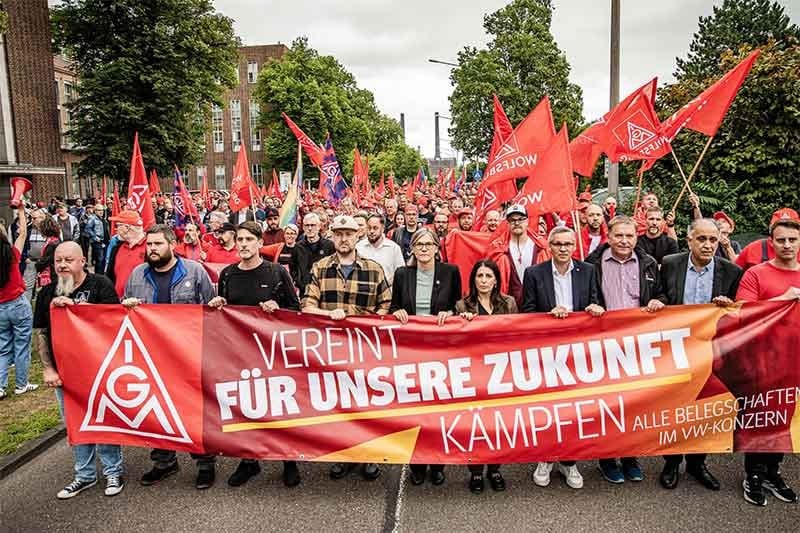
On 21 September, almost 1,80,000 auto workers took part in the protests at over 280 sites across Germany against the proposed job cuts and plant closures. Many more auto workers protested inside their factories.
Volkswagen (VW), the biggest auto producer in Germany plans to cut 100,000 jobs by the end of the decade. This will be the biggest job cut ever carried out in global automotive history. Other German auto producers like Mercedes-Benz and BMW are also planning job cuts.
Germany’s car industry has already reduced 1,00,000 employees since 2019. Automotive component suppliers have also cut about 74,000 jobs between 2019 and 2025, almost a quarter of their workforce.
According to the most recent collective agreement between IGM, the union and VW accepted what is called “the socially acceptable removal” of more than 35,000 jobs at VW’s German plants by 2030. The term “socially acceptable removal” means that workers who leave through retirement, by finding a new job, etc. are not replaced.
For workers, it is rather irrelevant whether jobs disappear through resignations, retirement, unfilled positions, the cancellation of the transition from apprenticeship to full-time positions, etc. In reality, each job that is eliminated by management increases the pressure on the remaining workforce.
It is a loss of income, health, training opportunities and family support and the future of entire community around the plant. This is capitalism – workers are asked to sacrifice so that capitalist’s profits are maintained or enhanced.
German auto workers are demanding:
- There should be no further job cuts, factory closures, or outsourcing to distant locations.
- There should be reduction of working time with full pay and no cuts to personnel.
- All workers on temporary contracts are to be transferred into full-time positions under the principle of “one operation – one workforce.”
- The current arrangement of an “on demand” workforce, management’s so-called “duty shifts” and the continuous availability of workers needs to end.
- The weekend belongs to workers and their families.
- There should be a planned transition towards decent, humane and sustainable mobility instead of production for the military – armament is no replacement for the destruction of jobs in the civilian industry.
- Public contracts should only be issued to companies that offer job security, are part of Germany’s established system of collective agreements, and are committed to Germany as a location for production facilities.