
Letter by Shri E. A. S. Sarma, Former Secretary to the Government of India to Union Minister of Environment, Forests and Climate Change
12/10/2026
To: Shri Bhupender Yadav Minister Union Ministry of Environment, Forests and Climate Change (MoEFCC)
Dear Shri Bhupender Yadav,
I invite your attention to my earlier two letters of 6 June and 9 August 2026 on the need to understand the energy and water implications of hyperscale data centres and recategorise them for the purpose of environmental impact assessment.
To date, your Ministry has not cared to respond to my suggestions, allowing a situation akin to jungle raj to prevail, with States clearing data centre projects in a highly indiscriminate manner.
While responding to a Parliament question on data centres, you informed the Rajya Sabha on 6 August 2026 (Unstarred Question No. 2136) that:
“Data Centres do not, per se, require Environmental Clearance (EC) under the Environmental Impact Assessment (EIA) Notification, 2006, as amended. However, AI Data Centres proposed as part of a ‘Building and Construction Project’ under Item 8(a), i.e. built up area exceeding 20,000 sq. m or a ‘Township and Area Development Project’ i.e. covering an area ≥ 50 ha and/or built up area ≥ 1,50,000 sq. m under Item 8(b) of the schedule to the EIA Notification, 2006 require prior EC. The EC for such a building project is granted by the State Environment Impact Assessment Authority (SEIAA) at the State/UT level.”
Source: Rajya Sabha Unstarred Question No. 2136
In this context, I had expressed my disbelief at your Ministry’s ignorance of the ongoing worldwide community opposition to the setting up of large data centres. Evidently, your officers are blissfully unaware of how local communities in different States are resisting the establishment of data centres because of their adverse impacts on local resources, including electricity, water, land and the environment. Many States in the USA are in the process of imposing moratoriums on data centres.
While your Ministry, having no clue about the functioning of data centres, continues to categorise them as mere “buildings” requiring no comprehensive environmental impact appraisal and no public consultation, your colleague, the Finance Minister, has equally nonchalantly announced a “tax holiday” for “foreign” data centres until 2047. This is being done without regard to the thousands of crores of rupees it will cost the taxpayer for every 1 GW data centre, and equally without regard to the threat such foreign data centres pose to our national security.
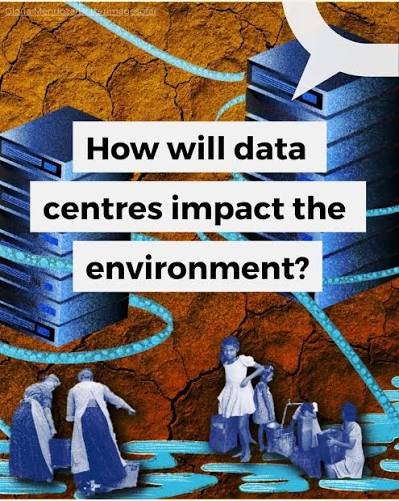
A hyperscale data centre of 1 GW capacity consumes 24 million kWh of electricity and 70 million litres of water per day. In other words, a 1 GW data centre consumes around one-fourth of the electricity that Delhi consumes. It uses 7% of the water consumed by the capital city. A 1 GW data centre may require 300 acres of land, potentially resulting in human displacement or deforestation.
Considering that data centres must operate without interruption, they impose an enormous burden on the electricity grid. That is why US regulators are imposing heavy electricity and water charges on data centres, whereas political leaders in Indian States, indifferent to people’s problems, are rolling out the red carpet for US data centre companies and offering them mind-boggling incentives.
Despite assurances from data centre promoters that they will depend only on renewable energy, a large share of the electricity consumed by data centres necessarily comes from coal-based power plants, considering the low capacity utilisation of India’s renewable energy plants. In other words, data centres leave a heavy carbon footprint.
To call hyperscale data centres “buildings” and grant them summary environmental clearance without any detailed appraisal or meaningful public consultation is to make a mockery of your Ministry’s obligation to conserve the environment under Article 48A of the Constitution and the obligations imposed by environmental laws enacted in pursuance of it.
Some UN agencies have assessed the environmental impacts of data centres. Your officers should study these reports:
The Ministry should revise the categorisation indicated in SO 1533 dated 14 September 2006. The Terms of Reference (TOR) for environmental impact appraisal of data centres need to be reframed to capture their wider environmental implications.
The Ministry of Environment, Forests and Climate Change should review the environmental clearances granted by its State agencies so far and mandate prior public consultation for all proposals pending on date. Otherwise, if your Ministry opts for a business-as-usual approach, data centres will cause irreversible environmental havoc and public discontent.
Mr Minister, your Ministry’s primary responsibility is not to promote foreign IT companies setting up data centres. Your responsibility is to assess their environmental implications in accordance with the laws of the land and do everything possible to protect the environment.
Regards,
Yours sincerely,
E. A. S. Sarma Former Secretary to the Government of India Visakhapatnam