
Resolution adopted by the Federal Executive Meeting of the All India Power Engineers Federation (AIPEF) held at Bengaluru on 12 June 2026
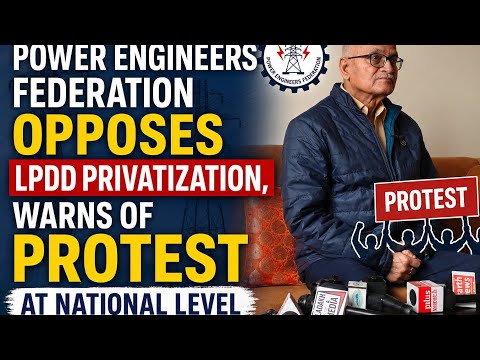
AIPEF Federal Executive Meeting adopted eleven resolutions. As the resolutions deal with various attacks and attempts at privatization going on presently in the country and are of keen interest to power workers and consumers, we are reproducing the resolutions one by one.
We here below reproduce the fourth resolution.
(Please visit https://aifap.org.in/17805/ for full list of resolutions and the full text of the first resolution, “Against the any unilateral attempt of Tabling of the Electricity (Amendment) Bill, 2025 in the Monsoon Session of Parliament”. Please visit https://aifap.org.in/17819/ for the second resolution, “Against Grant of Parallel Distribution Licences to Tata Power in Karnataka and in Defence of Public Sector Electricity Distribution.” For the third resolution “Against Grant of Distribution Licence to Google AI Data Centre in Andhra Pradesh and its Adverse Impact on The Public Power System” please visit https://aifap.org.in/17827/)
Resolution
Against Joint Venture / Privatization of Ladakh Power Development Department
The All India Power Engineers Federation (AIPEF), representing power engineers across the country, expresses its deep concern and strong opposition to the proposed Joint Venture (JV) between the Ladakh Administration and REC Power Development & Consultancy Limited (RECPDCL), which effectively amounts to the privatization and corporatization of the Ladakh Power Development Department (LPDD).
After detailed deliberations, AIPEF unanimously resolves as follows:
Whereas
1. LPDD is a vital public utility serving the people of Ladakh, one of India’s most geographically challenging and strategically sensitive regions, and its primary objective must remain public service rather than profit maximization.
2. The proposed JV envisages transfer of generation and distribution assets built with public funds and public investment to a corporatized entity in which operational control would effectively rest with the JV partner.
3. Ladakh’s unique topographical conditions, sparse population, harsh climate, and strategic border location require a public-sector-driven electricity system focused on reliability, affordability, and national security considerations.
4. The proposal introduces a commercial framework based on assured Return on Equity (RoE), which could ultimately result in increased electricity tariffs and additional financial burden on domestic consumers and economically weaker sections.
5. The continuation of subsidies under the proposed arrangement remains dependent on future government support and does not provide long-term protection to consumers from tariff increases.
6. Electricity infrastructure in Ladakh is of immense strategic importance from the perspective of national security and emergency preparedness, and therefore should remain under direct government ownership, management, and control.
7. The proposed model does not eliminate the need for government support, as continued revenue-gap funding has already been envisaged, indicating that privatization is not a solution to the underlying financial challenges.
8. The proposal raises legitimate concerns regarding the future of employees, institutional capacity, technical expertise, and the long-term strength of the public electricity sector in Ladakh.
9. A long-term licensing and operational arrangement may restrict future policy flexibility and prevent corrective measures if the model proves unsuitable for the unique circumstances of the Union Territory.
Therefore, AIPEF Resolves
1. To strongly oppose the proposed Joint Venture and privatization of the Ladakh Power Development Department.
2. To demand that the proposed agreement between LPDD and RECPDCL be immediately withdrawn and no further steps be taken without comprehensive public consultation.
3. To urge the Hon’ble Lieutenant Governor and the Administration of Ladakh to withdraw the proposal, considering its social, economic, strategic, and security implications.
4. To emphasize that electricity infrastructure in strategically important border regions must remain under full public ownership and democratic. accountability.
5. To call for meaningful consultations with employees, engineers, consumer organizations, elected representatives, civil society groups, religious bodies, and technical experts before any restructuring decision is taken.
6. To advocate strengthening LPDD within the public sector framework through enhanced investment, modernization, improved management practices, and adequate financial support rather than privatization.
7. To safeguard the interests of consumers by ensuring affordable electricity, universal access, and protection from tariff shocks that may arise from commercialized operations.
8. To protect the service conditions, job security, and professional interests of all employees and engineers presently serving in LPDD.
9. To support all democratic and lawful efforts of the people of Ladakh, consumer organizations, employees, engineers and civil society groups seeking preservation of the public character of the power sector in the Union Territory.
Conclusion
AIPEF firmly believes that the power sector in Ladakh must remain a publicly owned and publicly accountable service dedicated to the welfare of consumers, the development of the region, and the strategic interests of the nation. The Federation calls upon the Government of India and the Administration of Ladakh to abandon the proposed privatization initiative and instead strengthen LPDD as a robust and efficient public-sector utility.